
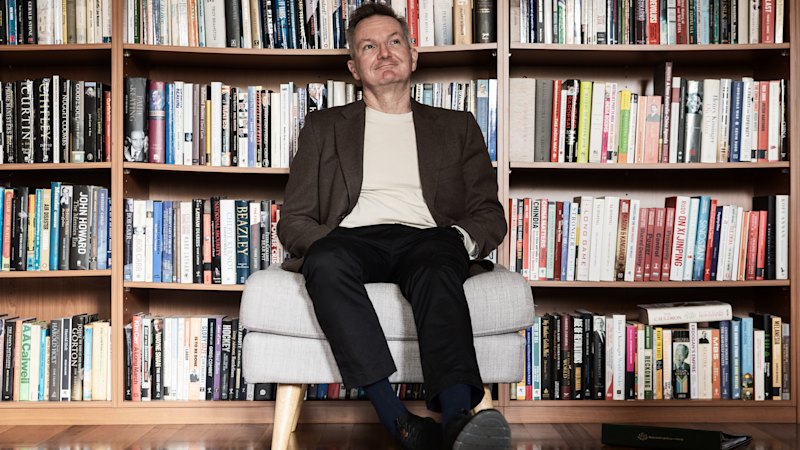
It’s 8am on a perfect spring morning in Sydney and Chris Bowen is in a bit of a mood. In a couple of hours he has to fly to a staffer’s wedding, but first he has to do his weekly update on the fuel supply. Just the fear of shortages sends the markets into a tizz, so he’s been performing this ritual ever since the US and Israel decided to bomb Iran.For a while it looked as though the crisis was easing, but then the Houthis blew up a Saudi fuel line. So rather than going to climate talks at the UN’s General Assembly in New York over the coming week, Bowen has to travel to Saudi Arabia to check on Australia’s fuel supplies. But first, he has to get changed so he can fly to Melbourne for the wedding. He can’t do that until he does the fuel update, and he can’t do that until the Channel 9 cameraman arrives, and he’s late.Bowen lives in a handsome blond-brick house on the fringe of an industrial zone in Smithfield, 30 kilometres west of central Sydney. If he gets a good run he’ll make it to the airport in 40 minutes, which is why we are in a scrappy little park near his home rather than at his electorate office a few minutes away in Fairfield. He paces, working his phone, mulling over the press conference, the flight, the wedding, the fuel crisis and the Saudi trip, and then, as if all this wasn’t enough, a magpie launches out of a stand of she-oaks and goes for his head. “Ah f---,” says Australia’s Minister for Climate Change and Energy.Minister for Climate Change and Energy Chris Bowen lets fly during question time at Parliament House.Alex EllinghausenAsk around and you find that even an outburst as reasonable as this, provoked by avian assault, is out of character. Despite the high-pressure portfolio, Bowen’s office is known for loyalty and low turnover. One long-time former staffer claims never to have heard him raise his voice in the office.This would come as a surprise to those who watch parliamentary question time, where Bowen unleashes soliloquies of almost joyous rage at the opposition. In the House he can summon detailed, prolonged, unscripted screeds of righteous contempt with such reliability that he is often lined up to speak last, as though to pipe government troops from the chamber.It would certainly surprise those who follow politics via social media or in the news and opinion pages of conservative media. There, Bowen exists as either a heartless ideological zealot, a man happy to destroy communities in pursuit of an unattainable renewable-energy nirvana, or a wild-eyed socialist incompetent who has left a trail of wreckage through three decades of public life.How they hate him. How they thrill at hating him! The comment sections beneath stories and reels about Bowen can be dark places. Under one recent interview clip posted on social media: “He disgusts me”; “He’s a greedy self-important bloody liar”; “That prick’s not worth feeding”; “Money-laundering rat”. Warren Mundine, a Labor Party president for a time before he decamped to the right after being passed over for a senate vacancy, recently joked about his murder during a political event – words he later told me he should have chosen more carefully.There are progressives who believe Bowen is failing to live up to this critical moment, to adopt the sweeping reforms needed to rapidly drive down Australia’s carbon pollution and accelerate the transition to a green future. And then there are those who declare Bowen to be an effective pragmatist, the first energy and climate minister to navigate the unimaginable complexities of the portfolio to improve energy security and reduce greenhouse emissions.“I think when the history of the climate wars is written, Bowen will be the hero,” says Matt Kean, the former NSW Liberal treasurer whom Bowen appointed to lead the Climate Change Authority, which provides expert climate advice to parliament. “I don’t think there is another public figure who has done as much to advance the effort of reducing emissions while still growing the economy.”Next month, Bowen will serve as “president of negotiations” at the next United Nations Climate Change Conference, COP31 – the acronym stands for Conference of the Parties – at which the 194 nations that are signatories to the Paris Agreement seek to manage the increasingly unwieldy treaty. This is a new position, one which Bowen created for himself in fraught negotiations with Turkey when it defeated his bid for Australia to host this year’s COP. For two weeks from November 9, Bowen will be on the world stage, managing the largest and most complex treaty negotiation on the planet, one which demands absolute consensus to achieve anything at all. It will either make his legacy or obliterate it.A young Bowen with his pets in the backyard of the family home in Smithfield, in Sydney’s west: “I was always just a nerd,” he says.Courtesy of Chris Bowen“I was always just a nerd,” says Bowen as we beetle around his home turf in his EV. On TV, Bowen doesn’t look big. He looks neat and wiry. In person he is even a little birdlike, particularly when his legs lean against the centre console as he drives. He has a presence, though. It was once suggested to me that he is the little bloke you’re advised not to bother at the pub, not that Bowen spends much time in pubs.Driving by his primary school, he tells the story of how he won a citizenship award in year 6 and was given the choice of a voucher from either a sports store or bookshop as his prize. He still has the copy of Paul Kelly’s 400-page book on Bob Hawke’s rise to power he took home. It’s worn, but the dust cover is intact.As a child, young Chris was obsessed with electricity and had a collection of double adapters. Courtesy of Chris BowenWe do a slow circuit around the cul-de-sac he grew up in as he points out childhood landmarks. “That was Matthew Martyn-Jones’ place. He used to be Wayne Swan’s press secretary … that was Mrs Hughes’, the Attards’, and their cousins the Abellas’.”We pull up in front of the fibro cottage he grew up in. The garden is trim, though there’s a little mould climbing the front panels. I ask how he passed his time as a kid. “I just studied,” he says. “See that house over there with the hedge? That was Harry Kewell’s place. I used to sit in my room studying and I could hear him kicking a football against the garage roller door, ka-thunk, ka-thunk, ka-thunk. When I visit schools I tell the kids, ‘You know, we were both doing what we wanted, we were both chasing a dream.’ ” What was your dream? “I wanted to be the treasurer. I wanted to be Paul Keating.” I laugh at the thought of a schoolboy dreaming of treasury. Bowen joins in.Chris Bowen as a baby with his brother Paul, father Ross and mother Christine.Courtesy of Chris Bowen At 15, Bowen attended his first Labor branch meeting. “There were two preselections coming up and everyone looked at me and said, ‘Who stacked this kid in?’ ” he said years later. “I was awestruck. I thought it was great. I thought it was fantastic. I was hooked for life.”The direction was set. School captain and dux at a local high school in 1990. The first in his family to attend university, he secured an economics degree in ’94. He was a Fairfield councillor in ‘95, mayor of Fairfield in ’98 and finally, in 2004, federal member for the seat of Prospect, later to become McMahon.In office, Bowen took precociously to the wet work of the bloody era, in 2006 becoming the first MP to publicly call for Kim Beazley to stand aside for Kevin Rudd. He would later back Rudd again against Julia Gillard. In 2013, Rudd rewarded him with his dream job, appointing him treasurer. Just 83 days later, the Rudd government was gone.The years Labor then spent in opposition scarred its survivors, and Bill Shorten’s loss of the 2019 election stung hard. Some in the party blamed Bowen, author of controversial tax policies, for the loss. Bowen wouldn’t cop it. “Franking credits was a controversial policy … for which, no doubt, we lost some votes,” he said in a press conference at the time, referring to one of those policies. “But I don’t accept that it is why we lost the election in entirety.”Home Affairs Minister Tony Burke – whose career has been bound with Bowen’s, emerging over the years as western Sydney heavyweights of the NSW right faction of the party with leadership designs – is more sympathetic. Shorten wanted to make expensive election promises but needed to demonstrate Labor could find the money to responsibly pay for them, he says. “Chris was told he needed to come up with more revenue measures,” says Burke. “There were some people who were pretty dark on him for different policies after that, but they do forget the context.” Shorten declined to comment.In 2021, Albanese asked Bowen to take on climate and energy. Memories of the 2019-20 Black Summer fires were fresh and the issue would be at the heart of the upcoming election. Bowen says he was reluctant at first, but Albanese argued he could make the economic case for transforming the energy system. Bowen was drawn to the opportunity to make big economic reforms: “There’s no bigger issue than climate.”His tenure began in May 2022 amid utter chaos. Months earlier, Russian President Vladimir Putin’s invasion of Ukraine had sent global energy prices soaring, then heavy rains hit the Australian east coast, flooding some coal mines and cutting coal train lines to others, driving prices even higher. The ageing fleet of coal-fired power stations began to wilt under the pressure, with units closing for repairs as demand leapt.Bowen during question time in parliament. He is known for his long, unscripted soliloquies aimed at the opposition.Alex EllinghausenWholesale electricity prices screamed up, and days later the regulator suspended the market for the first time in history. The threat of blackout was constant. “I was literally taking the oath of office, and I could feel my phone vibrating [in] my pocket,” says Bowen. It was a journalist demanding to know how he would respond to the energy crisis. “I remember we got back to the office, and the secretary and deputy secretaries and senior people in my new department were waiting to do the incoming minister briefing.” They wanted to introduce him to senior officials, outline ongoing work. “I said, ‘Guys, scrap all that. We’ll get to that one day. Now, the gas crisis.’ ”Alison Reeve, who heads the Energy and Climate Change Policy program at the Grattan Institute, says Bowen performed well. “There was a lot of very real fear of blackouts, and he was very good at communicating with people exactly what was happening. He took advice.” When the immediate threat receded, Bowen made crucial reforms, she says. “I think he does deserve a lot of credit. The governance structure had become completely dysfunctional under the previous minister, Angus Taylor, and what Bowen did was actually bring it back to a functioning group of [state and federal] ministers who were able to agree on changes.”Still, any hope that Bowen could keep Labor’s bold promise to cut household energy bills by $275 by 2025 was cooked. He had also vowed to increase the share of renewables in the grid to 82 per cent by 2030. This, in turn, was necessary to meet the promise to cut greenhouse pollution by 43 per cent below 2005 levels by 2030. And this would demand supercharging construction of solar and wind farms, transmission lines to carry new clean power to cities, more household batteries, domestic solar and slashing vehicle emissions. A suite of policies to drive this web of commitments soon began to emerge from Bowen’s office.So is Bowen’s plan working? Simon Holmes à Court, founder of Climate 200, the crowdfunding group that supports pro-climate political candidates, says Bowen has been effective, but he also pulls up a graph on the Open Electricity website which tracks Australia’s energy transition. It traces the steady march of renewables’ share of the Australian electricity market from about 6 per cent in 2007 to about 33 per cent when Bowen became climate and energy minister to about 47 per cent today. In other words, says Holmes à Court, Bowen’s policies have so far defended the line rather than rapidly advanced it. “Unless there’s a doubling or tripling of the build-out rate, it’ll take a few years past 2030 to get to 82 per cent, but we will get there.”Bowen points to two signs of success. One is the cut in wholesale energy prices announced by the regulator for the current financial year, which it attributes to the availability of new renewables. A bigger moment, says Bowen, came when heatwaves kicked in last December and energy demand soared.“I’m ringing [Australian Energy Market Operator chief executive] Daniel Westerman saying, ‘How are we going?’ because normally in a December that hot for that long, we have ministers outside begging people not to turn their dishwashers on. He’s saying, ‘We’re fine, we’ve got enough solar in the system, batteries are storing it, the grid is coping.’ So it was the first quarter where we passed 50 per cent renewables in the grid, and it was the highest energy usage in Australian history because everyone had their air conditioners on, and the grid was fine. That to me was a threshold moment.”But investment in renewables has slowed as construction costs have spiked, and some regional communities are digging in against new infrastructure reshaping their landscapes. Their fears are amplified by fierce campaigns waged by the opposition, One Nation and right-wing campaigning groups such as Advance, and they reverberate in conservative media.Some of Bowen’s colleagues worry he lacks the political skill to overcome the growing disquiet. As the political threats mounted, Bowen was also engaged in his international work and determined to host a COP.Bowen first announced Australia would bid to host the talks in 2022. It would be a Pacific COP, at which Australia would focus global attention on the existential threat to small island nations, securing crucial international finance for its neighbours, thereby deepening security ties with them as China sought to exert its influence in the region. Australia looked locked-in, holding nearly the total support of its UN group, whose turn it was to select the host. All except for Turkey, which soon launched its own bid.Bowen speaks in March at a press conference on petrol and diesel supply issues related to the conflict in Iran. Max Mason-HubersMost believed Turkey would eventually pull out, as it had in the past, after a little diplomatic wheel-grease had been applied. Not this time. Worse, when last year’s November talks in Brazil approached, the last viable deadline for a positive decision, it began to look like Bowen did not have the full support of his most senior colleagues.This was a critical blow for the bid, say several observers who spoke with Good Weekend but asked not to be named. Only the Department of Foreign Affairs could properly manage an effort like this, said one former diplomat, and it seemed absent. Another international observer said Bowen needed the PM’s overt backing, yet when he landed in Brazil, Albanese was absent. Still, Bowen talked a big game on arrival. “Let me make it clear – we’re not going anywhere,” he told reporters. “It’s the fight we’ve got to have because it is very much in Australia’s interests, and I believe in the world’s interest, having Australia as the president of COP31.”Albanese effectively ended the push by remote control by telling a press conference in Perth that if Turkey did not back down, Australia would not veto its bid. This was widely read as something close to sabotage, though Bowen disputes this. Albanese did not comment for this story.When news of Albanese’s comments broke, Bowen was wrestling with Turkey’s climate change minister Murat Kurum to secure his fallback position: the right to oversee negotiations at a COP Turkey would host, and to hold a beefed-up pre-COP meeting in the Pacific, which ultimately took place in Fiji. “To the degree [Albanese’s comments were] difficult, it was the perception that Australia was conceding in the middle of me negotiating to extract the negotiating rights,” says Bowen.“It was tough,” he concedes. “I was in a tough negotiation as it was, but we got the result. We didn’t win the physical COP hosting rights, but we got the opportunity to chair the negotiations. If I had a choice about which part to take, that is what I would take.”Burke denies that Bowen’s cabinet colleagues ran cold on the bid, though he agrees some feared holding the event in Australia posed political risks. “The big thing we wanted to deliver was for the Pacific, and we got the Pacific outcome. You don’t need a long conversation to know how important that is to the prime minister and to the foreign minister.” He says cabinet remains unified behind Bowen’s climate efforts.Amanda McKenzie, CEO of the Climate Council, says Bowen has been remarkably successful, even though the nation is off track to meet key climate targets. His job, she says, has been complicated by the combined opposition of conservative media, parties and political activists. Former Liberal prime minister Malcolm Turnbull, felled by his party over climate, agrees. “I don’t know who is hated most by [NewsCorp Australia’s 24-hour news channel] News24, Matt Kean, me or Chris Bowen. Probably Chris Bowen.”Why are the attacks so heated? “Because he is an effective and determined advocate,” says Turnbull, who believes conservatives have adopted a religious opposition to any action on climate. Still, he expects Bowen to be vindicated. When Turnbull advanced climate policies, renewables were the more expensive option. That’s no longer the case.Behyad Jafari, founding chief executive of the Electric Vehicle Council and now with the Minderoo Foundation, worked closely with Bowen on policy to reduce vehicle emissions standards and increase EV uptake. He backs Bowen, too. “The Liberal Party came out the other day with a hit list of all the things that they would change, it was [a list of] everything that Bowen had managed to get passed. These are each pretty significant reforms, so if you don’t like these things, and he’s the one who keeps getting them done, he becomes the easy enemy.”Jafari says Bowen is the most impressive minister he has engaged with at federal or state level; hardworking, methodical, across detail and, tellingly, a little formal. “Dealing with him, it never felt to me like we were chummy friends getting on. A lot of politicians can be pretty charming, and make it sort of very relational. With Bowen, it was always about the work and you knew exactly where you stood.”Burke, who as Home Affairs Minister keeps abreast of threats against public figures, says the savagery of the attacks on Bowen goes beyond normal political rhetoric. Bowen, he notes, is among a handful of senior ministers to have extra security assigned to him. “Climate change has been debated very differently in Australia to most of the world, and there is this extreme culture war, conspiracy-theory stuff attached to it all,” says Burke. “If he hadn’t been so successful in the portfolio, then the attacks might not have been as sharp.”Bowen with Home Affairs Minister Tony Burke. Photo: Alex EllinghausenDays later, Canberra reeled from the attack on MP Helen Haines. “It’s not really Australia, is it,” Bowen observed. “Our democracy is built around robust, respectful debate and all MPs must be able to live their lives free of fear.”Ask about Bowen among his antagonists and a few words keep coming up. Arrogant, smug, condescending, among them. “His delivery can be a bit punchy,” concedes a supporter. Not surprisingly, Liberal energy spokesman Dan Tehan goes in harder. “There is a grandiosity there. He lets his ego run ahead of himself. What has he actually done? We didn’t win COP. We ended up with pre-COP. He then talked up a big game for pre-COP and he failed to deliver, none of the leaders turned up.” (This was not strictly true, but far fewer attended than expected.) “He promised the $275 [electricity price cut] and there’s never been any sort of apology. That’s why he has become a lightning rod.”Conservative commentator Tom Switzer first met Bowen as an undergraduate at the University of Sydney. He disagrees with Bowen on just about everything, yet considers him a friend, and among the smartest politicians in office. He fears the strength of the rhetoric directed at him is often excessive, evidence of American-style polarisation in Australia, but says anger at his policies among conservative critics is legitimate and deeply felt.“When conservatives see him prosecuting the case for slashing the carbon footprint when other countries aren’t doing it, that’s when people think he’s not really reflecting the national interest.” But Switzer reckons there might be more to it. “There’s obviously something about him that’s off-putting when he makes his case, like he is doing it with excessive zeal.”Bowen rejects criticism he is arrogant or grandiose and insists the heat will not make him change course, though he laments that his wife and university-aged children have been witness to ugly moments in public. “You’re dealing with the rise of the far right around the world and in Australia, driven by climate disinformation. To get the job done you’ve got to be determined. Do I plead guilty to determination? Absolutely. Does that determination come across to some as arrogance? Probably, almost certainly, but the transition won’t happen if you don’t have that.”Sitting in his study, braced by walls of political biographies, he admits he is an introvert by nature, one who built a public face for politics. “I mean, I’m happy to sit here reading a book, right? But you don’t convince anyone else of anything by doing that. So you’ve got to get out and tell your story.”Bowen with Turkey’s Climate Change Minister Murat Kurum in Fiji at pre-COP.GettyIn the coming days, Bowen will travel to Turkey to lead COP negotiations, and there his negotiation skills will be tested in acid. He must ensure his working relationship with Turkish climate minister Murat Kurum does not falter, he must find universal consensus from nations whose interests vary wildly, and he must do so having spent much of the year focused on the Iran fuel crisis rather than on crucial climate diplomacy.Even in the best circumstances, managing COP negotiations is almost impossibly complex, says Jennifer Morgan, a former Greenpeace International chief who served as Germany’s climate envoy between 2022 and 2025, as Bowen was building his reputation among climate negotiators. Bowen, she says, is well known and well regarded in COP circles, though there are concerns that his compromise role could complicate proceedings.“When you become the COP president, you’re no longer the representative of your country, you become the representative of the world, in a way,” says Morgan. “You’re the one who has to bring all these countries together, you have to consider the interests of the small islands versus the interests of countries in the Gulf. You have to have a moral compass. In my experience with minister Bowen, he has those attributes.”Back in Fairfield, it’s been two days since the pre-COP event in Fiji finished, and media coverage has been brutal. Much has been made of the low leadership turnout, the cost, and of footage that appeared to show Bowen dozing off during one session. “A farce”, concluded Tehan. Pacific leaders were kinder, saying the event put their existential threat at the heart of the global process, though they did not shy away from reminding Bowen that Australia was failing them with its continued export of fossil fuels.Bowen seems chipper, despite the blowback, as he begins another Saturday morning fuel update. “OK, thanks for coming, everyone,” he begins, before diving into detail. Australia has 43 days’ worth of petrol, which is two days more than my update last week. We have 31 days’ worth of diesel, which is one day less than last week’s update, and we have 30 days’ worth of jet fuel…Later, we talk on the phone as Bowen is walking his dog. As we speak, the right-wing political gabfest CPAC is on in Brisbane; Angus Taylor, Pauline Hanson and Matt Canavan are headline speakers. Bowen’s name is raised constantly, a pantomime villain, each time drawing cheers and jeers from the crowd.In the morning, Bowen will return to Canberra for another sitting week. Is he preparing for a question-time attack over Fiji? “No, not really. They don’t target me so much any more. I always have answers.” Adding, after a pause: “I wish they would.”Read more from Good Weekend magazine:‘Never seen so many grown men cry’: The everyday Aussies who can’t afford another disasterDamned if you work, damned if you retire: The Baby Boomers stuck in a catch-22‘Far too presidential’: Does SA Premier Peter Malinauskas have his sights set on something else?Get the best of Good Weekend delivered to your inbox every Saturday morning. Sign up for our newsletter.
Harry Kewell was his neighbour, Paul Keating was his hero. The making of climate change minister Chris Bowen
Full Article
Original Source
Read the full article at Smh →KhanList aggregates and links to publicly available news content. We do not host full articles from third-party sources. Always verify important information with original sources.