
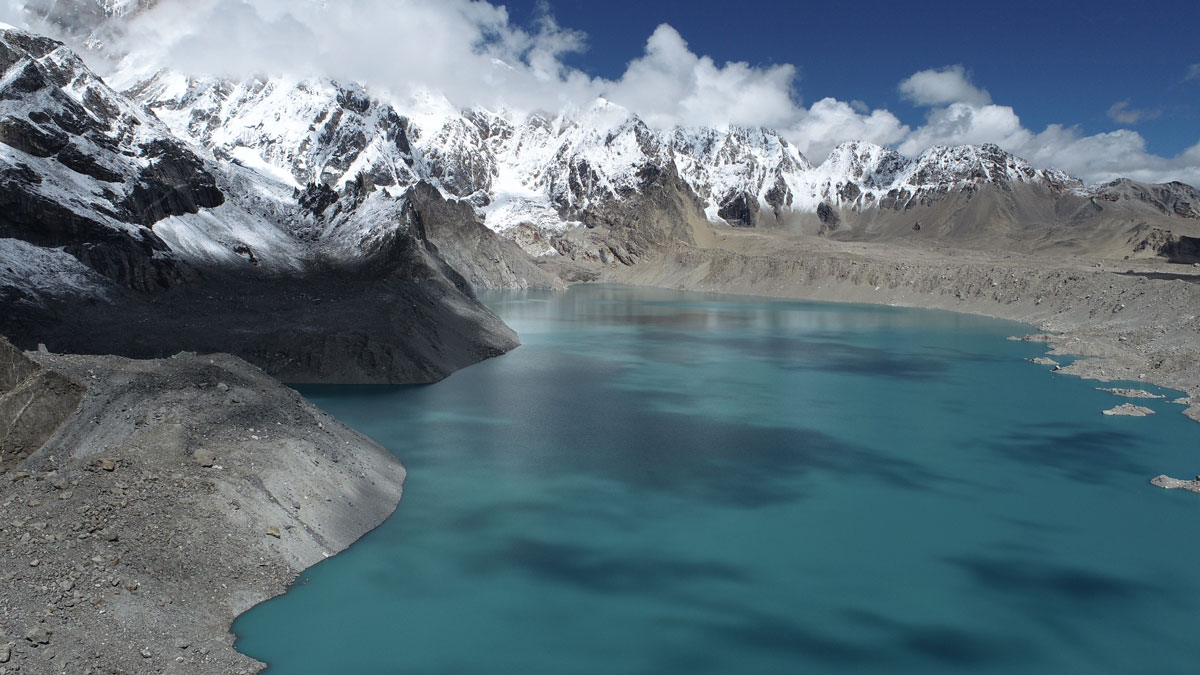
Galong Co, a lake in the central Himalayan Poiqu River basin, holds a large volume of water and has been assessed as posing a high outburst flood risk. New research explores how such lakes could provide hydropower while supporting flood risk management. Credit: Zhu et al. research team Source: Water Resources Research As mountain glaciers retreat in the face of a warming climate, glacial lakes are expanding, increasing the risk of glacial lake outburst flood events that cause damage and destruction to communities downstream. However, harnessing the power of this excess water could both provide a renewable energy source for these communities and help reduce flood risks. The Poiqu River (also known as Sun Koshi) basin spans approximately 2,150 square kilometers of the China-Nepal border, with 106 glacial lakes spread throughout its basin. Glacier area shrank by 19% between 1976 and 2017, while the total area of glacial lakes increased by about 110% between 1964 and 2017. The basin’s steep terrain and substantial water volume suggest that many of these lakes that can put downstream communities at risk could also offer benefits. Previous studies of glacial lake expansion tend to focus on the hazards melting glaciers pose. Zhu et al. assessed the potential of 37 glacial lakes in the Poiqu River basin. Using climate projections and estimates of how water moves in and out of the lakes as well as elevation differences between the lakes and the surrounding terrain, the researchers explored how much electricity the lakes could generate and which sites might be suitable for future development. Researchers mapped how water flows into and out of each lake, calculating the annual water budget through four means: glacier runoff, nonglacier runoff, precipitation, and evaporation. Using the output from six global climate models under four different emissions pathways, the researchers then estimated changes in water availability through 2100. Next, they combined these estimates with river network and elevation data to identify and then rank which sites were suitable for hydropower development downstream, calculating how much electricity each site could generate. Across the four climate scenarios, the 37 lakes could generate an average of 212.8 gigawatt-hours (GWh) of electricity annually from 2025 to 2030, with production declining to 194.3 GWh per year by the end of the century. After the lakes were ranked in terms of how suitable they were for development, Paqupuco emerged as the highest-priority site, with a potential power generation of 14.3 GWh per year. For context, the estimated annual generation of 212.8 GWh is equivalent to the annual electricity use of about 21,000 U.S. households, assuming 10,000 kilowatt-hours per household per year. A glacial lake hydropower project installed in Nepal in 2021 could produce about 0.88 GWh per year if operated continuously at full capacity. The researchers also modeled how the same approach could be used for controlled water releases from high-risk lakes like Gangxico. (Water Resources Research, https://doi.org/10.1029/2025WR041374, 2026). —Rebecca Owen (@beccapox.bsky.social), Science Writer Citation: Owen, R. (2026), Harnessing glacial lakes for hydropower, Eos, 107, https://doi.org/10.1029/2026EO260376. Published on 23 November 2026. Text © 2026. AGU. CC BY-NC-ND 3.0Except where otherwise noted, images are subject to copyright. Any reuse without express permission from the copyright owner is prohibited.
Harnessing Glacial Lakes for Hydropower
Full Article
Original Source
Read the full article at Eos →KhanList aggregates and links to publicly available news content. We do not host full articles from third-party sources. Always verify important information with original sources.