
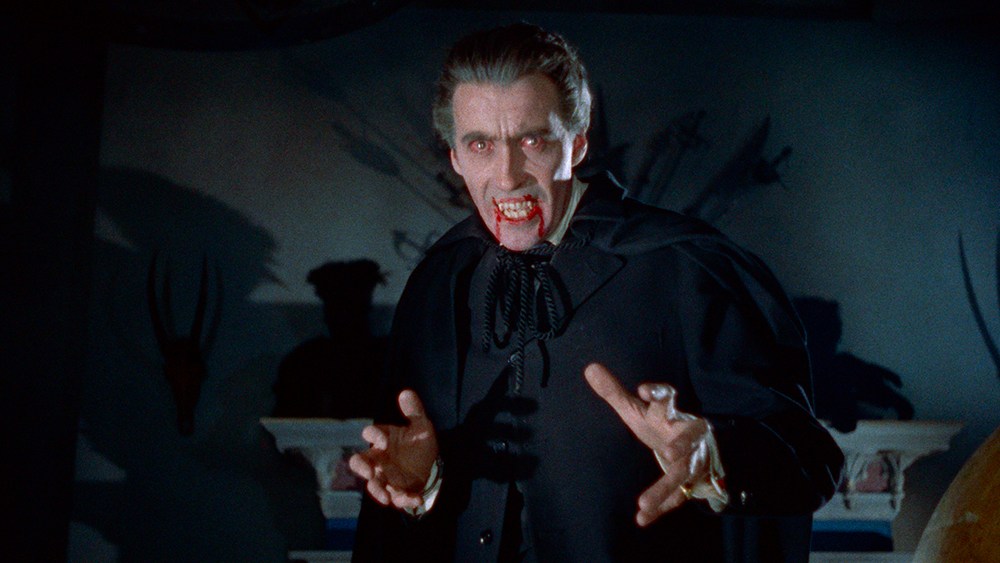
In the credits for the “Paranormal Activity” stage play currently running on the West End before it heads off to Broadway next year, next to Blumhouse, which produced the original hit film franchise, sits the name of one of cinema’s most historic and iconic horror brands: Hammer. The British production company, founded in 1934, is famed for its Gothic reinventions of monsters such as Dracula, Frankenstein and the Mummy starring horror titans such as Peter Cushing and Christopher Lee. Most of these movies released in the late 1950s, 60s and early 70s, influencing generations of noted filmmakers such as Guillermo del Toro, Tim Burton and John Carpenter, to name just a few. Yet it had nothing to do with “Paranormal Activity.” But for John Gore, the British theater impresario who made a name in the U.S. through his John Gore Organization by backing the likes of “The Book of Mormon,” “Hamilton” and, now, “Paranormal Activity: A New Story,” he simply wanted to see the Hammer name — a shadow of what it was during the glory days — back in the spotlight alongside arguably the current reigning horror icons. Popular on Variety “Instead of my U.S. company, I put Hammer on it — because I thought we just have to have it there,” he tells Variety. “It’s a taste of the future!” For Gore, the future for Hammer — which he acquired in late 2023 — is to see the brand resurrected, much like the famed blood-sucking Count himself, and become part of the horror conversation just as the genre continues to enjoy its most successful period in cinematic history. The next step towards this leans into its vast library of classics, with a 4K restoration of its 1958 hit “Dracula” releasing in more than 144 U.K. cinemas this week and landing in the U.S. (as “Horror of Dracula”) later this month following a premiere at the Academy Museum in LA. Also at the museum, Hammer and John Gore Studios are supporting its recently launched exhibition “The Horror Show,” which in January will celebrate the history of Hammer. Gore says his commitment to Hammer, his first major acquisition in the film world, is backed by a deeply personal connection, having adored its horrors while growing up in the late 60s and 70s. “I loved those films from a very young age,” he says, adding that Hammer’s titles “captured my imagination” in a way the earlier black-and-white horrors hadn’t. “They felt very real, and had the atmosphere with this sort of red-velvet quality to it all.” It’s a commitment that has seen Gore build up an assortment of supporting companies around Hammer, forming John Gore Studios in the process. The fast-growing outfit is now producing upcoming titles such as period romp “The Return of Stanley Atwell,” starring Nicholas Galitzine and Ella Purnell and from “Hamnet” banner Hera Pictures, and the Wallis Simpson biopic “The Duchess,” starring Joan Collins and Isabella Rossellini. But Hammer was a keystone. It was also a major “leap of faith,” admits Gore, who acquired the company almost as a “blind purchase” when it was on the brink of financial collapse and due diligence would have “cost 10 times the amount of what it was to take it out of bankruptcy.” He says he wasn’t sure if he would “just end up owning a name,” with Hammer having co-produced so many of their titles with Hollywood studios — many of the majors funding them outright. “But I knew the catalogue inside out, and was very happy with what we got.” John Gore Courtesy John Gore Studios After Hammer, Gore acquired the noted London-based remastering outfit, Silver Salt Restoration, which had worked on the Ealing comedies. “Every [Hammer] film was in a real state, so rather than paying for restoration, buying a restoration company seemed to make an enormous amount of sense, especially a restoration company that has done so many great British things,” he says. Then, appreciating the importance of U.K. distribution, he bought KFilm, the parent company of Kaleidoscope Home Entertainment and Icon Film Distribution. Suddenly Hammer sat within a framework of entities — formally announced as John Gore Studios in early 2025 — that could give its dusty reels a makeover and get them out into the open. First up was the home entertainment 4K release of one of Hammer’s lesser-known titles, “Captain Kronos: Vampire Hunter,” followed by last year’s theatrical release of a 4K restoration of its classic “The Curse of Frankenstein,” one of six Frankenstein titles Hammer made starring Cushing as the monster-maker. Next up is possibly the most famous release of them all. “‘The Curse of Frankenstein,’ did extremely well, but ‘Dracula,’ for me, was always going to be the big one,” says Gore, who lists it as the “greatest Dracula film” ever made. “I’ve seen a lot of Dracula, especially over the last few years, but there’s nothing quite like Christopher Lee coming down that staircase. Christopher Lee as Dracula was the definitive Dracula for me.” For the 4K restoration, undertaken by Silver Salt, Gore also worked closely with U.S. licence holder Warner Bros, who through the studio’s library historian George Feltenstein dug up something very special. The famed, near-mythical, climax of “Dracula” saw Lee’s Count claw at his face as he disintegrated in the sunlight, pulling his skin away in agony as he rapidly decomposed into ash. It was an extended scene considered too gruesome by U.K. censors, who demanded cuts before giving the film an X rating. It was cut in the U.S. as well. But in Japan, it wasn’t touched and Feltenstein went looking deep into the archives. “And he found a copy that was just marked ‘Japan’ which had those elements in it,” says Gore, who made sure it was included in the new release. “I guess you could call it the director’s cut.” There are more Hammer restorations being plotted, Gore and his team — including COO Anouska Spiers — sitting down with rights holders in the U.S. to figure out how to work together. But there are also significant production plans, involving both new and existing IP. On the fresh IP side, Canadian feature “Ithaqua” — a period cannibal horror starring Luke Hemsworth and Kevin Durand — offers what Gore describes as “Hammer’s first new monster.” But the “real question,” he says, is “what do we do with the classics?” Essentially, how do you take what Hammer so famously did with Dracula and Frankenstein and make something new, exciting and in keeping with the company’s legacy. “It’s very hard to contemplate how we would just do a straight remake of something that is a classic,” he says, citing Gus Van Sant’s failed shot-for-shot remake of “Psycho” as an example. But Gore does have some thoughts. Across his films, Cushing famously portrayed Frankenstein as corrupt, ruthless or full-on villainous (such as 1964’s “The Evil of Frankenstein”). “The Cushing Frankenstein has never been redone — where Frankenstein is evil,” he says. “In most films, Frankenstein is a tortured scientist but the evil Frankenstein is something I’d like to look at.” An easier place to start could be the less recognizable Hammer titles, the ones less likely to spark upset among aficionados. One title Gore claims has been mooted is “Countess Dracula,” the 1971 film in which a 17th-century aristocratic woman discovers her youthful appearance and libido can be restored by bathing in the blood of young women. “It was great, but it wasn’t such a tentpole in terms of the Hammer catalogue,” he says, adding that there have also been queries about revisiting 1968 cult horror “The Devil Rides Out.” “That film has real power to it. Christopher Lee spent years talking about how that was for him the most terrifying experience.” Hammer Films. Poster Illustration by Robert Sammelin There’s much to be planned, but the hope is that the combined search for new big screen horror (much like Gore says he “always hunting for the next big musical or major play”) coupled with a considered exploration of how to respectfully exploit its vast library of monsters — alongside partners in the U.S. — will rejuvenate the Hammer name. There’s definite enthusiasm and activity — and backed up by financial support — something which for such an iconic brand has been a very long time coming. Whether Gore is Hammer’s saviour after so long in the cinematic dungeons remains to be seen. But its new owner comes in not just a dedicated and obsessive fanboy — “I feel great responsibility in bringing this stuff back,” he says — but an entrepreneur who, thanks to his money-spinning theater business, has the crucial ability to green light projects “within horror’s budget limits.” There are also many other Hammer fanboys out there — many of them among the most renowned genre filmmakers working today. Alongside Burton and del Toro, the likes of Stephen King, Quentin Tarantino, Sam Raimi, Edgar Wright and Peter Jackson have referenced Hammer titles or expressed the influence of its work (Jackson literally shot a Super8 version of “Captain Kronos” as a teenager and later cast Christopher Lee in “The Lord of the Rings”). Maybe one of the greats would love the opportunity to now direct a Hammer movie for themselves. Gore suggests there’s hope. “We actually have a letter from the 90s where Martin Scorsese wrote to Hammer saying, ‘I would love to make a Hammer film,'” he says. “And they never replied.” Gore was recently speaking to Oscar-winning costume designer and frequent Scorsese collaborator Sandy Powell and asked for her advice . Her response: “It’s very simple. Just reply to his letter.”
Hammer Films Boss John Gore on Resurrecting the British Horror Icon, Plans to Remake the Classics and Why Christopher Lee Was the ‘Greatest Dracula’
Full Article
Original Source
Read the full article at Variety →KhanList aggregates and links to publicly available news content. We do not host full articles from third-party sources. Always verify important information with original sources.