
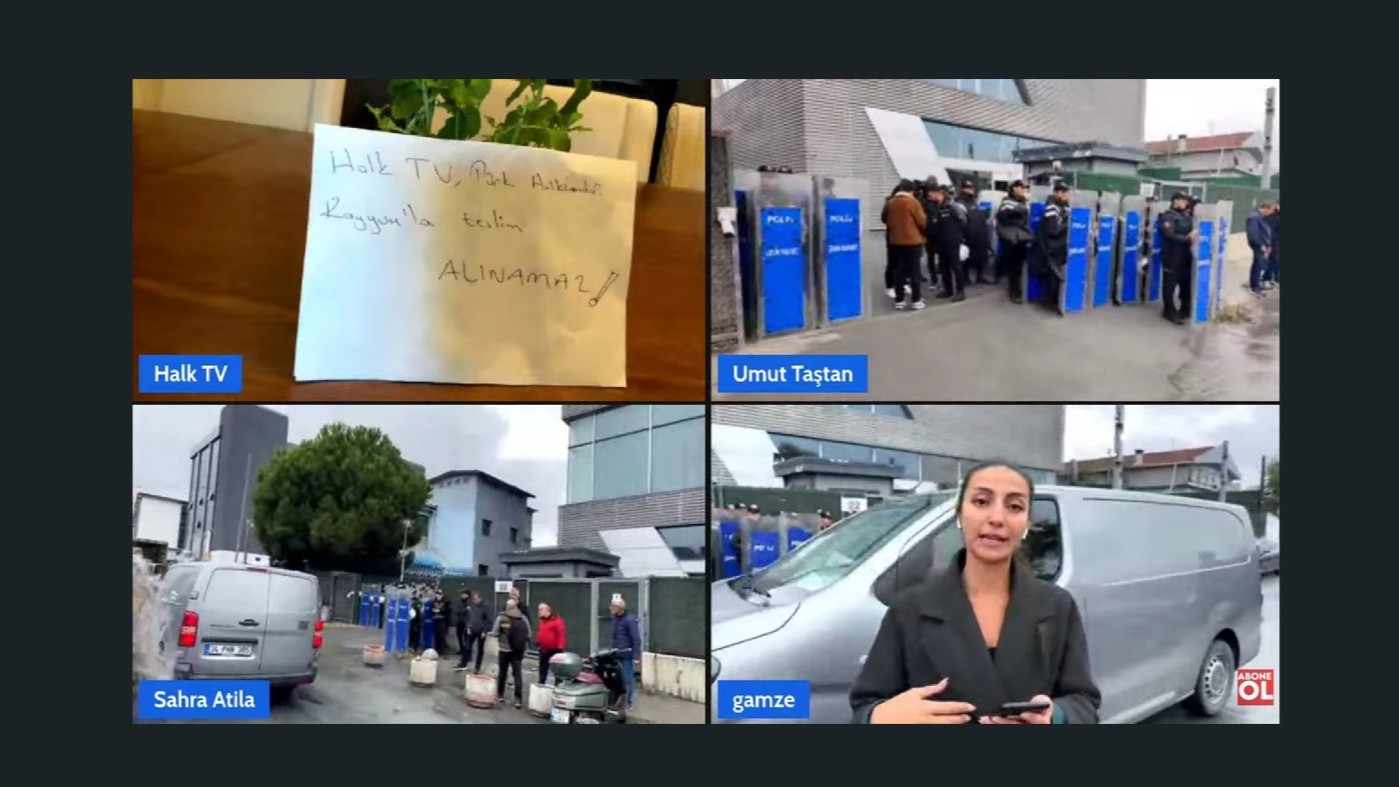
As a noose tightens on one of Turkey’s last remaining independent TV channels, the transformation of a once diverse media sector into a ‘univocal government-dominated ecosystem’ is almost total. One of the last remaining TV channels operating in Turkey that operates on a wide range of platforms and is accessible to millions of critical viewers, Halk TV, has just been taken over. On October 14, police raided its headquarters in Istanbul, the broadcast was suspended, and a state-appointed trustee was put in charge of the channel. It’s the latest example of how the capture of the media landscape that has been unfolding for the last two decades has led to transformation of the country's media from a flawed but plural sector into a univocal government-dominated ecosystem. The media landscape in Turkey was never a liberal idyll. Concentration of media ownership, political patronage and close relations between media owners and governments long predated the coming to power of President Recep Tayyip Erdogan's Justice and Development Party, AKP. But while the media landscape had never been truly free, it never was as barren as it is currently. As a child I remember coming across a TV interview on Kanal 6 from 1995, during which the moderator, Umit Zileli, was targeted on air by Istanbul’s then Metropolitan Mayor, Erdogan, and Ankara’s Metropolitan Mayor Melih Gokcek. At the time I expected that the two mayors would be merely defensive rather than hostile when asked about corruption allegations. But both walked out of the TV station. Fast forward to 2001, when a deep financial crisis had already weakened the media and multiple media outlets were taken over by the state-run Savings Deposit Insurance Fund, TMSF. This allowed the state a unique role in direct control of private media and in deciding who can own and operate media companies. While censorship had existed in the country before, what happened with the confiscation and direct control of private media was a long term, slower and more “effective” strategy. This saw financial pressure, selective investigations, tax penalties, changes in ownership, regulatory sanctions – and the transfer of outlets to cronies that aligned 110 per cent with the government’s policies. Over the last two decades, multiple big media groups caved under this pressure. Now a TMSF trustee has been appointed to run Halk TV too. Conformity as business strategy Newspapers for sale in Istanbul, May 2023. Photo: EPA/ERDEM SAHIN.Over two decades, Turkey’s media became more politically dependent. The economic interests of media owners through public contracts, licenses, advertising, and loans through public banks were all intertwined with government favours. As the two sides became mutually dependent, editorial conformity became the biggest business strategy. In the aftermath of the 2016 coup attempt, a State of Emergency was declared. Scores of outlets were closed, hundreds of journalists were detained, or had to go into exile and media companies were seized in the name of “national security”. While the immediate target was announced to be the movement led by cleric Fethullah Gulen, who the authorities blamed for the coup plot, the consequences extended well beyond it, shutting down small independent digital media outlets that had no connection to political groups. The State of Emergency normalised the state appointment of trustees to the board and management of media outlets. More than 90 per cent of the media thus became under direct control of progovernment investors. This meant not only an editorial shift but ownership structures being rebuilt around political loyalties. In this regard, rather than describing the state of affairs in Turkey as “censorship”, “media capture” is more accurate. At this stage, the government controls editorial lines, discourse, public advertising, renewal of licenses. The course of events produces silence without needing an explicit order. Three-part control mechanism Halk TV’s Editor-in-Chief, Suat Toktas, gives a farewell speech with the channel’s staff on October 14. Photo: Halk TV/Facebook. In the capture of the media in Turkey, three instruments stand out. The first is ownership. With TMSF becoming a central tool for controlling the seized media groups, this opened the way to transferring media to politically aligned buyers. This has put the government both in the position of both regulator and market-maker in the media sector. Another pressure point is financial. Public advertising, tendering processes, loans through public banks, tax enforcement and selective tax breaks can be used to reward loyalty and punish critical views. Over the years, the Press Advertisement Agency, BIK, has been used often to control funding allocated to critical outlets. Finally, the Radio and Television Supreme Council, RTUK, has become notorious for imposing fines and sanctions on TV channels critical of the government. In addition to conventional broadcasters, since 2019 RTUK has also been put in charge of online broadcasts, extending the government’s control to digital media. In 2023, following Erdogan’s victory, control over media changed gear and was no longer confined to TV channels, newspapers and ownership structures. After Erdogan had to run in a second round of elections, after failing to win the first round, in May 2023, analysts started speculating about what would likely happen if he were to win only with a narrow margin, when to prove that he can keep the country under control, he would need more aggressive policies. Since the 2023 elections, pressure has reached a new level and the digital sphere – to where independent media had been escaping – has been shrinking fast. Months before the election, the notorious Disinformation Law came into effect. During our meeting as the international media freedom delegation, on our annual visit to the Turkish parliament, the representative of Erdogan’s Justice and Development Party, Hakan Cavusoglu, claimed this law would never be used to target journalists. Since then, we have seen arrests, convictions and greater overall pressure, all through this law. The vague wording of this law made it a crucial instrument, targeting journalists, especially their reports on corruption, security and public spending. Another aspect is increasing pressure on digital platforms. Through a series of advertising bans, substantial fines and bandwidth throttling, digital platforms’ content was blocked or removed. The government continuously makes requests for user data from platforms. This practice has shifted the burden of censorship from the government to private digital platforms. This process also coincided with Elon Musk’s takeover of Twitter and his statement that he would comply with local regulations to make sure his platform remains accessible. This would be a good moment to repeat something I have long said: “Private companies cannot be trusted as the guarantors of free expression and media freedom!” As conventional independent media almost disappeared, access blocking, content removal orders and licensing pressure have made it harder for news readers to break out of the government narrative and find critical reporting, even online. This has resulted not only in the repression of the media but also in the quiet erosion of the public’s right to access information, compare sources and form independent informed decisions on their own. Why Halk TV matters Turkish flags at a ceremony at the Bosphorus Bridge in Istanbul to mark the first anniversary of the 2016 coup attempt, July 2017. Photo: EPA/TOLGA BOZOGLU. In a landscape where over 90 per cent of the media were now under government control, only a handful of outlets were reachable through analogue and digital broadcasting due to the aggressive licensing regulations that prevent new media to penetrate this scene. Halk TV was one of the very few outlets in this space, where critical journalism and opposing voices could find a platform, participate in the political debate and reach a mass audience. In such a disproportionate landscape, those few platforms available to the people still have millions of daily viewers, as they are important for people seeking information beyond the official narrative. It is exactly this reason that puts such critical outlets on the spot – and a trustee becomes the consequence. A trustee in this context is not merely a public employee who manages the finances to keep the organisation afloat. They go beyond administration and determine editorial priorities, personnel, programming and the channel’s general ability to function as an independent voice. Previous examples have shown that once a trustee is appointed to a media outlet, it is turned inside out and a loyal audiences built over the years is lost. Corruption allegations should not be exempt from investigation and should be applied in a consistent and transparent manner, not excluding the progovernment investors and media owners. When the trusteeship tool repeatedly targets critical media, while the progovernment conglomerates expand and benefit from public funding, confidence in the neutrality of the process collapses. The capture of the media landscape in Turkey did not happen overnight, and cannot be reversed through a single court ruling, or even change of management. It came about through crises, seizures, tax pressure, forced sales, political ownership, regulatory discipline and extension of controls to digital screens, all of which sent waves of chilling effects, even on individual citizen journalists. When Halk TV headquarters is raided by police at dawn and a trustee enters the building, the question is no longer whether a critical channel will return to the air. The question is whether Turkey still has a media landscape that is capable of scrutinising power, ensuring pluralism and treating journalism as a public good. The answer also is not simple, and can only emerge once captured institutions are separated from each other and from the political interests they have long served, and can act autonomously. The cycle can be broken, however. Patience is the most important component for the next phase of rebuilding independent media in Turkey. Legal protections for editorial independence, repealing or rewriting the Disinformation Law, transparent and non-discriminatory regulation of broadcasting and online platforms, and an end to the use of public advertising, licensing, financial pressure as instruments of political influence are the pathway to a better future for the media. We at the international media freedom organisations, professional journalism and media associations, European institutions and democratic governments have to keep demanding these reforms from Turkey, pressing both governing and opposition parties to declare their support for media freedom and pluralism. The reforms to be passed for substantial progress to be made in restoring media freedom cannot be abstract principles but must be concrete benchmarks tied to Turkey’s international commitments. People have not given up on their demand for reliable information and continue to seek out independent outlets. Journalists continue to document abuses despite legal risks, and courts, especially the Constitutional Court, occasionally recognise that sweeping blocking or content removal orders violate free expression and media freedom. This resilience built up in Turkey now needs to be turned into durable protection; solidarity among journalists, cross-border reporting, legal defence practices, secure digital distribution, media literacy initiatives and sustained public demands for media freedom are the key elements. This struggle is not about saving one TV channel but about the public’s right to see, question and decide freely. Gurkan Ozturan is Turkey Country Rapporteur for Freedom House’s Freedom on the Net; and works as Media Freedom Monitoring Officer at the European Centre for Press and Media Freedom (ECPMF), as part of Media Freedom Rapid Response (MFRR). The opinions expressed are those of the author and do not necessarily reflect the views of BIRN.
Halk TV Takeover Confirms ‘Long Capture’ of Turkey’s Media
Full Article
Original Source
Read the full article at Balkaninsight →KhanList aggregates and links to publicly available news content. We do not host full articles from third-party sources. Always verify important information with original sources.