
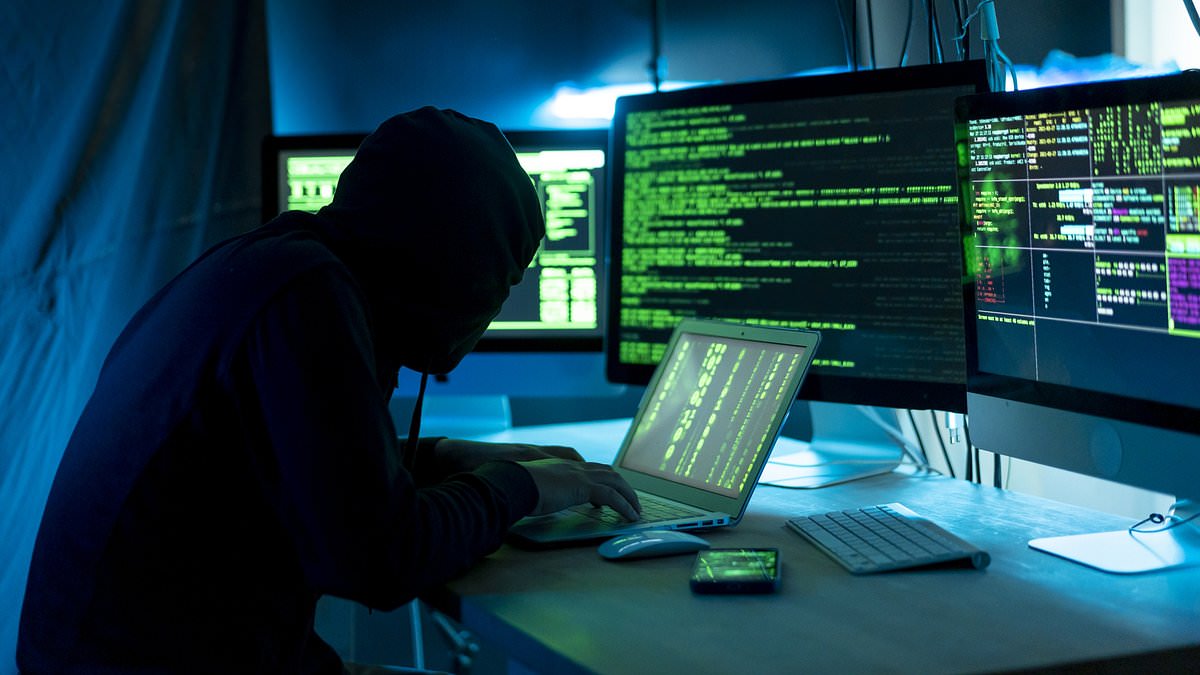
Published: 13:04 EDT, 2 November 2026 | Updated: 13:56 EDT, 2 November 2026 Rival Russian and Ukrainian hackers have claimed credit for a cyber-attack that led to fake nuclear war alerts being issued in both countries.The bogus alarms went to millions of people across Russia and Ukraine in an apparent tit-for-tat exchange by two groups.The first warning came just after 11pm on Sunday when Ukraine's air raid app, which is used by some 6.7 million people a day, was struck.One of the fake alarms said Russia had launched a hypersonic Oreshnik missile, which is capable of carrying a nuclear warhead. The weapons can travel more than 7,000mph and have previously been used by the Kremlin on three occasions, hitting the Kyiv region, and the cities of Dnipro and Lviv.Other messages wrongly warned of a chemical threat to the Ukrainian capital of Kyiv with a third telling residents street fighting was likely to break out and to stay in their homes.Some of the messages were written in Russian. Others were a mix of English and Ukrainian, with spelling mistakes included.Ukraine's air force said shortly afterwards on the Telegram messaging app that the air raid system appeared to have been hacked by Russia.'The air alert app appears to have been subjected to enemy influence,' the air force statement said. 'There is no radiation threat! Stay calm and follow our updates on our channel!' Some of the fake alerts issued to Ukrainians on Sunday, which warned of a nuclear attack Shortly after the hack on Ukraine's alert system, hackers hit Russia's emergency network Many Ukrainians reportedly just ignored the hoax alerts, assuming the app had been compromised by hackers. But others were left terrified. 'I lay on my bed and wondered what was coming,' one woman called Nina told The Guardian.A newly-founded hacking group called 'Hitcore' has claimed responsibility for the incident, with one message in Russian including a link to a Telegram set up by the group, which has a logo of a metallic eagle emblazoned over the Russian flag.All-clear messages were sent shortly afterwards for each of the alerts and Ukraine's Ministry of Digital Transformation said the emergency app had been temporarily suspended, but other means of alerting the public were working, as were air raid sirens.Then, a few hours later, Russian state news agency TASS quoted the Ministry of Emergency Situations in Moscow as saying its mobile app had been hit by a massive cyber-attack that resulted in the spread of false information to the public.Several regional social media accounts run by the department sent out messages warning of an imminent nuclear attack on Russia.In the Belgorod border region, residents received a Telegram message warning 'nuclear warheads... have been launched at all regions of Russia', and telling them to 'urgently stock up on food for three weeks'.Atesh, a pro-Ukrainian hacking group, posted a screenshot of the alert on its Telegram channel early on Monday, with a message saying: 'The Ministry of Emergency Situations app has been hacked!'The guerrilla group later claimed responsibility for the hack, having previously carried out cyber-attacks against Russia. However, the claim could not be independently verified. Two hacking groups have claimed responsibility for the cyber-attacks (file image) The Kremlin attempted to play down the impact of the security breach, saying it was not one of its main public warning system channels, but just what it called a supplementary source of information.The Russian ministry said in a statement on Telegram that its experts were working to restore the app to normal operation.'We ask the public to remain calm and to trust only official sources of information – the Russian Ministry of Emergency Situations' website and the department's official social media accounts,' it said.News of the hacking war came shortly after a six-day ceasefire between Moscow and Kyiv ended on Sunday. The White House said the truce was set up by First Lady Melania Trump.However, evidence has emerged that Russia used the pause to reinforce its position in Oleshky and to rotate in new troops.
Hacker wars: Rival Russian and Ukrainian cyber groups claim credit for attacks on each country's air raid systems that saw some civilians alerted to fake nuclear and chemical warfare
Full Article
Original Source
Read the full article at Dailymail →KhanList aggregates and links to publicly available news content. We do not host full articles from third-party sources. Always verify important information with original sources.