
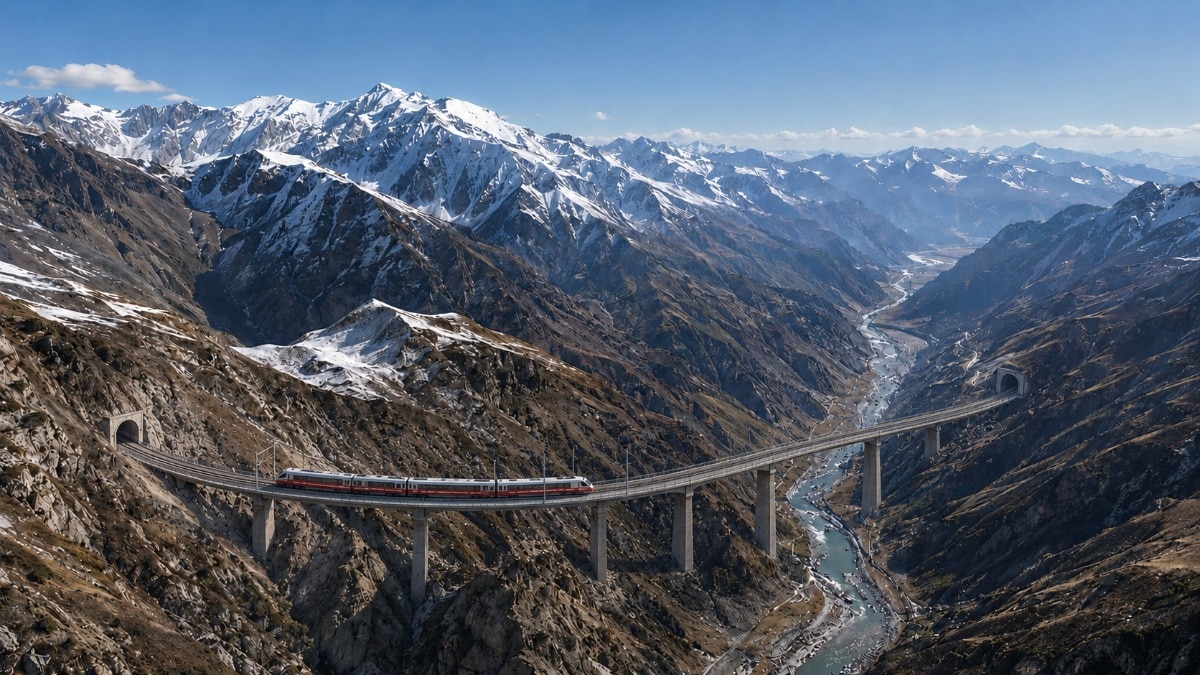
The flash flood near the Nepal-China (Tibet) border has wrecked the Himalayan nation's key road link to Tibet, highlighting the risks facing Beijing's proposed Belt and Road Initiative (BRI) railway between Tibet and Kathmandu. Experts have called for a rethink of the design and disaster safeguards before the railway project moves beyond paper.The proposed Nepal-China (Tibet) railway would cross the Tibetan Plateau and tunnel beneath the Langtang Himal, part of the central Himalayas, before descending to Kathmandu Valley. (Image: Google Earth/ AI-edit)The intense flash floods left very little recognisable of what was the Gyirong Land Port between Nepal and China (Tibet). The land port has collapsed, while roads and bridges have disappeared under mud and debris. Rescuers arriving at the site found "nothing but ruins".The devastation at the border post, located at around 1,800 metres (5,900 feet) above sea level in the fragile Himalayan terrain, has wiped out a crucial land-based trade route between Nepal and China. But the damage could have wider implications. With Gyirong and its surrounding areas devastated, the floods have also thrown into question China's proposed Belt and Road Initiative (BRI) railway linking Tibet with Kathmandu.The railway, which has barely progressed beyond paper since it was conceived in 2016, now faces a fresh and formidable challenge. The floods have exposed the hazards of building such a project in the fragile Himalayan terrain, prompting experts to call for a reassessment. Any such project in this vulnerable region could also have adverse strategic implications for India.Experts have flagged the construction of a mega dam near the Namcha Barwa, right before the Brahmaputra enters India. Experts have sought cross-border hydrological studies, real-time warning systems and a new disaster-management framework, before the project can take shape beyond paper. A massive collapse involving glacier ice and rock in Nepal's northern Langtang region on August 26, sent water, mud and debris surging through the Lhende Khola, Bhotekoshi and Trishuli river systems. It devastated communities, roads, bridges and hydropower projects in Nepal and struck the Gyirong Port on the Tibetan border.The disaster killed over 1,250 people in Nepal and left thousands missing. The Himalayan nation's preliminary economic losses have been estimated at 10% of its economy, the Nepalese finance minister has claimed. Nepal has sought climate compensation from India even though the disaster can't be directly attributed to Indian emissions or actions. The demand raises questions because Kathmandu knew the Himalayas were fragile while permitting its own and Chinese-backed infrastructure projects across the hazard-prone region. An India Today OSINT report identified at least 90 Chinese infrastructure assets across the Tibetan Himalayan belt, including 27 air assets, 17 railway assets, 33 mountain tunnels and 13 dams, reservoirs and hydropower projects.Nepali politicians have questioned the railway's viability even before the flood. "What will we export to China, and what will we import from Tibet through the railroad? So let's build roads instead," former Nepal minister Minendra Rijal said, noted a 2024 analysis by Hari Bansh Jha, a former professor at Nepal's Tribhuvan University, and a Visiting Fellow at the ORF.The disaster, called "once-in-a-lifetime", has revealed the consequences of concentrating highways, bridges, hydropower plants and other infrastructure in narrow Himalayan valleys, which are very vulnerable to floods, landslides, earthquakes and unstable glaciers.WHEN NEPAL'S ROAD TO CHINA DISAPPEAREDImages from Gyirong showed torrents of water and debris engulfing buildings at the border complex. Roads, electricity and communications were cut. That prevented heavy equipment from reaching the worst-hit area, even as Beijing tried to restrict the flow of information from its territory. Although Nepal lies downstream of the river system hit by the flood, visuals from the country have revealed the true scale and destructive force of the disaster."There was no road... it was all virgin forest and sheer cliffs," Chinese rescue worker Zou Mingqi said after his team crossed mountains and used ropes to reach the port. At the complex, he said, "As far as the eye could see, there was nothing but ruins," reported news agency Reuters.Gyirong, also spelt Kyirong or Kerung, has long been a trading route between Tibet and Nepal. China formally opened the modern crossing to international users in 2014. Its importance increased after the 2015 Nepal earthquake badly damaged the older Zhangmu-Kodari route (east of Gyirong-Rasuwa), diverting traffic towards Gyirong-Rasuwagadhi.By 2024, Gyirong was handling nearly 30% of China-Nepal trade. It was also an important overland entry point for Indian pilgrims travelling to Tibet for the Kailash Mansarovar Yatra. Its closure, therefore, disrupts not only bilateral cargo movement but also tourism, pilgrimage and local livelihoods.Apart from Gyirong, pilgrims can reach Kailash Mansarovar through Uttarakhand's Lipulekh route that has been disputed by Nepal, which has been disputed by Nepal under former PM KP Sharma Oli. Another route is through Nathu La in Sikkim. Some take Nepal's weather-dependent Simikot-Hilsa air route. Gyirong was popular because it allowed gradual acclimatisation and was connected to Kathmandu.The disruption is likely to put additional pressure on other China-Nepal crossings, particularly the Zhangmu-Tatopani route. But that route has its own history of closures and vulnerabilities. So, Nepal's trade with China depends on a few fragile Himalayan routes.THE RAILWAY DREAM THAT NEVER TOOK OFFChina put forward the plan for a railway to Kathmandu through Gyirong in 2016. In 2018, it was incorporated into the Trans-Himalayan Multi-Dimensional Connectivity Network under the BRI, and it was listed among the projects considered at the second Belt and Road Forum in 2019.The railway would extend China's existing rail network from Shigatse in Tibet towards Gyirong (approximately 550 km), and then cross into Nepal's Rasuwa district before reaching Kathmandu. The planned section in Nepal is approximately 72 km.The shorter Nepal section would arguably be the more difficult one. A Chinese pre-feasibility study prepared in 2018 estimated that approximately 98.5% of the 72-km route would consist of tunnels or bridges. The proposed alignment would connect Kathmandu, Nuwakot and Rasuwa districts and require complex engineering through steep, seismically active Himalayan terrain.The Nepal section's was estimated at $2.75 billion. Older estimates placed the wider Gyirong-Kathmandu project’s cost as high as $5.5 billion. That was close to Nepal's total annual government revenue in 2018, according to The Kathmandu Post.China provided grant assistance for the project’s early studies, including a commitment that AidData estimates was worth approximately $18.37 million after adjusting for inflation to 2023 prices. A separate, more extensive Chinese-funded feasibility study began in December 2022 after delays caused partly by the Covid pandemic. Chinese teams completed field investigations and were drafting the report earlier in 2026, the report noted.But construction has not begun, the final route and cost have not been settled, and there is no confirmed financing arrangement for building the line. Nepal wants China to fund the railway through a grant rather than a loan, a 2019 report revealed. Beijing has not committed to paying the entire construction bill. The project, therefore, barely moved beyond the study stage before the flood struck on August 26.According to a PTI report, a six-member Chinese tunnel-expert team was deployed at the Upper Trishuli-3B hydropower project, where China Railway was carrying out civil construction.Unlike China's proposed rail line to Nepal, India has operational rail links with Nepal. It includes the 52-km Jaynagar–Bijalpura route and freight links at Raxaul-Birgunj and Jogbani-Biratnagar. Multiple railheads in Bihar, Uttar Pradesh, Uttarakhand and West Bengal also serve Nepal-bound trade and travellers.NEPAL FLOOD HIT KATHMANDU-TIBET RAILWAY'S WEAKEST POINTThe disaster struck after a long silence from Beijing. Experts say the project must only move ahead only after its environmental risks are reassessed.Taiwan-based journalist and China watcher Aadil Brar highlighted the location of the devastation on X.After the Nepal flood, Bhutanese journalist Tenzing Lamsang described the event as a potentially decisive challenge to the Gyirong-Kathmandu rail project."The Nepal-Tibet floods caused by a glacier collapse in the Langtang mountains may now become the biggest challenge to the stalled Kyirong (Kerung)-Kathmandu Railway line," Lamsang wrote on X. "The proposed 72-km line cuts under the Langtang national park and mountain range with major tunnels."He also said that the estimated $5.5-billion cost was equivalent to roughly one year of Nepal's government revenue when that estimate was made, and that around 98% of the Nepal section was expected to comprise tunnels and bridges.So the Nepal-China railway route would have to construct tunnels, elevated bridges and protective engineering in the vulnerable young Himalayan terrain. It would not be just a road on the edge of a river. The scale of destruction in the recent flood highlights that the project could have to deal with debris, slopes, glacier lakes near the seismic fault line and the constant threat of cross-border floods.Researchers told the South China Morning Post said the disaster should become a catalyst for closer China-Nepal cooperation on Himalayan hazards."The August 26 mountain flood is no isolated incident," said Balmukunda Regmi, a professor at Nepal's Tribhuvan University. He called for China and Nepal to establish automated, real-time warning systems for high-risk glacial lakes.It must be noted that what happens in the upper reaches of the Nepalese and Chinese Himalayas can also have devastating consequences downstream in India.Cheng Fei, an associate researcher at the West China Frontier Research Institute, said cross-border hydrological assessments should be included in the railway's feasibility studies. Such assessments should examine how rivers, glacial lakes, unstable slopes and possible debris flows affect the entire watershed region of the Himalayan drainage system, reported the South China Morning Post.Lucknow-based political science and international relations professor Chandra Mohan Upadhyay criticised big Chinese infrastructure projects in the fragile landscape."This is the price of so-called development and the cost of Chinese ambitions, the people of Nepal paying today," he wrote on X. "Tomorrow it will be the turn [of] India and Bangladesh. The common people are paying with their lives for the shameless destruction of nature by big powers," he also said.Hari Bansh Jha, the former Tribhuvan University professor, in his piece in ORF, warned that the "India-China railway rivalry" could improve Nepal's connectivity but might also threaten its long-term national interests and expose it to debt risks. However, India had funded the Jaynagar-Bardibas railway through a grant. Also, there has been no construction-financing arrangement between India and Nepal for the proposed Raxaul (Bihar)-Kathmandu line.Yes, the available evidence of the Nepal flood points to cascading natural forces involving glacier ice, rock, debris and water. However, the warnings by experts point to concern about a poorly assessed infrastructure, and the threats to crores of people in the sub-Himalayan region.The flood has wrecked Nepal's key road route to China, and it has warnings for the BRI's Himalayan ambitions. China and Nepal must discuss if the proposed Kathmandu-Tibet railway can be built through such a fragile landscape without triggering consequences that could be difficult to foresee or contain.- EndsPublished By: Sushim MukulPublished On: Sep 7, 2026 08:00 IST
Gyirong post wiped out: Nepal flood jolts China-Nepal BRI rail plan
Full Article
Original Source
Read the full article at Indiatoday →KhanList aggregates and links to publicly available news content. We do not host full articles from third-party sources. Always verify important information with original sources.