
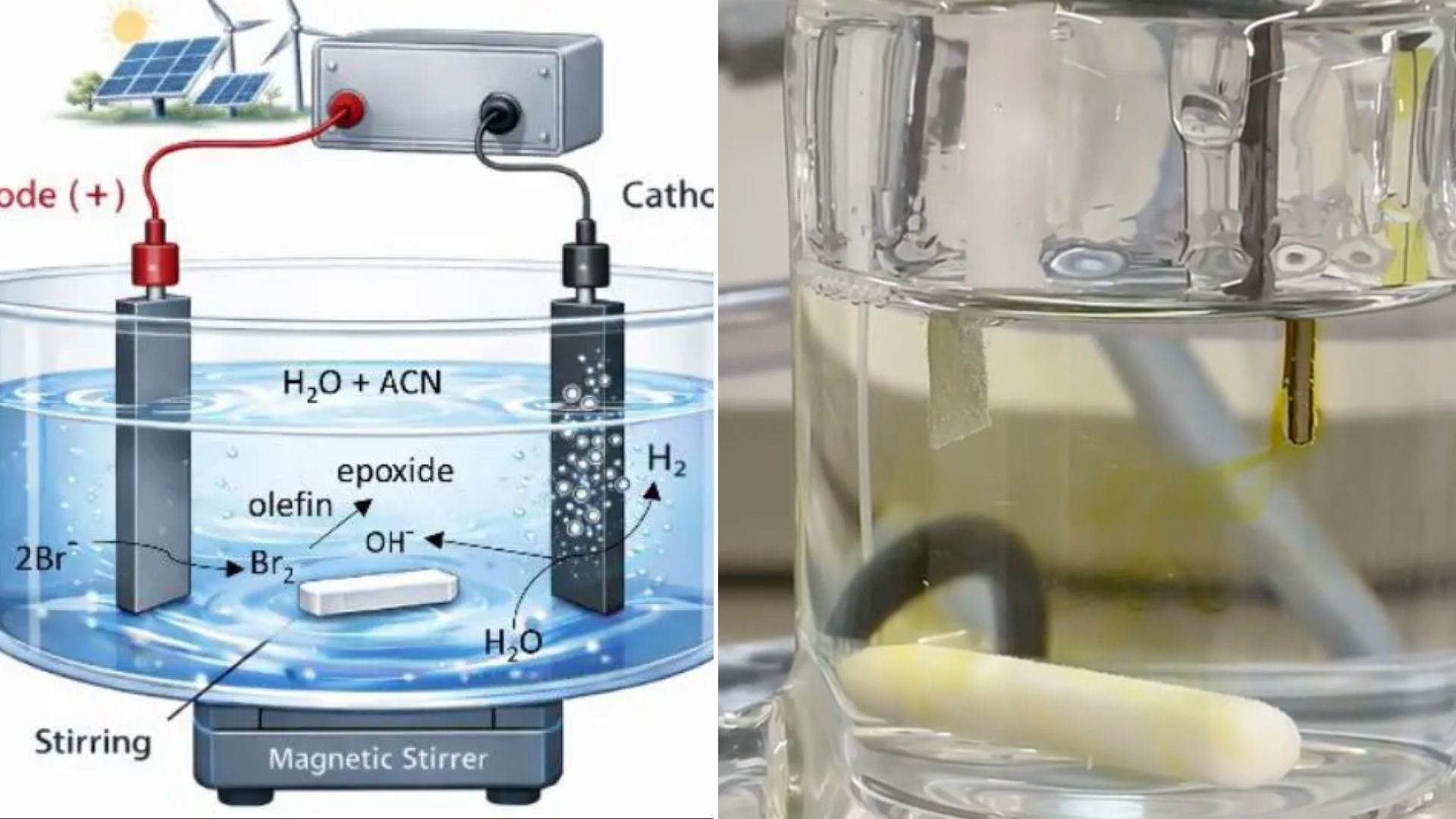
A new electrochemical process developed by researchers at the Technion, Israel Institute of Technology, could make green hydrogen production more economically attractive by producing a valuable industrial chemical alongside the fuel. The approach replaces the oxygen normally generated during water electrolysis with an epoxide, a class of chemicals widely used to manufacture polymers, coatings, adhesives, pharmaceuticals, and other products. Researchers report that the system achieved 98% efficiency for both hydrogen generation and the parallel epoxide-producing reaction. The study, published in Nature Communications, was led by Prof. Avner Rothschild of the Technion Faculty of Materials Science and Engineering and Dr. Guilin Ruan, a postdoctoral researcher. The team filed a U.S. patent application for the technology. Replacing oxygen with a valuable chemical Green hydrogen is produced by using electricity from renewable sources to split water into hydrogen and oxygen. While the resulting hydrogen can help decarbonize industries that are difficult to electrify directly, its wider adoption has been constrained by its cost compared with hydrogen produced from fossil fuels. The Technion team approached the problem by rethinking what happens on the other side of the electrolysis process. “Instead of producing oxygen,” the researchers sought to generate an epoxide, turning what is normally a coproduct into a potentially valuable chemical feedstock. In their experiments, the researchers report 98% efficiency for both hydrogen production and the parallel epoxide synthesis. This means, according to the team, that only about 2% of the electrical charge was lost to competing reactions. The researchers also report achieving a current density they say is compatible with large-scale industrial electrolysis. Membrane-free electrolysis The process builds on earlier work by Rothschild and his collaborators the separated the electrochemical reactions that normally produce hydrogen and oxygen. That concept forms the basis of membrane-free electrolysis, which avoids the membrane traditionally used to separate the two electrode reactions. H2Pro has commercialized an earlier technology from the research group. The new system takes the concept in a different direction by combining hydrogen production with chemical synthesis. According to Ruan, its performance comes from optimizing the complete electrochemical system rather than focusing on a single electrode or reaction. The system brings together the electrodes, a redox mediator, the solvent environment, and the operating configuration. This allows the researchers to produce hydrogen and epoxide without a membrane separating the electrodes. A potential economic advantage The approach could offer an additional economic incentive for green hydrogen production because the electrolysis process would produce two useful outputs rather than hydrogen and oxygen alone. However, the reported results are from the researchers’ experiments, and the study does not establish that the technology is ready for commercial-scale deployment. While the reported current density is described as compatible with large-scale electrolysis, further development is needed to show how the process performs under sustained industrial operating conditions. The European Research Council supported the research through the H2Bro project, following Rothschild’s ERC Advanced Grant awarded in 2023. It is also part of the Waste to Value inter-university research initiative funded by Israel’s Council for Higher Education.The researchers have filed a U.S. patent application for the technology, suggesting they see the process as having potential beyond the laboratory.Get the latest in engineering, tech, space & science - delivered daily to your inbox.Kaif Shaikh is a journalist and writer passionate about turning complex information into clear, impactful stories. His writing covers technology, sustainability, geopolitics, and occasionally fiction. A graduate in Journalism and Mass Communication, his work has appeared in the Times of India and beyond. After a near-fatal experience, Kaif began seeing both stories and silences differently. Outside work, he juggles far too many projects and passions, but always makes time to read, reflect, and hold onto the thread of wonder.
Green hydrogen process reaches 98% efficiency while producing valuable chemicals
Full Article
Original Source
Read the full article at Interestingengineering →KhanList aggregates and links to publicly available news content. We do not host full articles from third-party sources. Always verify important information with original sources.