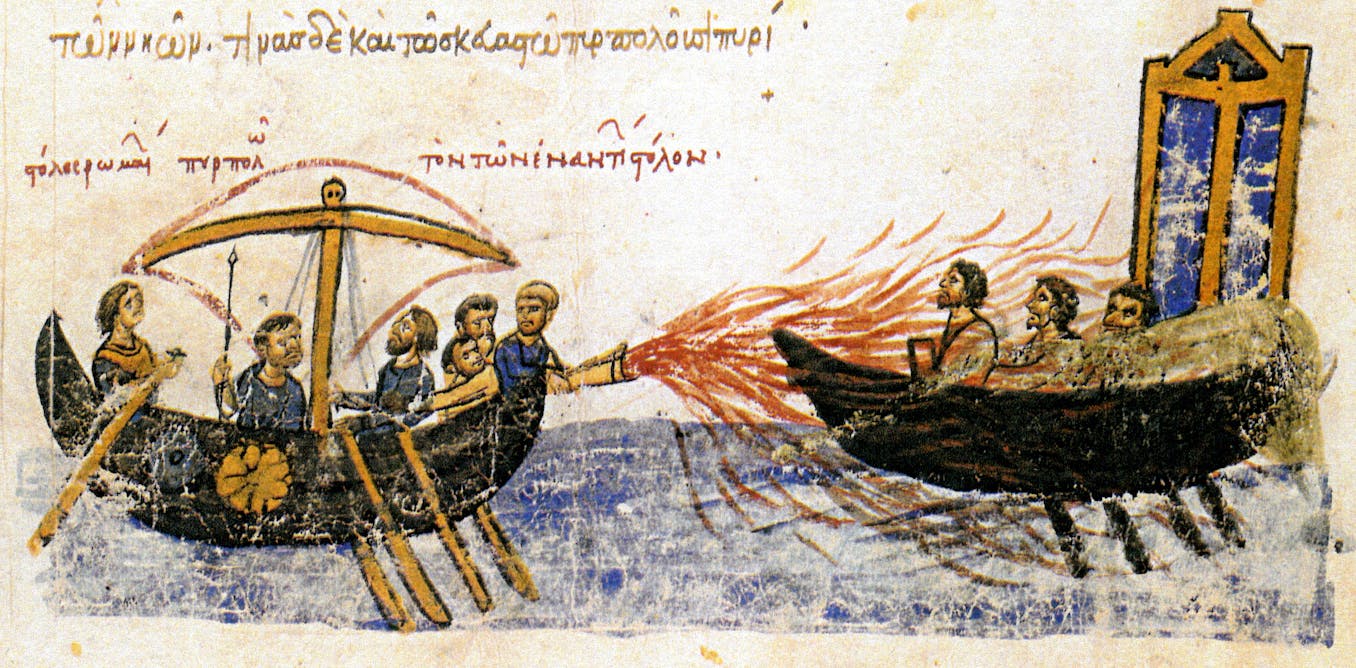
Before modern weapons of mass destruction, there was Greek fire (ignis graecus). This was the term medieval Crusaders applied to Byzantine (Eastern Roman) incendiary weapons famously used in naval combat in the Eastern Mediterranean from around 673 CE to at least the 1180s. So secret was the recipe for Greek fire that it died with the Byzantine Empire, which fell to the Ottoman Empire in May 1453. Since then, many alchemists, historians, chemists and experimental archaeologists have tried to work out the long-lost recipe of this Byzantine super-weapon. So, what do we actually know about this secret super-weapon? How to use a secret weapon Greek fire was a combustible liquid, sprayed onto enemy fleets through a brass or bronze tube (siphōn) mounted on the bows of Byzantine ships. The liquid stuck to the surface of whatever it was sprayed on, including water, and couldn’t be extinguished. This Byzantine-era napalm gave their fleets a major tactical advantage over enemy vessels. In the 7th century, the naval prowess of the rising Arab power presented new challenges for the Byzantine Empire. Arab seamanship and technology – including the lateen sail, a triangular sail on a long yard that allowed ships to sail closer to the wind and thus be more manoeuvrable – proved a considerable threat. It was in this context that Greek fire came to the fore. Byzantine emperors were always keen to showcase access to divinely-inspired technologies that sustained their cultural and political dominance. One source comes to us via Theophanes the Confessor, a monk and chronicler writing in the early ninth century. He reports that the weapon was invented by Kallinikos, a Jewish architect from Heliopolis in Syria, who had been driven from his home by Muslim forces. The new weapon, which Theophanes calls “sea fire”, was used successfully to destroy the Arab ships blockading Constantinople, the Byzantine imperial capital, during the Battle of Cyzicus (around 673 CE). Emperor Constantine VII Porphyrogenitus, who warned foreigners against seeking to learn the secret recipe of Greek fire. Wikimedia/Woofer The “sea fire” caused the Arab ships to catch fire; the entire crew of these ships perished. However, Theophanes oddly writes that Byzantine warships equipped with a siphōn were already available in 671–672. In other words, Kallinikos may have merely improved the weapon. Greek fire was also used against those desiring to usurp the Byzantine throne, like the rebel Thomas the Slav. An army officer of Slavic origin from the Pontus region (now in modern Turkey), Thomas’ naval forces were defeated by the Byzantine emperor Michael II in 821 CE. In his imperial policy manual, Byzantine Emperor Constantine VII Porphyrogenitus, who reigned from 913 to 959 CE, warns foreigners about seeking to learn the secret recipe of Greek fire. Chapter 13 of his manual says: This too was revealed and taught by God through an angel to the great and holy Constantine, the first Christian emperor […] it should be manufactured among the Christians only and in the city ruled by them, and nowhere else at all, nor should it be sent nor taught to any other nation whatsoever. When a military governor betrayed the secret, the emperor reported God punished the traitor as he was about to enter the holy church of God, fire came down out of heaven and devoured and consumed him utterly. Used against Vikings and Normans In the 11th century, the Viking leader Ingvar the Far-Travelled encountered Byzantine ships armed with Greek fire weaponry. The Viking saga recording this encounter relates that the substance was heated over a furnace before a brass tube emitted the flames with a terrible roar. What this description omits is that a pump would have been used to pressurise the combustible liquid. Modern historians assume a naked flame would have been placed before the siphōn, igniting the pent-up material when released by a valve. One of the last documented naval uses of Greek fire, recorded by Byzantine princess Anna Komnene in her text Alexiad, was against a fleet of the Republic of Pisa (centred on the city of Pisa in Tuscany, Italy) in 1099 near the Greek island of Rhodes. She writes that the siphōn of each ship had a gilded head of a wild animal, such as a lion, so the fire passed through its mouth – adding to the terror experienced by the empire’s enemies. Anna Komnene also records the use of Greek fire against the Normans on land in 1108. The Normans, who were descended from Norse Vikings who had settled in northern France and the local Frankish population, had by that time expanded their reach into the Mediterranean world. A lost recipe To this day, we are unsure of the precise ingredients used to make Greek fire. A 2002 attempt to replicate it, led by Byzantine historian John Haldon, settled on the use of a special kind of crude oil only found in the region between the Black Sea and the Caspian Sea – then part of Byzantine territory. This oil is light and low in viscosity but readily combustible – perfect for use in a flame-throwing device. This might have been mixed with pine resin or pine oil, which is sticky but also highly flammable. The legacy of Greek fire Despite its undeniable success, use of Greek fire declined over the centuries. Either the “secret” of the technology used to propel the flame was eventually lost, or the source of the crude oil passed beyond Byzantine control as the empire dwindled. Regardless, Greek fire left a considerable cultural mark. The subject of myth and much speculation, it resurfaced as “wildfire” in George R.R. Martin’s fantasy novels, adapted into the show Game of Thrones. In this world, “wildfire” was also a heavily-guarded state secret and could burn on water. Through this, the horror and almost mythical power of Greek fire was introduced to a new generation.
Greek fire was the most devastating weapon in the Eastern Roman empire. But what was it?
Full Article
📰 Original Source
Read full article at Theconversation →KhanList aggregates and links to publicly available news content. We do not host full articles from third-party sources. Always verify important information with original sources.