
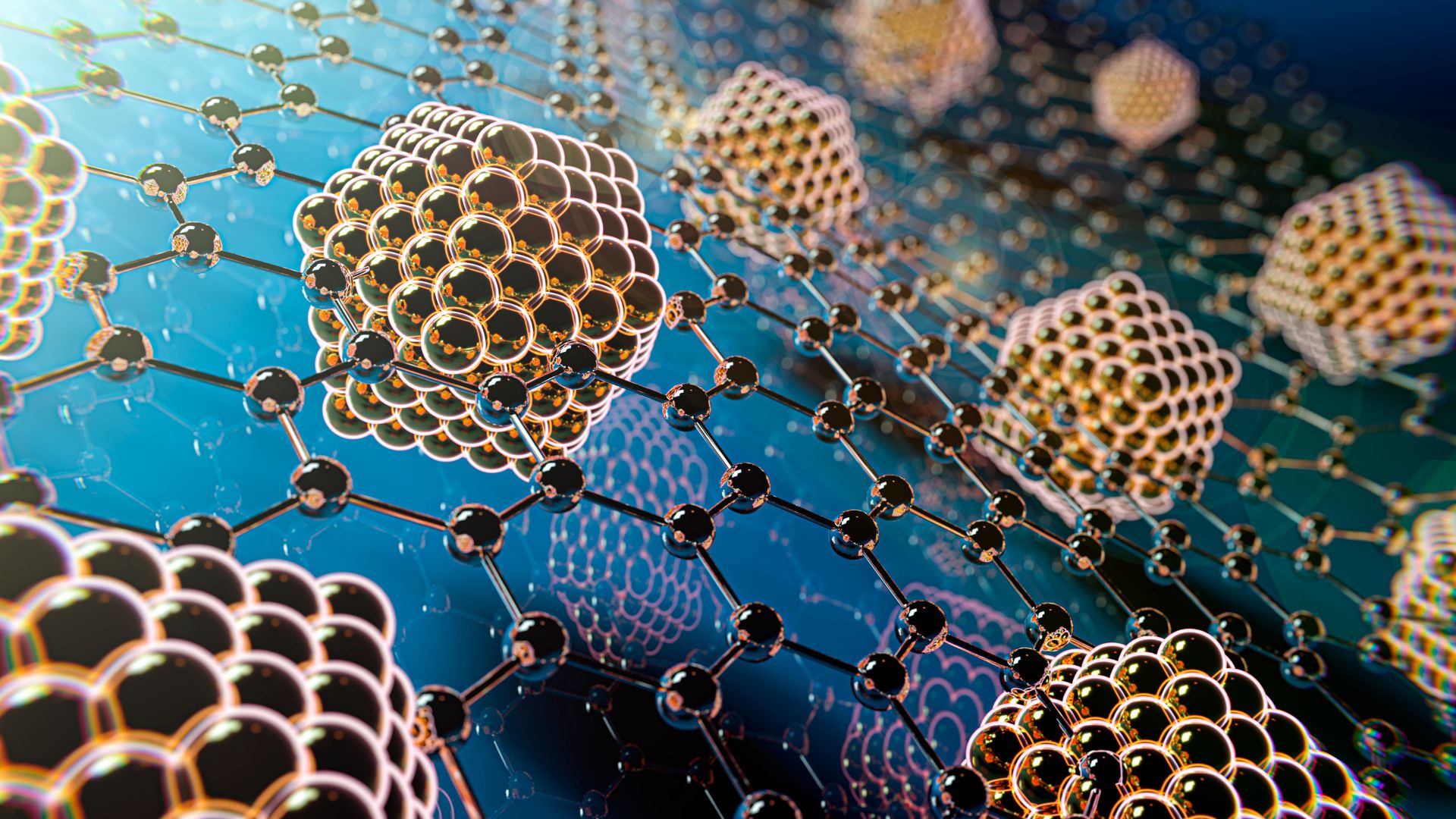
Researchers have completely switched off superconductivity in magic-angle graphene by weakening interactions between electrons, providing strong evidence that those interactions are central to the unusual phenomenon. The result comes from a new device built by scientists at The University of Manchester’s National Graphene Institute and collaborators. It allowed the team to control electron interactions in magic-angle twisted bilayer graphene more precisely than earlier experiments. Magic-angle graphene is made by stacking two graphene sheets with a tiny rotational offset of about 1.1 degrees. At this angle, the material can develop unusual electronic states, including superconductivity. But scientists have debated what causes electrons to pair up and produce the effect. One possibility is a conventional mechanism in which vibrations of the material’s atomic lattice help electrons form pairs. Another points to interactions between the electrons themselves. The new experiment tested those competing ideas by deliberately weakening the electron interactions. Screening electrons at nanoscale The researchers built a structure containing two twisted graphene bilayers separated by less than a nanometre. The two bilayers remained electronically separate, allowing one to act as a tunable screening layer for the other. By increasing the carrier density in the neighbouring graphene bilayer, the team progressively weakened the Coulomb interactions between electrons in the magic-angle graphene. The superconductivity weakened with the screening and was eventually completely suppressed. The effect was also seen in another important state of magic-angle graphene. The correlated insulating state disappeared under the same conditions, while measurements showed that the superconducting critical temperature could fall by more than an order of magnitude. The researchers achieved this control over electron interactions at distances as short as 0.3 nanometres. The extremely small separation between the two graphene systems allowed the screening effect to be much stronger than in earlier experiments.“When we switched on the screening, we were surprised to find that superconductivity was completely suppressed. This provides clear experimental evidence that superconductivity in this system originates from strong electron-electron interactions,” said Professor Alexey Berdyugin from the National University of Singapore, the corresponding author. Narrowing the superconductivity mystery The result also helps rule out a simple conventional explanation. If superconductivity in magic-angle graphene were primarily driven by phonons, or vibrations of the atomic lattice, weakening Coulomb interactions would be expected to leave the effect largely unchanged or even strengthen it slightly. Instead, the experiment produced the opposite result. Screening the electron interactions weakened and ultimately eliminated superconductivity, supporting an unconventional mechanism for electron pairing. The researchers stress that the experiment does not identify one definitive pairing mechanism. Several theories involving collective electronic interactions remain possible. However, the findings place tighter limits on explanations for superconductivity in magic-angle graphene. The work could also help researchers study other materials where strong electron interactions are thought to play a role, including high-temperature superconductors. “Personally, I am interested only in high-temperature superconductivity – preferably at room temperature or above. This study was done at temperatures so low that even helium turns liquid. But unless we understand what makes superconductivity work, we are unlikely ever to reach room-temperature superconductivity, let alone make this remarkable phenomenon commercially useful. Our study takes only a tiny step – but still a step – in that direction, helping to nail down the mechanism of exotic superconductivity in graphene. Rome was not built in a day,” said Professor Sir Andre Geim. The study was published in Physical Review X. Get the latest in engineering, tech, space & science - delivered daily to your inbox.With over a decade-long career in journalism, Neetika Walter has worked with The Economic Times, ANI, and Hindustan Times, covering politics, business, technology, and the clean energy sector. Passionate about contemporary culture, books, poetry, and storytelling, she brings depth and insight to her writing. When she isn’t chasing stories, she’s likely lost in a book or enjoying the company of her dogs.
Graphene superconductivity switched off, showing electron interactions drive it
Full Article
Original Source
Read the full article at Interestingengineering →KhanList aggregates and links to publicly available news content. We do not host full articles from third-party sources. Always verify important information with original sources.