
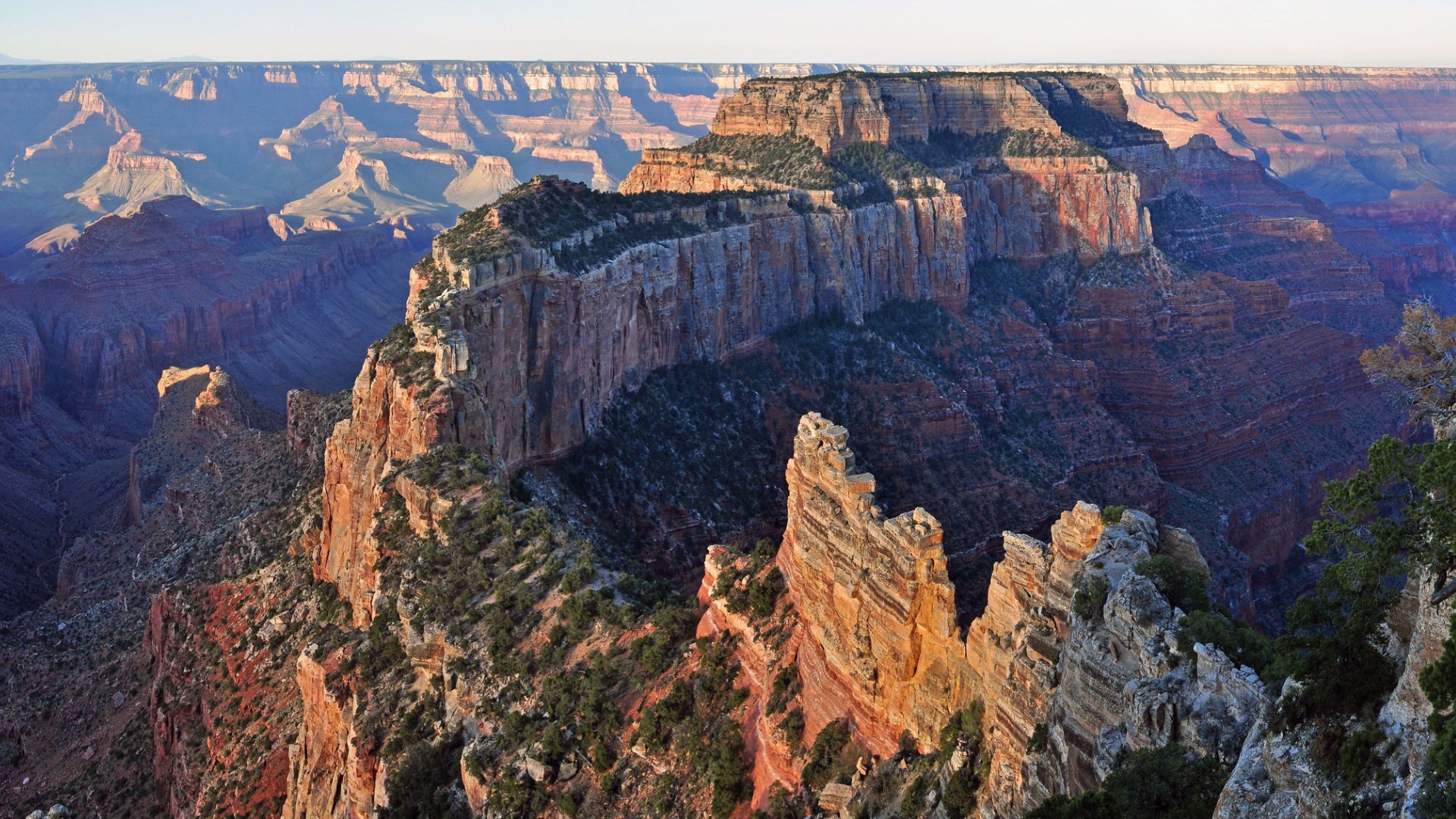
Scientists may have uncovered evidence of a colossal ancient cliff that stretched across much of North America and helped expose rocks now visible deep inside the Grand Canyon hundreds of millions of years before the modern canyon formed. The proposed geological feature, dubbed the “Great Escarpment of Laurentia,” may have stood roughly 1 kilometer high and stretched for thousands of kilometers across what is now the United States. According to a new study published in Geology, the massive escarpment formed around 800 million to 750 million years ago as the ancient supercontinent Rodinia began to break apart. The researchers argue that the enormous cliff system triggered prolonged erosion that stripped away vast amounts of rock and helped expose some of North America’s oldest geological formations. The findings could also offer a new explanation for one of the Grand Canyon’s biggest geological mysteries: the Great Unconformity, a vast gap in the rock record where more than a billion years of geological history is missing. A continent-scale cliff The research team, led by University of Southampton Earth scientist Thomas Gernon, combined plate tectonic reconstructions with landscape evolution models to investigate how western North America changed during the breakup of Rodinia. Their reconstruction suggests that the Grand Canyon region once sat near an ancient continental margin in a position comparable to modern great escarpments found in places such as South Africa and Brazil. As this rift-related escarpment formed and gradually retreated inland over tens of millions of years, it may have driven extraordinary levels of erosion. The researchers’ models suggest that areas near the escarpment could have lost as much as 8 kilometers of rock, with erosion decreasing farther away from the ancient cliff. The study says this process would have exposed deep crustal basement rocks, including ancient crystalline formations now visible within the Grand Canyon. The proposed escarpment may have extended across a huge section of ancient Laurentia, the geological core that eventually became much of North America. According to the University of Southampton, the cliff system stretched across regions corresponding to present-day Arizona, Utah, Idaho, Wyoming, Colorado, Texas, Oklahoma, Arkansas, Missouri and Illinois. A clue to the Great Unconformity The Grand Canyon preserves around 2 billion years of Earth history, yet more than half of that geological record is absent across the erosional surface known as the Great Unconformity. Scientists have previously linked this missing rock record to several processes, including tectonic activity associated with supercontinent cycles and ancient glaciation. The new study instead places particular emphasis on a continent-scale rift-flank escarpment formed during Rodinia’s breakup. According to the study, the resulting uplift would have created steep terrain and high ground that could be intensely eroded over long periods. This could help explain why the amount of missing rock associated with the Great Unconformity varies so dramatically across the southwestern United States. Rather than being caused by a single uniform event, the researchers suggest that erosion may have been strongly influenced by the location and evolution of this enormous ancient landscape. The findings also extend beyond the Grand Canyon. The researchers say the ancient escarpment may have influenced river systems, sediment transport and the flooding of continental interiors long before the rapid diversification of complex life during the Cambrian explosion.If correct, the Great Escarpment of Laurentia would represent a long-lost landscape feature that reshaped a significant portion of North America, and left behind clues that can still be read in the rocks of the Grand Canyon today.Get the latest in engineering, tech, space & science - delivered daily to your inbox.Kaif Shaikh is a journalist and writer passionate about turning complex information into clear, impactful stories. His writing covers technology, sustainability, geopolitics, and occasionally fiction. A graduate in Journalism and Mass Communication, his work has appeared in the Times of India and beyond. After a near-fatal experience, Kaif began seeing both stories and silences differently. Outside work, he juggles far too many projects and passions, but always makes time to read, reflect, and hold onto the thread of wonder.
Grand Canyon’s missing billion years may trace back to a giant 1-km cliff
Full Article
Original Source
Read the full article at Interestingengineering →KhanList aggregates and links to publicly available news content. We do not host full articles from third-party sources. Always verify important information with original sources.