
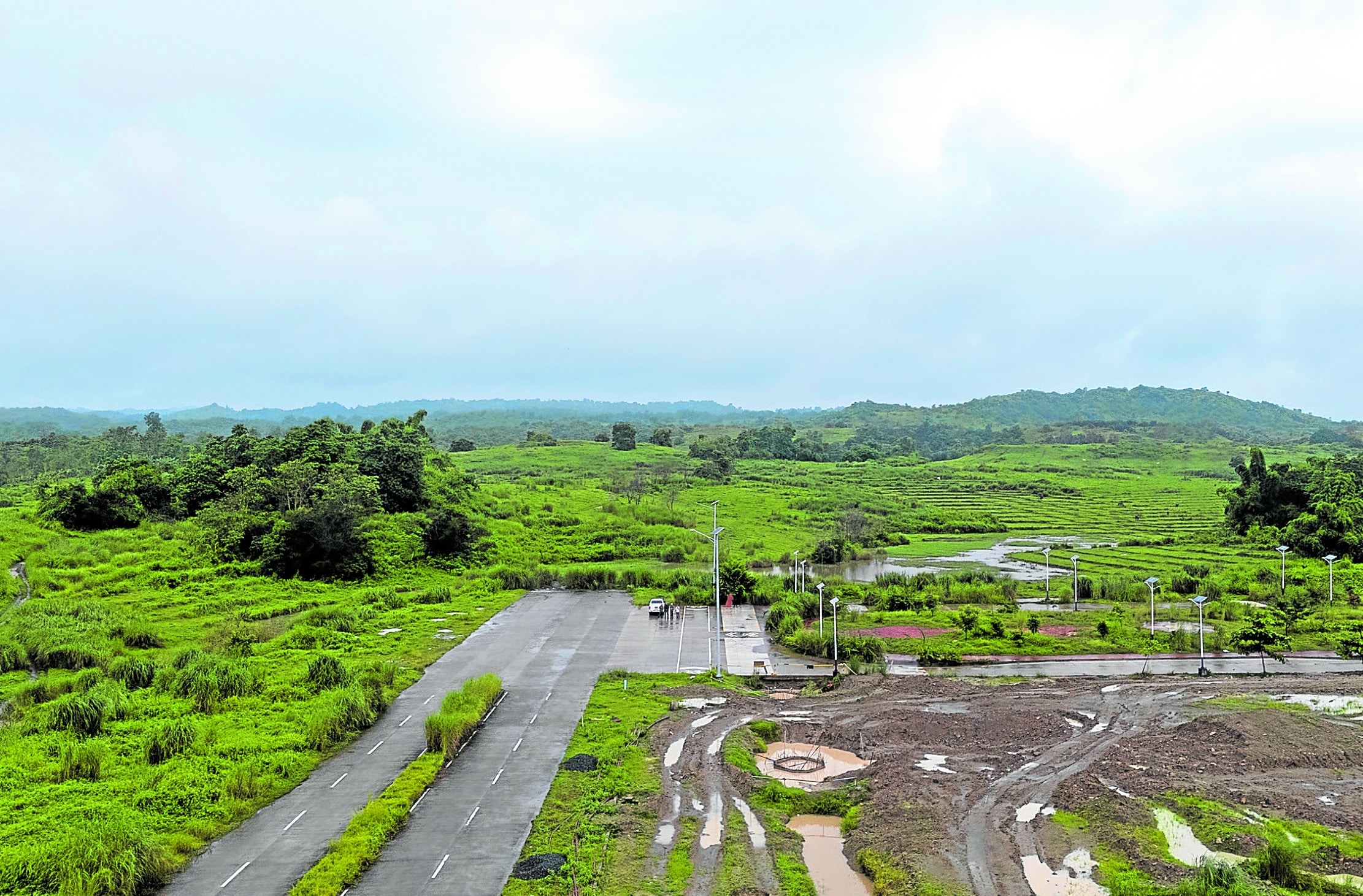
PERFECT LOCATION This photo taken on July 27 shows a portion of the 1,620-hectare site for the proposed industrial hubat New Clark City in Capas, Tarlac, under the United States-led Pax Silica initiative. —Grig C. Montegrande MANILA, Philippines — The government has begun updating the census of communities in Capas, Tarlac, as it seeks to determine “appropriate assistance and safeguards” for residents who may be affected by the proposed industrial zone under the Pax Silica initiative planned for New Clark City in the town. According to the Bases Conversion and Development Authority (BCDA), the agency leading the project, it has started validating the socioeconomic profile of families and residents, including indigenous peoples (IP), in Sitio Sapang Kawayan, which lies within and around the proposed 1,619-hectare hub. This census update is being conducted with the National Commission on Indigenous Peoples (NCIP) and comes as the BCDA moves forward with plans for the Pax Silica hub—which it now calls the “Clark Advanced Manufacturing Park.” Article continues after this advertisement The BCDA, however, did not provide the results of the census update, saying it is still consolidating the final figures with the NCIP. “We want to assure the community that every family receives the exact support, protection, and opportunities they deserve as this vision comes to life,” BCDA president and CEO Joshua Bingcang said in a statement. READ: Protect PH first: Why Pax Silica needs Senate nod to proceed The updated census is intended to establish a more accurate community baseline that would guide safeguards, assistance and other measures for families that may be affected as project preparations advance, the BCDA said. US-led partnership It is only part of a broader process that includes community identification and validation, joint surveys and documentation, review of existing agreements and the eventual processing and release of appropriate assistance. Article continues after this advertisement READ: Pax Silica brings promise – but at what cost? “We are building the foundation of the Clark Advanced Manufacturing Park on a principle of shared progress. True development means no community is left behind,” Bingcang said. Article continues after this advertisement First introduced in April, the controversial artificial intelligence (AI) hub planned for New Clark City aims to establish a physical advanced manufacturing ecosystem that could serve as a platform for the Philippines’ participation in the broader Pax Silica initiative. Pax Silica is the wider, United States-led international partnership focused on building trusted and resilient supply chains for critical minerals, semiconductors, advanced manufacturing and AI infrastructure and logistics. It was launched in December 2025 as a coalition of seven countries—the United States, Australia, Israel, Japan, South Korea, Singapore and the United Kingdom. Since then, more than 30 countries have signed the Pax Silica Declaration, including the Philippines. Last April 17, Trade Undersecretary Ceferino Rodolfo, also the managing head and vice chairperson of the Board of Investments, signed the declaration signifying the Philippines’ joining of Pax Silica. Through this, the US Embassy in Manila said the Philippines and the United States will establish a 4,000-acre, or 1,600-hectare, industrial zone in the Luzon Economic Corridor (LEC) to serve as the “first AI-native industrial acceleration hub under Pax Silica.” The US plans to build an industrial hub in the country as Washington seeks to cut reliance on Chinese technology and supply chains for AI, semiconductors and critical minerals. Consultations The BCDA said it has been holding consultations with Tarlac government officials, members of the clergy, academe and other stakeholders to discuss the proposed Pax Silica hub and gather concerns and priorities from communities in the area. Through these engagements, the BCDA said it seeks to ensure that development planning takes into account not only the project’s economic potential but also the needs of affected communities. The first site tipped to be developed is at New Clark City in Tarlac, projected to attract $40 billion to $70 billion in investments and generate more than 130,000 jobs. Earlier, Bingcang said that over 50 companies—including several trillion-dollar tech firms—had expressed interest in investing in the first Pax Silica site. The BCDA has already signed a memorandum of understanding with a Korean and a Japanese company. He noted that only one or two of the interested firms plan to build data centers, which generate relatively few jobs; the bulk of investment is expected to flow into manufacturing and clean energy. Pax Silica is seen as a boon to the local mining industry as the country is endowed with abundant reserves of copper, nickel, chromite and cobalt. These “critical minerals” could be processed in-country and used in the manufacture of higher value technology products, such as semiconductors at Clark. Bingcang said contract negotiations are expected this year. Opposition The BCDA is aiming to finalize a framework agreement for Pax Silica by November 2026. Bingcang said that if US President Donald Trump visits Manila that month for the 49th Asean Leaders’ Summit, the agreement could be unveiled as one of the major announcements marking the 80th anniversary of Philippines-US relations. Under that timeline, this will be followed by the planning stage in 2027, with construction expected to begin in early 2028. However, Pax Silica continues to face broad domestic opposition over fears of community displacement and environmental, energy, and water risks. Earlier, at a Palace press briefing, Bingcang addressed some concerns raised about the project, including its environmental impact, water supply, IP rights, mining, defense-related use, and legal and regulatory requirements. He clarified that Pax Silica is envisioned as a manufacturing-driven industrial ecosystem rather than a large data center complex, noting that manufacturing offers greater potential for high-quality job creation. Your subscription could not be saved. Please try again. Your subscription has been successful. Bingcang also emphasized that the collaboration among the United States and other countries participating in Pax Silica would be commercial, not military, in character. Thus, as a business engagement, there would be no need for Senate ratification which a bilateral treaty would require. —WITH A REPORT FROM INQUIRER RESEARCH
Gov’t holding census in areas Pax Silica hub may affect
Full Article
Original Source
Read the full article at Newsinfo →KhanList aggregates and links to publicly available news content. We do not host full articles from third-party sources. Always verify important information with original sources.