
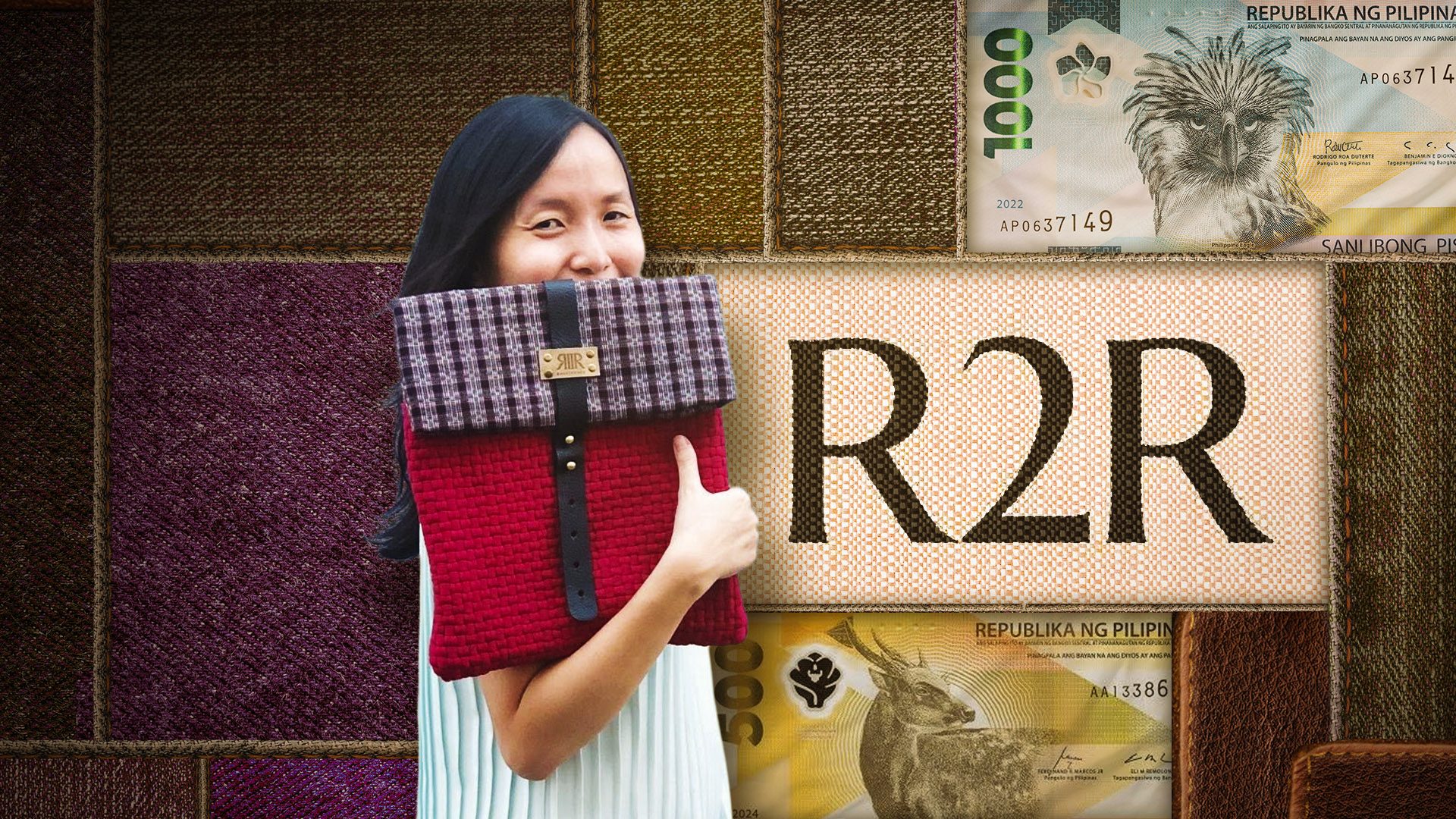
In December 2016, Reese Fernandez-Ruiz stood before the people of Rags2Riches at their Christmas party and told them it might be their last. “I thought we were going to close,” she recalls. “It was a very sad Christmas party.” She chose that night, she says, because nearly everyone would be in one room, and because she wanted them to hear it as soon as she knew. She had just given birth to her first child only a few months earlier and still could not walk straight. Around her were the office team and the artisans from the communities, the weavers whose hands had built the company over nine years. Every sign pointed to closure. What she held on to, privately, was a sliver of hope. Cinderella story In the mid-2000s, Reese found herself in Barangay Payatas, Quezon City as part of an immersion program. This was her initial meeting with some of the community members, particularly women who wove foot rugs out of scrap cloth. These women would work all day to finish ten rugs but would only be able to take home between P12 to P16 due to the long chains of middlemen that controlled the trade. This stuck with Reese. Together with eight other individuals, they returned to Payatas with a business partnership offer for the women weavers. While the idea was noble, they must earn the weavers’ trust. It was quite understandable considering that the community had heard many of the same promises before. Despite this, three artisans agreed to give it a try. Thus, Rags2Riches was born. With a P10,000 donation, the founders hauled scrap cloth straight from factories and sold the rugs at school bazaars. With the middlemen gone, the three women earned far more than before. Word spread and soon enough, the original three artisans grew to 30, then 50, then 100, and by 2013, more than 900 artisans were employed across the areas of Payatas, Tondo, Caloocan, and Sucat. The beginning of Rags2Riches can be categorized as a Cinderella story. “We didn’t start as a fashion brand,” Reese says, “and because we started with communities, we really grew with the communities. The way the artisans would weave the materials before is quite different in form from what you see right now. And we have grown alongside them to get here.” That beginning still shapes how Reese describes the company. To her, that history sets R2R apart from brands that simply buy from artisans. “Our artisans are not just suppliers or a blip in our history,” she says. “They are really part of our identity.” She does not dismiss brands that simply buy from artisans as suppliers. A market of any kind, she says, is better than none. But she wants those relationships to go deeper than commerce, and she would rather bring such brands along than shut them out. “I’d rather be inclusive with everyone so that they can have bridges,” she says, “and then they can walk those bridges and be real partners of the communities.” Partnering with communities, however, also meant making products people would genuinely want to buy. That pulled Reese into a world she knew almost nothing about. “I didn’t have a fashion or design background,” Reese says. “I also didn’t grow up with fashion and design around me. I was frequently on survival mode growing up, so beautiful things were just an afterthought.” Reese understood why people needed food, vegetables and gas. Fashion was different. It runs on personal taste and aesthetics, and on cycles that are hard to read. “It’s quite intimidating,” she admits, “because I didn’t know what people wanted.” Advisers and expansion The founders knew from the start that sympathy would not sustain sales. In fact, they saw rugs being bought only because they were useful, not because the story was moving. To make products people would actually want, the founders sought help. The breakthrough came two months after the company was formed, when the group approached designer Rajo Laurel, who agreed to help and went on to serve as an unpaid adviser. Other leading Filipino designers followed, including Amina Aranaz-Alunan, Oliver Tolentino, Olivia d’Aboville and Kenneth Cobonpue. From rugs, R2R expanded into bags, home pieces and accessories, all built around the signature R2R weave. By 2013, R2R products were sold in Philippine stores and online, and through partners in London and Edinburgh; international sales began that February. More recent collaborations include work with artist Leeroy New and with DoiTung of Thailand, and an upcycling and sewing service with IKEA. Partners abroad took notice. In 2013 and 2014, a grant from the AirAsia Foundation funded artisan training and a push into global markets, producing exclusive R2R x AirAsia collections sold on board its flights. In 2015, R2R became the first organization in Asia, and the first outside the United States and Canada, to receive the women-owned business grant of American fashion brand Eileen Fisher. Reese credits no single study for getting the designs right. Instead, she describes a daily discipline. The design team starts from what the artisans already know how to do. Then it listens closely to the market, especially R2R’s devoted customers, whom the company calls advocates. “They tell us their feedback in very kind ways, so we’re very grateful to them,” she says. “Because of them, we’re able to design and innovate again and again and again until we got to where we are right now.” Today, she says, R2R’s products are always sold out and its pre-order list is very long. “But that wasn’t the case from day one,” she adds. “We had to learn along the way.” Not every lesson came from the market, though. The hardest one came from inside the company. By its ninth year, R2R had won recognition at home and abroad. Its social impact was never in doubt. Its business fundamentals were. Impact, she says, was never the hard part. “What was harder was the business metrics.” Reese says. That gap came to a head at the Christmas party of 2016. When she weighed the company’s chances that December, she saw four or five things that would all have to happen for R2R to survive the coming year. Each one seemed unlikely. She made herself a promise anyway. If they all came through, she would do whatever it took to make the company not just survive, but succeed. Business math All of them came through. “They were so unlikely, but they happened,” she says. “And that was on me now. After that, I was like, okay, now we have to do the work.” The whole team took on that work. Reese, however, knew her own share was personal. She had to face a belief she had carried for years: that she hated math and could never be good at it. “When you’re in business and you say you hate math and you’re not good at it, it’s very dangerous,” she says. “Business has a lot of numbers, and for the longest time, I really didn’t want to go through our numbers.” She is careful about how much blame to take. “That’s not the only reason why we almost closed,” she says, “…but that is the reason that I can be responsible for, like, 100 percent.” She was already in her thirties and believed it was too late to learn. Anything she needed, she thought, she should have learned in school. But she would not waste the chance the company had been given. “So I said, let us try this,” she recalls. “I will have to really learn business math from scratch.” Her method was blunt. She took the financial models built by investment managers R2R had worked with over the years and reverse-engineered them. She went through all of the company’s financials and crunched every figure. “I cried for days because I couldn’t balance [the] balance sheets,” she says. “And then I just practiced and practiced, until before I knew it, I could make financial models in a few minutes.” It is an unusual turnaround story. The company was saved, in part, because its leader agreed to become a different leader. The crisis changed the company as much as it changed its leader. “We realized that if the business is not profitable, if it’s not doing well, we can’t do this for a long time,” Reese says. “And if you can’t do this for a long time, what’s the point? Because this is a livelihood. Livelihood means you have to sustain it every single day, for as long as it is needed.” What kept the impact intact was a choice the founders had made early. Social impact at R2R does not come from a separate program. It comes from how the products are made and who makes them. “Because we have built ourselves in such a way that social impact is a direct result of our operations and supply chain,” she explains, “it didn’t become hard to still have the social impact,” while the company fixed its finances. The system was designed around the people doing the work. Most early artisans were mothers who could not leave home for a full workday. R2R lets them weave assigned parts at home, committing to a set number of hours a day. Finished panels went to a community center for quality checks, then to a workshop for assembly. By 2013, two to three hours of work earned an artisan P350 to P500 a day. That was enough to feed a family and keep children in school, against the P12 to P16 a whole day once paid. Pay was only the start. In partnership with CARD Bank, part of each artisan’s earnings goes straight into a savings account in their own name. For many, the bank passbook was the first they had ever owned. Micro-insurance through CARD’s CaMia covers housing and hospitalization. R2R’s Artisan Academy has run workshops on financial literacy, values formation, family counseling and nutrition, alongside skills and quality training. New artisans train for three to six months before joining production. The numbers have grown with the model. R2R also says it has kept hundreds of tons of textile waste out of landfills by upcycling factory overstock. They also kept track of how well artisans keep their savings, a sign of whether families can plan for the future. Their impact numbers are not kept from the people who produce them. Transparency is built into R2R’s governance. Artisans, suppliers, subcontractors and employees have been represented on R2R’s board. And the Christmas party, once the scene of a near-goodbye, has become the place where Reese reports to the artisans. “They also know our annual reports,” she says. “I report them at every Christmas party. I give them the spreadsheets.” She laughs. “It’s their favorite part. It’s not, but I tell them they’ll enjoy it.” The point, she says, is that the artisans see their work, where it goes, where the whole company is heading, and the impact they are making together. The woman who once avoided the numbers now hands them to the people whose lives depend on them. Where the company is heading, it turns out, is a long way off. Ask Reese about her vision for the next five years, and she pushes back. “For R2R, everything that we do should look at 100 years or more,” she says. The ambition behind that timescale is specific. “I want to build one of the few Philippine heritage brands,” she explains. Around the world, there are brands whose histories stretch back to the 1700s or 1800s. “But in the Philippines, we don’t have a lot of that. And I think having that has the potential to build industries and support more communities.” Philippine heritage A Filipino heritage brand, in R2R’s hands, is built from Filipino heritage itself. Beyond its own weave and upcycled fabric, the company works with indigenous textiles from across the archipelago. These include inabel from Ilocos, such as binakol and pinilian; ikat-based weaves from Ifugao and Kalinga; Mangyan ramit from Mindoro; and T’boli abaca weaves from Lake Sebu in South Cotabato. Some of these textiles were once used as galleon sails or traded as dowries. Many carry patterns that encode wind, waves, mountains and family bonds. Reese worried that younger T’boli were losing interest in weaving, and said R2R hoped to help keep the tradition alive. She also wanted to bring work to rural artisans so they would not have to migrate to the cities. Keeping a heritage alive, though, requires a company that outlives the people who founded it. A century-old company cannot depend on one person, and Reese says so plainly. “Our systems and supply chain are designed in such a way that they already include the artisans,” she explains. “Even if I’m not going to be the president of R2R in the future, if somebody else will be, it’s already in the DNA. It is in the branding, it is in the systems. So it almost doesn’t matter who the leader is,” she adds. “It should be the systems in place. Otherwise, it can’t be a 100-year company if it’s just driven by one person.” The business model, the supply chain and the company policies are all designed so that the artisans are included at every step. Every product, she stresses, is handmade. “It’s not a small collection. It’s not a seasonal collection. It is literally everything we do,” she says. “And we want that to continue for the long haul.” Reese also sees a public role for enterprises like hers. In her 2022 Tatler Asia interview, she argued that grassroots businesses help connect what happens in communities with the policies government designs, and the reverse. In that view, a company that keeps Filipino hands at work and Filipino weaves in use is part of building the nation, not only its economy. Thinking in centuries has also changed how Reese measures her own success. “When I was much younger, it was about, if we reach this milestone, if we get this award, this recognition,” she says. “But we are so far from that right now, because we have been through so much. We have really seen what it takes to build an enterprise to this level. And the goal is 100 years, so short-term success wouldn’t cut it.” There is no longer a finish line. “My definition of success is the race that we’re running,” she says. “Are we still running the race that we wanted to run? Are we on the same path that we wanted to be on from the beginning? Are we still values-aligned? If we are, then we are successful right now.” She admits the idea is not tidy. R2R still chases milestones, and still wants to achieve more. But she also makes room to pause and recognize that the work is good and worth continuing. And she counts the company’s habit of questioning itself as a strength. “As long as we still question what we do, because we still do, and I think that’s healthy,” she says, “…and as long as we know we still have things to do, places to go and things to achieve, I think we are on the path to success, and we are successful.” That same patience shapes the advice she gives to young people who want to change their own communities, drawn from nearly two decades of practice. “Doing good is not a one-time thing,” Reese adds. “It’s a daily thing. It’s a habit. It’s consistency that matters. If you are only going to do good once you have a set of parameters first, then you will never get there. So do it imperfectly, but do it anyway.” To those dreaming of their own social enterprise, she offers a narrower charge. “Do it for the right reasons,” she says. Sustainability does not have to be fully worked out on day one, but the commitment has to be consistent. Choose one path, one advocacy, and grow from there. “If you want to do too many things all at the same time, it’s going to be very difficult, and the chances for success would be lower,” she says. “And we do need to be successful, because we need more of you.” Reese Fernandez-Ruiz, Rags2Riches FB Every sign once pointed to closure. What Reese held on to was a small piece of hope, and a promise to do whatever it took if that hope came through. From a business proposal in Payatas to a fashion house with waiting lists, she learned that doing good only matters if it lasts. Now she continues to build a Filipino brand meant to outlive her. – Rappler.com John Laurence Robes is a part-time lecturer under the Department of Marketing and Advertising, Ramon V. del Rosario College of Business at De La Salle University (DLSU). He completed his undergraduate degree in Bachelor of Arts in Organizational Communications at the University of the Philippines Manila, and his Masters of Marketing Communication from DLSU. Apart from being a part-time lecturer, he is also the Project and Research Assistant for the PHINMA-DLSU Center for Business and Society (PDCBS) and is an i5 Grant Competition for Innovative Pedagogy Awardee by the PRME ASEAN+ Chapter in 2023. Currently, he is pursuing his doctorate under the Doctor of Business Administration program at DLSU.
[Good Business] The Rags2Riches story: Woven to last
Full Article
Original Source
Read the full article at Rappler →KhanList aggregates and links to publicly available news content. We do not host full articles from third-party sources. Always verify important information with original sources.