
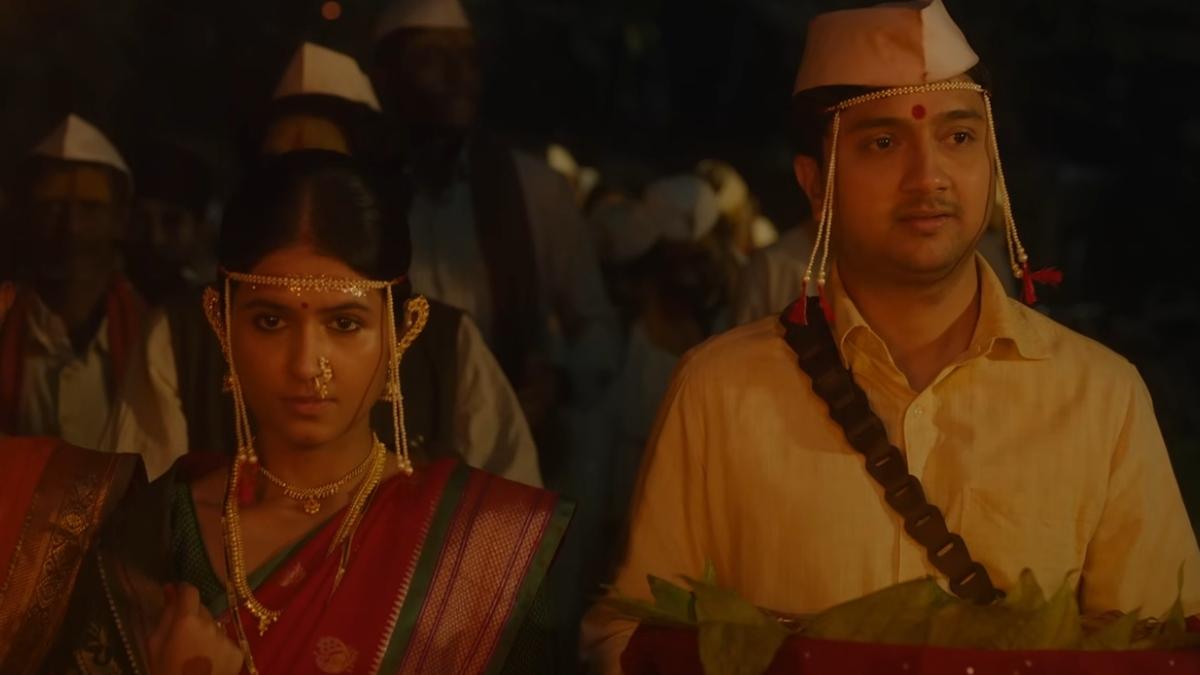
The night is long with no place to belong. There’s the overzealous bloom of an odd couple’s wedding in a quaint village and an underlying doom of everything that could go wrong in the darkness. A hint of that disharmony is apparent right through the opening frame in writer-director Santosh Davakhar’s Marathi feature Gondhal as the veteran ritualist Bhivaba (Kishor Kadam), walks with his grandson, Vishnu, towards the mansion of the newly weds, Suman (Ishita Deshmukh) and Anand (Yogesh Sohoni).With a lantern held by Vishnu being the only source of light and a haunting folk song briskly echoing in distance, the film jumpstarts like an eerie dream. It then unnervingly stretches time to introduce all its characters amidst the traditional ritualistic performance of Gondhal in the relentless single-take sequence extending to 25 minutes. Through it all, one thing is easily apparent: there’s more to this Gondhal than meets the eye. The dichotomy is invoked even in the title, a nod to the rapturous cultural tradition in Maharashtra where a mix of dramatic song and dance performances go on through the night to summon blessings of the local god during a religious ceremony. At the same time, the word is colloquially used to describe occasions of chaos — something that the film stunningly lays out in the complicated internal dynamics between its characters. Each of the characters has a plight of their own. Bhivaba is mourning the disappearance of his son, suspecting foul play at the hands of the oppressive village head, Abasaheb Patil (a menacing Suresh Vishwakarma) and his obedient son Sarjerao Patil (Nishad Bhoir). The latter is smitten by the charms of Suman, who was forced into marriage with Anand, the only character in the film with an extended sense of naivete, and the subject of many a inside jokes among the villagers who question his masculinity.Within this triangular setup, a host of jealousies are invoked, anger is reciprocated and lust holds sway as the night intensifies into eccentricities of the Gondhal.Gondhal (Marathi)Director: Santosh DavakharCast: Ishita Deshmukh, Yogesh Sohoni, Kishor Kadam, Suresh Vishwakarma, Nishad Bhoir, Anuj Prabhu, Vitthal KaleDuration: 120 minutesSynopsis: A traditional ritual for a newly wed couple in a village in Maharashtra takes a fatal turn as internal jealousies and conflicts collideDavakhar’s screenplay is nestled with a Shakespearean capacity to display a rousing interplay of these primary emotions. At its centre is a depiction of versions of masculinities with Sarjerao’s muscular build and testosterone-fuelled passions contrasting with the eternal softness of Anand. A third kind is presented when Sahebrao (Anuj Prabhu) partakes in the Gondhal cross-dressing as a woman. All three of them are related to Suman, who uses Sarjerao’s attraction, makes fun of Anand’s benignness and wants to settle with the love of Sahebrao, while herself being reduced in her agency to make decisions in a perpetually patriarchal setup. A still from ‘Gondhal’ | Photo Credit: Davakhar Films All of threads and internal conflicts are meticulously introduced in the first half and mature through the night alongside the song and dance. The juxtaposition of the folk songs and journeys of the characters progresses seamlessly with Illaiyaraaja’s minimal background score making its presence felt in stray moments of intensity. Davakhar even leaves a small space for critical reflection on the lull created by the Gondhal on the onlookers, which is used for undue means by one of the performers, who brings up the supremacy of God and religion when this ritual is questioned by a member of the audience. There is also a masterful unification between the formal choices and narrative beats. Filmed largely with the use of practical lights emanating from lanterns and fireplaces, Davakhar and cinematographer Amalendu Chaudhary aren’t hesitant in letting scenes unfold in the darkness, as it later becomes a motif in the plot, extending beyond its style and rooting itself in the realism of the story.The incandescent lighting also attaches a historical appeal to the story. It is hard to tell if it is taking place in contemporary times or is set in the distant past, adding a strange circularity to the night. If not for a scene in the third act which shows the year 1851 written atop a house, a dream-like timelessness pervades throughout.The ambiguity prevails even through the earthy dialogues having an unmissable rural sophistication, full of region-specific innuendos, coupled with a heavily accented Marathi spoken by the actors. This leads to an added layer of authenticity to the performances where Kishor Kadam strikes out embodying Bhivaba’s deep-seated emotional turmoil with his usual intrinsic pull. Nishad Bhoir’s stark presence adds steam and fervour to the plot while Ishita Deshmukh’s turn as the playful, cunning bride hits the right notes even as she misses the tone occasionally. The actors largely escape the typicality pervading some Marathi films, going beyond the popular style to revel in a world which also has qualities of a stage play, especially the manner in which characters are framed and made to speak with an instantaneous rigor. It is the punch in the conversations that drive the emotional complexities, making the twists in the tale seem like an outcome of the psychological tension brewing all along.All of it finds a resonance in the Gondhal, with the better part of the second half unfolding like a feverish musical. Davakhar knows exactly when to show what as he goes beyond the tropes of folk cinema storytelling to tell an understated, propulsive story from the countryside. Kishor Kadam in ‘Gondhal’ | Photo Credit: Davakhar Films At the heart of it, Gondhal documents a traditional practise while blending a compelling, cynical tale about the frailties of human emotion. It is technologically sound, thematically rich, culturally vibrant and perennially intelligent in its filmmaking choices. Perhaps that is why it was selected as India’s official entry to the Oscars 2027 after being nearly forgotten when it was released in theatres in December 2025.Regardless of what lies ahead in its Awards journey, Gondhal will remain an achievement merely due to its audacious existence. In the chaos of overstimulated contemporary filmmaking excesses pouncing in layers of sameness, the film strives to differ, making clear that a lantern is all it takes to make sense of the deep, dark night.Gondhal was re-released in theatres on November 13 and is currently running with limited shows
‘Gondhal’ movie review: Santosh Davakhar’s illuminating one-night tragedy
Full Article
Original Source
Read the full article at Thehindu →KhanList aggregates and links to publicly available news content. We do not host full articles from third-party sources. Always verify important information with original sources.