
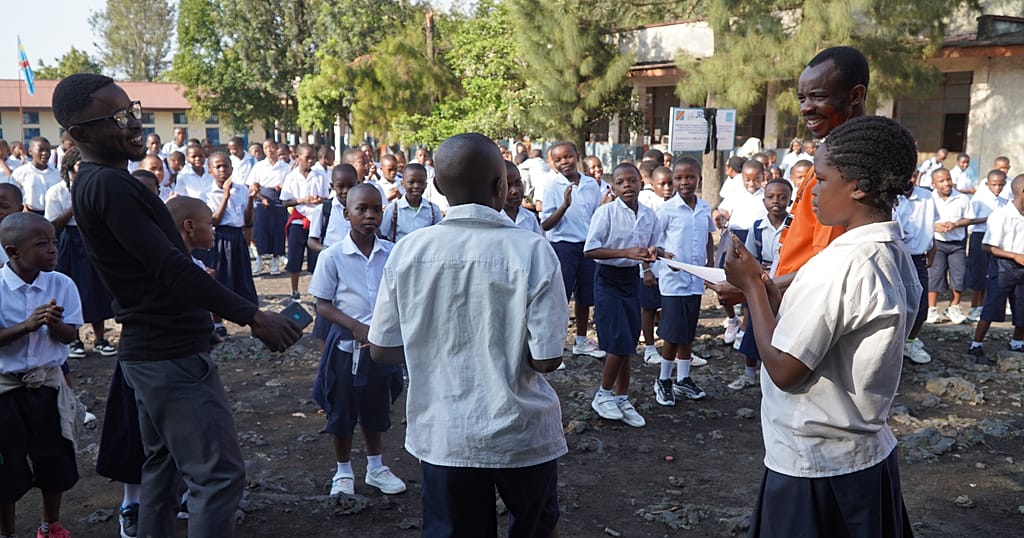
Amid trauma linked to violence, poverty and the threat of Ebola, children in Goma remain particularly vulnerable. A local NGO is trying to provide them with psychosocial support and material assistance. In Goma, in the east of the Democratic Republic of Congo, the consequences of armed conflict continue to weigh heavily on children. For some, violence, displacement and separation from their families have left deep and difficult-to-measure scars. The resurgence of Ebola in the region has added to these challenges. In response, the NGO Samaritan Assistance for Vulnerable People (SAV) is focusing on psychosocial support, education and health awareness. In Goma, the Samaritan Assistance for Vulnerable People NGO organised a solidarity day for children considered particularly vulnerable. School supplies were distributed, along with protective kits against Ebola. The aim was to address some of their essential needs, while also raising awareness of prevention measures against an epidemic affecting several areas in the east of the country. “These orphaned children are human beings, but they are often forgotten during awareness campaigns. We have now prioritised these children so that they can have the same understanding of the Ebola virus,” said Espoir Kikuni, the head of the SAV NGO. But behind the material assistance lies another urgent need: mental health. In the beneficiary schools, the organisation is also running a mental health and psychosocial support programme. The aim is to assist children dealing with trauma linked to conflict, displacement and precarious living conditions. For the NGO, helping these children also means trying to break the cycle of trauma that can be passed from one generation to the next. “Our region has been in this situation for more than 30 years. We really need to focus on investing in these children so that this situation can be brought to an end and does not spread to future generations. That is how we can limit what is known as intergenerational trauma,” said Espoir Kikuni. In the classrooms, teachers are on the front line, witnessing the consequences of this situation. Some pupils struggle to concentrate. Others become more aggressive or withdraw into themselves. According to school officials, these behaviours may be linked to the conditions in which the children are growing up. “They have nothing, and every hour we spend with them here, we can feel the poverty they are experiencing. Psychologically, they are traumatised because they live away from their parents. That is already a serious problem affecting their mental health,” said John Mwamba, principal of EPAIMOG School. For education teams, schools must therefore be more than places of learning. They must also provide children with a sufficiently stable environment to help them regain a sense of security and routine. Nearly two years after the fighting that led to the capture of Goma, the consequences of the conflict remain visible in the daily lives of many children. Poverty, displacement and trauma are now compounded by health concerns linked to Ebola. For charities and education workers, the challenge is to prevent these successive crises from permanently undermining the future of an entire generation. Through psychosocial support, schooling and health awareness, the objective is simple: to help these children gradually regain a more stable environment and rebuild their lives despite the wounds left by years of crisis. Additional sources • Malaika Élysée
Goma’s orphaned children find hope through education and solidarity
Full Article
Original Source
Read the full article at Africanews →KhanList aggregates and links to publicly available news content. We do not host full articles from third-party sources. Always verify important information with original sources.