
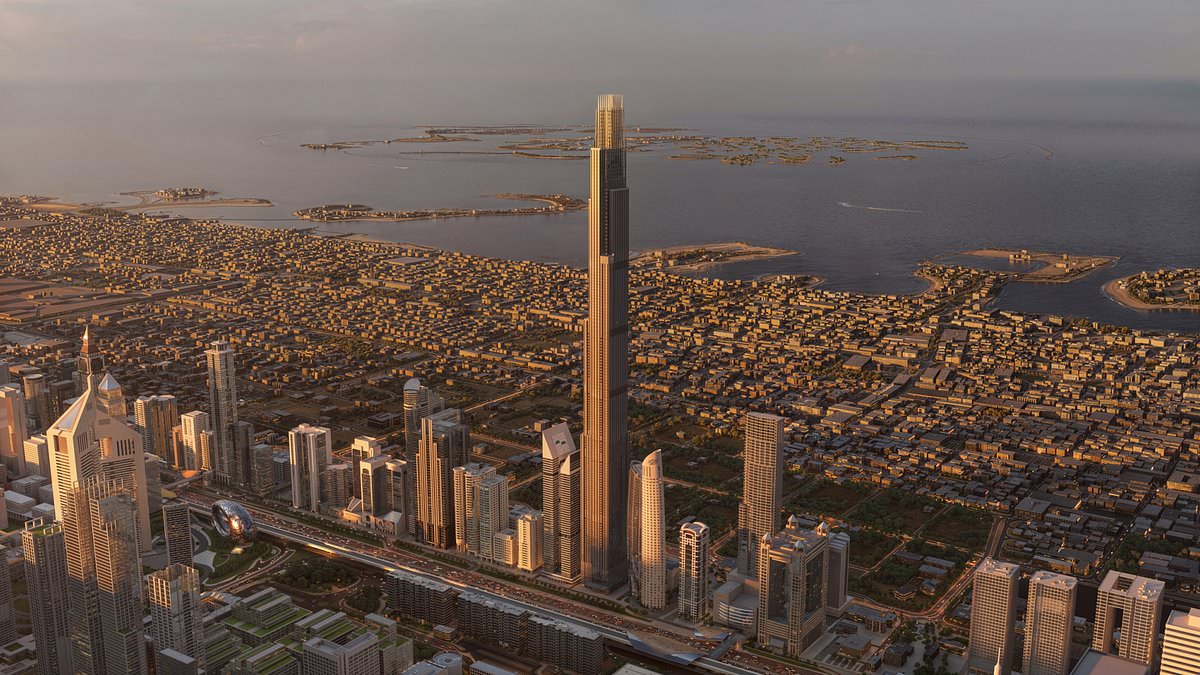
If you think the lift to the top of The Shard is a long ride, spare a thought for future visitors to Dubai's Burj Azizi. The skyscraper will feature a staggering 2,071ft (631.5m) continuous elevator journey – the equivalent of 140 floors – making it one of the longest single lift rides on Earth. KONE, the company behind the technology, says a new generation of AI-powered, lightweight elevators is helping make such record-breaking journeys possible.And it said its design could one day carry passengers more than a kilometre into the sky. ‘What was once considered a futuristic vision for cities is steadily becoming reality, with skylines reaching beyond a kilometre in height,’ Philippe Delorme, President and CEO of KONE, said.‘Multi-use buildings such as the Burj Azizi are leading the way in supertall cities, seamlessly integrating living, working, hospitality, retail, and other services.‘KONE's new high-rise solutions are the answer to our customers’ ever-evolving urban needs and a remarkable milestone for our industry.’ KONE has announced that Dubai’s Burj Azizi skyscraper – set to be one of the world’s tallest once completed – will feature a 2,071ft (631.5m) continuous elevator journey. Pictured: Artist's impression of when the skyscraper is finished KONE said their lifts utilise wireless power transmission, wireless data transfer, AI-powered traffic management systems and ultra-lightweight hoisting ropesWhile skyscrapers have transformed dramatically over the last century, most elevators still rely on the same basic traction principles developed more than 150 years ago.That poses a major problem for architects hoping to push buildings higher into the sky.As towers rise, the steel ropes used to lift elevator cars become increasingly heavier. Eventually their sheer weight becomes a limiting factor, with traditional systems typically topping out at around 1,600ft (500m) of travel.To tackle the problem, KONE has combined a number of advanced technologies including wireless power transmission, wireless data transfer, AI-powered traffic management systems and ultra-lightweight hoisting ropes.The company says the innovations will allow elevators to travel higher than ever before while using less energy and fewer construction materials.Perhaps the most striking development is the removal of heavy travelling cables and governor ropes.In 2013, the company introduced a lightweight hoisting technology called UltraRope. Made of a carbon fibre core surrounded by a unique high-friction coating, it weighs only about a fifth of a similar conventional steel rope.The new system also uses wireless communications and battery-based power, reducing the total weight of a lift installation by around 3,000kg in a building with 984ft (300m) of travel.The wireless approach makes lifts far less vulnerable to the swaying and movement experienced by supertall skyscrapers. Dubai's Burj Azizi is expected to become one of the tallest buildings on Earth. When completed, the tower will feature a single elevator journey measuring 2,000ft (631.5m) The lifts will use artificial intelligence to monitor how people move through a building and automatically improve elevator allocationSeveral of the new systems will be installed in Dubai's Burj Azizi, a 2,378ft (725m) skyscraper currently under development that is expected to become one of the tallest buildings on Earth.The company is also promising lifts that dramatically reduce waiting time.Its latest destination control system uses artificial intelligence to monitor how people move through a building and automatically improve elevator allocation.By learning from passenger behaviour over time, the system can adapt to daily traffic patterns and reduce waiting and travel times.According to KONE, journey times during busy rush-hour periods could be cut by up to 60 per cent.The technology could prove particularly valuable in mixed-use mega-towers, where thousands of residents, office workers, hotel guests and shoppers all compete for lift space.Meanwhile, double-decker elevators could carry more passengers while using fewer shafts, helping developers make better use of expensive floor space.‘By combining patented technologies, advanced engineering and lifecycle expertise, we are helping customers overcome constraints that have traditionally limited vertical construction,’ Pascal Nassour, Senior Vice President of Global Major Projects at KONE said.‘The same solutions that support complex high-rise projects today can help shape the next generation of urban development as more buildings reach past the one-kilometre mark.’
Going up! Dubai skyscraper will feature a 2,000ft continuous elevator journey - with double-decker cars to transport more people
Full Article
Original Source
Read the full article at Dailymail →KhanList aggregates and links to publicly available news content. We do not host full articles from third-party sources. Always verify important information with original sources.