
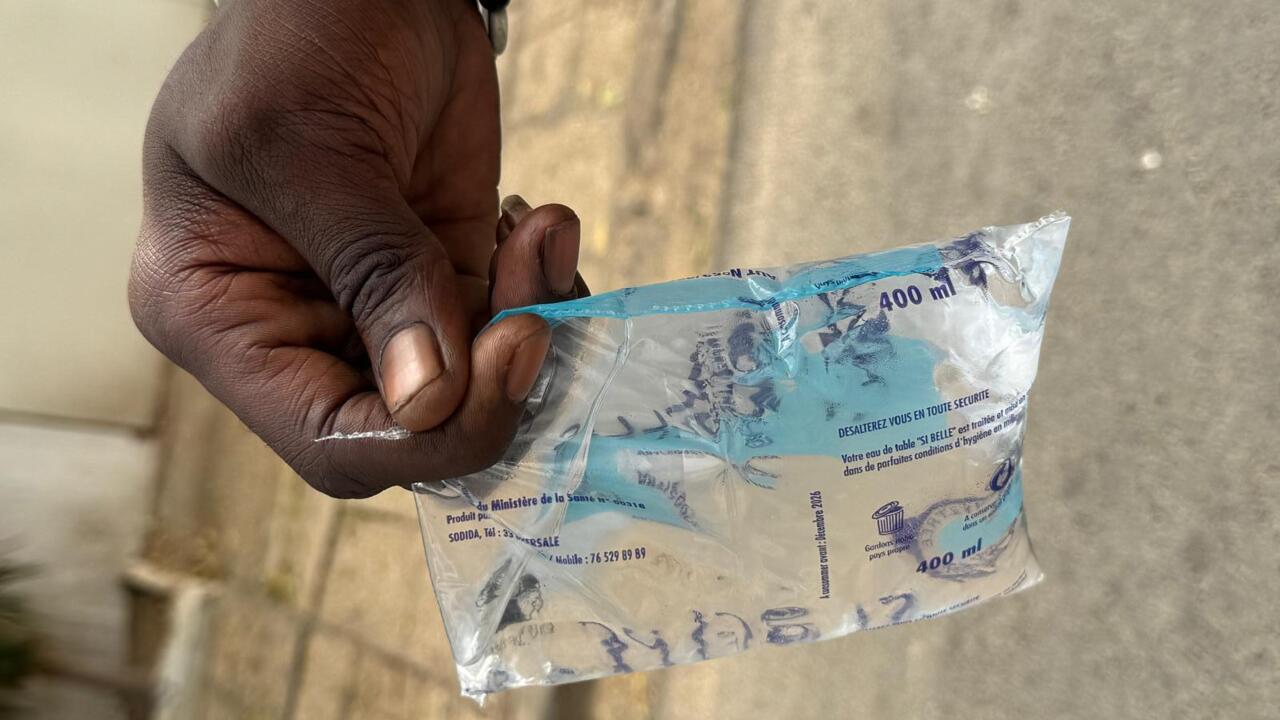
Plastic water sachets are an essential way to provide people in Guinea with safe and affordable drinking water. But their use clashes with the government’s objective of outlawing single-use plastics. Until a solution can be found, authorities have been forced to lift a ban, less than three weeks after implementing it. Issued on: 25/10/2026 - 13:41 4 min Reading time The Republic of Guinea passed its law to ban single-use plastics two years ago, but only enforced it on 20 September. However, in the face of mounting public anger, it was forced to do a U-turn and lifted the ban on 7 October, for the next six months. “To govern is to foresee. The ban was a most reckless decision,” said Emmanuel, who buys water sachets every day in the capital Conakry. “How can you ban the population’s only access to safe drinking water without having provided an alternative solution?" asked Oumou, also from Conakry. “You can’t suddenly go green and make people go thirsty.” RFI also spoke to Faya Blaise, who said he would like government ministers to “come see how life goes in the poorer neighbourhoods”. “They should see how we live and the difficulties we face before making decisions that impact us directly." A water sachet production factory in a suburb of Guinea's capital, Conakry. © RFI/Tangi Bihan Health issues The World Bank describes Guinea as a country with poor infrastructure and widespread poverty, with 3.7 million of its 15.1 million people living on less than $4.20 per day. Emmanuel in Conakry described the lengths he has to go to for safe drinking water, given the expense of buying it bottled. “I pay CFA 3,000 [around €4.50] for a small bottle of water and CFA 500 [€0.75] for a water sachet of 400ml. I decided to collect rainwater and bought a product at the pharmacy to kill the bacteria it might contain and purify it.” Jonas from Dabola, in central Guinea, told RFI that nobody in his small town drinks the tap water provided by the national water company. “It is as filthy as water in a pig’s wallow. It contains bits of clay, and I have to filter it to bathe." Disappointment and anger after world fails to agree plastic pollution treaty Ben Youssouf Keita, a doctor who runs a medical centre in Conakry, told RFI there had been a rise in the number of patients with water-borne diseases after the ban was enforced in September. “A lot of patients were admitted for abdominal pain and diarrhoea. After talking to them, we found out that they have been drinking water from boreholes, or tap water." He welcomed the temporary pause in the ban, saying it could avert cases of typhoid or dysentery, adding: “Meanwhile, the government should launch an awareness campaign on the need to boil water wherever it comes from – rain, river, wells – before drinking it." Lambanyi market in Conakry. © AFP/Sidiki Keita Alternative solutions Following the lifting of the ban, factories producing single-use plastic water sachets have resumed their activities – for the next six months, at least. Abdoulaye Fofana heads a water sachet production plant and is the chairman of the Union of Mineral Water Producers. He told RFI that the sector needs to quickly find environmentally friendly solutions. “We are challenging our suppliers to find biodegradable plastics. In order, hopefully, to set up small companies for collecting and recycling the plastic. That should ensure a healthy, unpolluted environment." Abdoulaye heads up a small industrial sanitation company. He said that bags made of cassava fibre could replace plastic sachets. “It is environmentally friendly because it is biodegradable and takes six months to disintegrate. Cassava is widely consumed in Guinea. This is an alternative that will give work to the farmers,” he said. However, the price of biodegradable sachets is far higher than that of plastic sachets. In light of this, Mamady Aminata Touré, an environmental campaigner, is calling on the government to focus its efforts on developing the recycling sector. “There aren’t many companies involved in plastic processing and recycling in Guinea. We need to develop this sector and build confidence in these companies. And that’s where the government has a role to play with incentives and subsidies." For M’Bany Sidibé, head of the Union for the Defence of Consumers in Guinea, the best long-term solution is to develop the national water authority. “It will take at least five to 10 years to get safe, drinking water across the whole of Guinea,” he told RFI. Sidibé warns that in the absence of an alternative that is as cheap as plastic water sachets, they will remain essential.
'Go green and go thirsty': Guinea’s plastic ban clashes with need for safe water
Full Article
Original Source
Read the full article at Rfi →KhanList aggregates and links to publicly available news content. We do not host full articles from third-party sources. Always verify important information with original sources.