
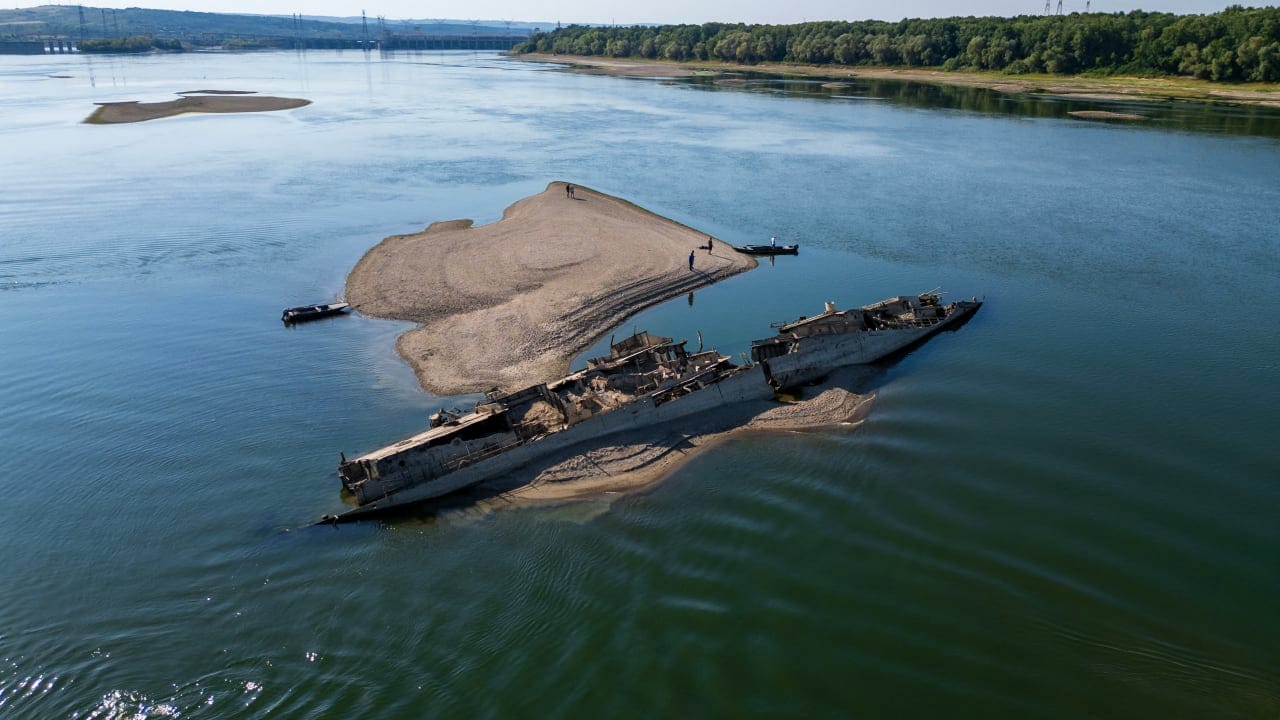
According to the WMO State of Global Water Resources Report, the water cycle has become “erratic and unpredictable” over the past few years.Follow us on GoogleThis aerial photograph shows the wreckage of a World War II German warship, one of dozens sunk by retreating Nazi forces in September 1944, emerging from the low waters of the Danube River near Prahovo, Serbia, on August 11, 2026.(photo credit: Andrej ISAKOVIC / AFP via Getty Images)SEPTEMBER 22, 2026 14:33Rivers around the world in 2025 had one of the driest years in more than three decades, according to a new report from the World Meteorological Organization (WMO).The report provides a comprehensive analysis of the Earth’s water cycle, including river discharge, groundwater, evapotranspiration, land water storage, and snow and ice.Some parts of the cycle are fast, such as precipitation and river flow, which can respond to weather within days or weeks. Other parts of the cycle, like glaciers and seasonal snowpack, are much slower and can take up to decades“Traditionally these slow reserves have acted as the planet's savings account: a buffer that absorbs bad years so that a single drought or a single dry season does not translate directly into a water crisis,” said WMO Secretary-General Celeste Saulo. “We are depleting that savings account.”“Global terrestrial water storage has shown a declining trend since 2014–2016, a persistent, decade-long signal. For the fourth consecutive year, every major glaciated region on Earth lost ice mass.”This aerial photograph shows the melting Rhone Glacier, above Gletsch, in the Swiss Alps, on July 24, 2026. (credit: Fabrice COFFRINI / AFP via Getty Images)“Groundwater tells a similar story,” she said. “Nearly two-thirds of monitored wells worldwide showed conditions outside the historical norm in 2025, and the balance shifted further toward deficit compared with 2024, not toward recovery.”“At the same time, we are seeing more water-related disasters. The strengthening El Niño will increase the risk of drought in some areas, and flooding in others.”River discharge in 2025 lowest in 35 yearsAccording to the WMO State of Global Water Resources Report, the water cycle has become “erratic and unpredictable” over the past few years.River discharge in 2025 was the lowest in 35 years, with below-normal flows across over 36% of the global basin area, the WMO report showed, based on data from 13 global hydrological models.Additionally, the report showed that for the seventh consecutive year, the share of river basins in “normal” condition ranged from 34% to 38%, compared with an average of 46% between 1991 and 2020.The report noted that the total amount of water stored in groundwater, lakes and rivers, soil moisture, vegetation, and ice and snow has been steadily declining since the mid-2010s.It also found that 2025 marked the fourth consecutive year with widespread glacier loss, leading to mass flooding and long-term water insecurity.Between 2023 and 2025, glaciers lost a cumulative 1,400 gigatonnes of water, roughly equivalent to the amount needed to fill about 560 million Olympic-sized swimming pools.Numerous record-breaking natural disasters in past few yearsWMO added that international National Meteorological and Hydrological Services (NMHSs) reported numerous record-breaking floods and droughts over the past few years.The WMO report showed that Asia and Africa together accounted for at least half of all recorded water-related extreme events and more than 80% of reported associated deaths over the past five years.“Water respects no borders. A river basin's water balance depends on what happens in another country,” said Saulo. “A glacier's retreat in one country reshapes water availability for populations hundreds of kilometers downstream.”“This is precisely why we need shared data, shared standards, and shared early warning, the exact function WMO exists to perform.”The Environment and Climate Change portal is produced in cooperation with the Goldman Sonnenfeldt School of Sustainability and Climate Change at Ben-Gurion University of the Negev. The Jerusalem Post maintains all editorial decisions related to the content.Follow us on Google
Global water reserves decline as river discharge falls to 35-year low in 2025, WMO report shows
Full Article
Original Source
Read the full article at Jpost →KhanList aggregates and links to publicly available news content. We do not host full articles from third-party sources. Always verify important information with original sources.