
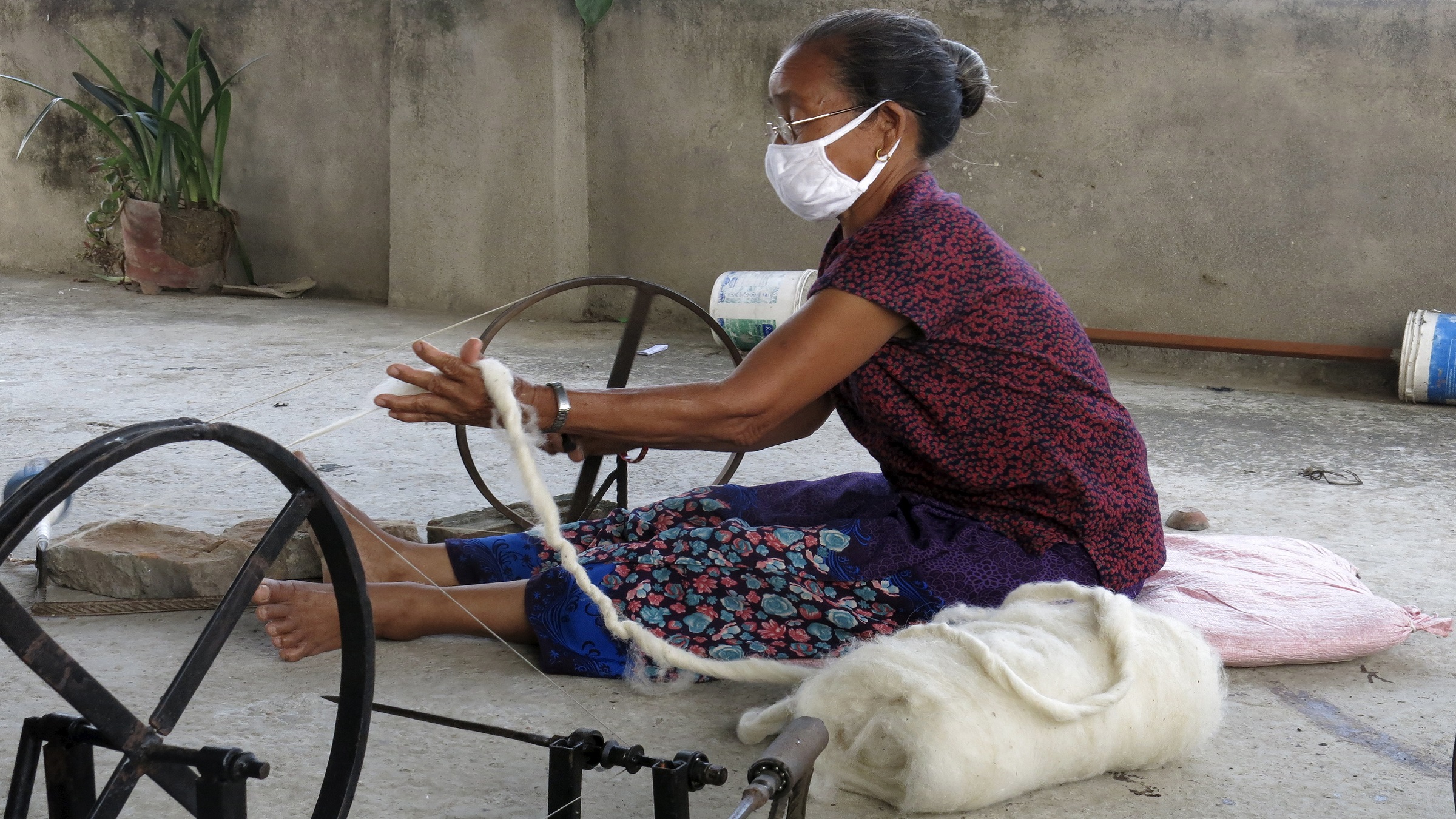
In Naya Padampur, Nepali women are building livelihoods through microenterprises that earn them income and reduce their dependence on forest products.Previously, many women ventured into the forest outside of Naya Padampur to fetch firewood, a dangerous task due to the proximity of wild animals such as rhinos and tigers.Successful women-led microenterprises in Nepal and beyond have provided a symbiosis between land and community, allowing conservation efforts to flourish while acting as a catalyst for women’s empowerment.Still, many women in Nepal face societal and financial hurdles to building businesses and owning property. NAYA PADAMPUR, Nepal — A spinning wheel whirs on a rooftop in Naya Padampur in south-central Nepal, sending ivory strands of yarn through Bin Maya Gurung’s practiced fingers. Smile lines crinkle at the corners of her eyes as she works. Her limbs move in synchrony with the wheel, both integral parts of the machine that ensures her family’s well-being. She’s sitting at the top of a building that houses a wool spinning enterprise, which has blossomed in the years since she learned to spin wool in the early 2000s. It’s one of many women-led microenterprises that have sprouted across the country. The past few decades have seen many women in rural Nepal venture into the business environment for the first time, as governmental regulations and societal norms started to shift. The benefits for women entrepreneurs are significant, with a 2022 study conducted in the Parbat district of Nepal showing that 96% of women involved in microenterprises felt confident in supporting their families with the money they earned. The microenterprises are also important in another way: They provide an alternative source of income to rural families, lessening their reliance on forest products such as timber. Successful women-led microenterprises — in Nepal and elsewhere — have provided a symbiosis between land and community, allowing conservation efforts to flourish while acting as a catalyst for local income generation and women’s empowerment. The growth of these microenterprises in Nepal mirrors a growing global recognition of the benefits of women’s involvement in both forests and enterprise. Many women-led microenterprises harvest non-timber forest products with low impact or even a beneficial impact to forest systems. Others, like the spinning enterprise, lessen a household’s reliance on forest products altogether. But for many Nepali women, social, financial and regulatory hurdles make it an uphill climb to get these businesses off the ground. The sign outside the enterprise headquarters in Naya Padampur. Image courtesy of Nadia White. From the ground up When Gurung arrived in Naya Padampur, her income source became a risky endeavor. Gurung, now 73, had been part of a settlement called Padampur, which was located within the boundaries of what is now Chitwan National Park, home to vulnerable and endangered species such as single-horned Asiatic rhinoceroses (Rhinoceros unicornis), Bengal tigers (Panthera tigris tigris) and gharials (Gavialis gangeticus). In the 1990s, the Nepali government ordered the relocation of Padampur residents to a place outside the park — the place that is now Naya (new) Padampur. Gurung remembers her early days in Naya Padampur well. The area was freshly deforested for the settlement. There were very few resources for the residents, and no irrigation systems for farming. Rhinos came close to their houses and roamed across the area nearby. Gurung’s main source of income for the family at that time was raksi, a traditional Nepali spirit. In order to make the liquor, she was forced to travel into the forest directly outside of the Naya Padampur settlement to fetch firewood, a process made vastly more dangerous because of the proximity of wild animals such as rhinos and tigers. Gurung faced the possibility of wildlife encounters and attacks on these daily trips. Women in rural Nepal still face an elevated risk of wildlife attacks because their daily tasks, such as collecting water and firewood, often take them directly to the forest edge. A 2026 study found that while women made up less than half of the total tiger attacks in Nepal from 2010-24, the fatality rate of wildlife attacks on women exceeded 70%, whereas the fatality rate in men was under 50%. Gurung took that risk every day to bring income home. Bin Maya Gurung sits in the enterprise’s headquarters in Naya Padampur. Image courtesy of Nadia White. At the time of the relocation, there was a general push toward community forestry and community-centric conservation. Nepal passed the Forest Act in 1993, which allowed community forest groups to take over the management of state-owned national forests in their areas. Today, community forest user groups manage around one-third of total forest cover in Nepal, giving agency back to local communities. There were also many NGOs providing training and funding for the development of microenterprises in Nepal’s rural communities. Two examples were the U.N. Development Programme’s Micro Enterprise Development Programme and programs from the National Trust for Nature Conservation in Nepal (NTNC), which sought to increase community involvement in conservation and provide workshops for women focused on business literacy and marketable skills. Around Chitwan, these businesses now focus on everything from elephant grass weaving and soap making to beekeeping and nature guiding. Many of the enterprises utilize non-timber forest products for income, according to a case study by the Climate and Development Knowledge Network (CDKN). These businesses — which can produce eco-friendly products such as bamboo baskets, candles and nettle powder, or products such as coffee and bamboo — can actually benefit the larger ecosystem in many ways, CDKN wrote in their study, as well as stimulating the economy. “Planting of bamboo, coffee, and broom grass on fallow land has supported soil conservation, while the establishment of a permanent tree nursery by a women’s cooperative has helped prevent soil erosion and landslides,” CDKN wrote. Gurung saw a future free from her reality at the time. She knew of the NTNC and other NGO workshops, and she’d seen women engaged in wool spinning in other communities. She thought if she could get a workshop together, she could leave behind the dangers of wildlife encounters on her treks to the forest. So she gathered 25 women and contacted the NTNC. That wool spinning workshop marked the start of Gurung’s business journey, one that has stretched over the past two decades. It’s given her freedom from the risky work she used to undertake and brought a powerful source of revenue to her family. It’s allowed her to finance her grandson’s university education and start three different bank accounts to save up money for her family’s future. And it’s greatly diminished her firewood collecting. During a spinning workshop Gurung was teaching, she mentored Buddhimaya Ghale, who is now the head of the spinning business, which employs 600 women within the Naya Padampur area and another 300 across Nepal. The women involved in the project make anywhere from 8,000-40,000 Nepalese rupees ($52-$263) per month depending on the amount of time they can devote to the handicrafts. The business also offers trainings in wool spinning. When women are involved in microenterprises, their social status changes, Ghale said. They are able to assert themselves as decision-makers in the household because they provide income for the family. As they slowly emerge as business leaders, they are able to assert their independence more freely. Sanjay Chaudhary, co-founder of the Tharu Community Women’s Hand, an organization that provides handicraft and business skills workshops for women in the Indigenous Tharu community in the surrounding Chitwan area, said his wife and sister have both been able to establish themselves as entrepreneurs in the community. They actively voice their opinions in town and at meetings, and it’s led others in the community to perceive them differently. “They’re more empowered, and they started challenging so many social norms, and it’s very good that they’ve started questioning so many conventional narratives,” Chaudhary said. Buddhimaya Ghale sits behind her desk at the enterprise’s headquarters in Naya Padampur. Image courtesy of Nadia White. An uphill climb The stories of successful women entrepreneurs speak for themselves. But despite the economic and social benefits, many women remain on the outskirts. Ghale said the journey into the workplace is not an easy one for women. In many cases, they first need to persuade their families to support their endeavors. Ghale had to strike out on her own to find work for the first time, since her husband did not approve. After their struggles in the home, Chaudhary said women often face increased scrutiny due to Nepal’s traditionally masculine business environment. In the process of securing loans or other necessary steps to starting a business, he said women will often be asked where their husband is, or judged based on whether they have a good family. Another hurdle is property rights, Chaudhary said. Only about 20% of women in rural Nepal own land, according to a 2026 study conducted by the Climate Policy Initiative, which makes providing collateral for the bank extremely difficult. The government has tried multiple strategies to address this, according to Arjun Chapagain, who works as a sustainable forest management coordinator for the Federation of Community Forestry Users Nepal. Nepal’s new Constitution in 2015 granted equal rights to land ownership for men and women. But Chapagain said the reality has yet to catch up with the new policies. “Even [in] that case, the people just keep only their name here, but again, the control is with the man,” Chapagain said. The government has also created specific subsidized loans for women entrepreneurs, Chaudhary said. One example of this is a homeownership loan by Nabil Bank designed specifically for women. But the same study from the Climate Policy Initiative suggests that these loans are still proving elusive for women. According to their report, 88% of the women surveyed in the study relied on personal savings to start their businesses, and only 56% had accessed formal finance. “This broadly reflects the cumulative impact of cumbersome application processes, stringent evaluation criteria, lack of guarantors, limited advisory support, geographic constraints, and gender bias—particularly for smaller enterprises,” the authors wrote. And in order to access business loans, microenterprises must be formally registered. A 2026 World Bank Group report evaluating the benefits of formalization found that for about 78% of informal microenterprises, the costs accrued for formal microenterprises would outweigh the benefits of formalization. The Kathmandu Post reported statistics from the Nepal Department of Industry showing that the rate of new registrations for microenterprises has plummeted nearly 75% in five years. Without scale-specific interventions, the World Bank argues it will be difficult for these enterprises to reach their true growth potential — instead remaining a subsistence income to keep families afloat. A spinning wheel sits on a table inside the enterprise’s headquarters in Naya Padampur. Image courtesy of Nadia White. Enterprise and conservation Yet Chaudhary said prioritizing these enterprises may be the key to getting reluctant communities on board with new environmental regulations. Living in Chitwan’s buffer zones, such as Chaudhary’s home in Sauhara, comes with heavy restrictions on fishing, hunting and collecting firewood. At the moment, he said his community has quite a bit of negative sentiment toward conservation due to those restrictions. “If the park administrations could promote or motivate women for forest-based … enterprises, then that could be the biggest strength,” Chaudhary said. “That could help to make the mindset or narratives positive.” In addition to the societal benefits, enterprises such the elephant grass handicrafts taught at the Tharu Community Women’s Hand use forest resources highly efficiently, Chaudhary said, with minimal impact on the landscape. Instead of chopping timber, the women simply harvest grasses for their handicrafts, and a small amount of grass can go a long way. Their organization also collaborates with local mahouts, or elephant handlers, Chaudbury said. The mahouts harvest elephant grasses for the microenterprise trainings on their regular forest patrols, so women do not need to make the risky journey into the forest. After years of wool spinning, Gurung said she rarely visits the forest. Her livelihood no longer relies on forest products. She can feel her body start to age and slow down, but her work is something she can continue in her old age. Gurung set the spinning wheel in motion. Now her legacy runs through each thread of the group’s handicrafts, and wheels across Nepal will spin long after she is gone. Woven rugs created by the spinning enterprise lean against the wall at the business headquarters in Naya Padampur. Image courtesy of Nadia White. Banner image: Bin Maya Gurung spins wool on the rooftop of the enterprise’s headquarters in Naya Padampur. Image courtesy of Nadia White. This story is published through a collaboration between Mongabay and the University of Montana’s School of Journalism. Students traveled to Nepal in May 2026 to report on wildlife, conservation and other environmental issues. You can read more about the program here. Citations: Gartzia, L., Peña-Legaskue, I., Samsami, M., & Schøtt, T. (2026). The Sustainable Impact of Women Entrepreneurs in Rural Communities. Business & Society. Retrieved from https://journals.sagepub.com/doi/10.1177/00076503261428783 Dhaubhadel, S. (2022). Economic empowerment of women through micro-enterprises: A case study of Parbat district of Nepal. International Research Journal of MMC, 3(4), 1-9. doi:10.3126/irjmmc.v3i4.48852 Dhakal, B. K., Lamichhane, B. R., Kandel, S., Subedi, N., Low, M., & Silwal, T. (2026). Tigers in the neighborhood: Factors associated with fatal tiger attacks in a human‐dominated landscape, Nepal. Ecology and Evolution, 16(8). doi:10.1002/ece3.74206 Credits Topics
Given a chance, women-led microenterprises uplift Nepali communities & conservation
Full Article
Original Source
Read the full article at News →KhanList aggregates and links to publicly available news content. We do not host full articles from third-party sources. Always verify important information with original sources.