
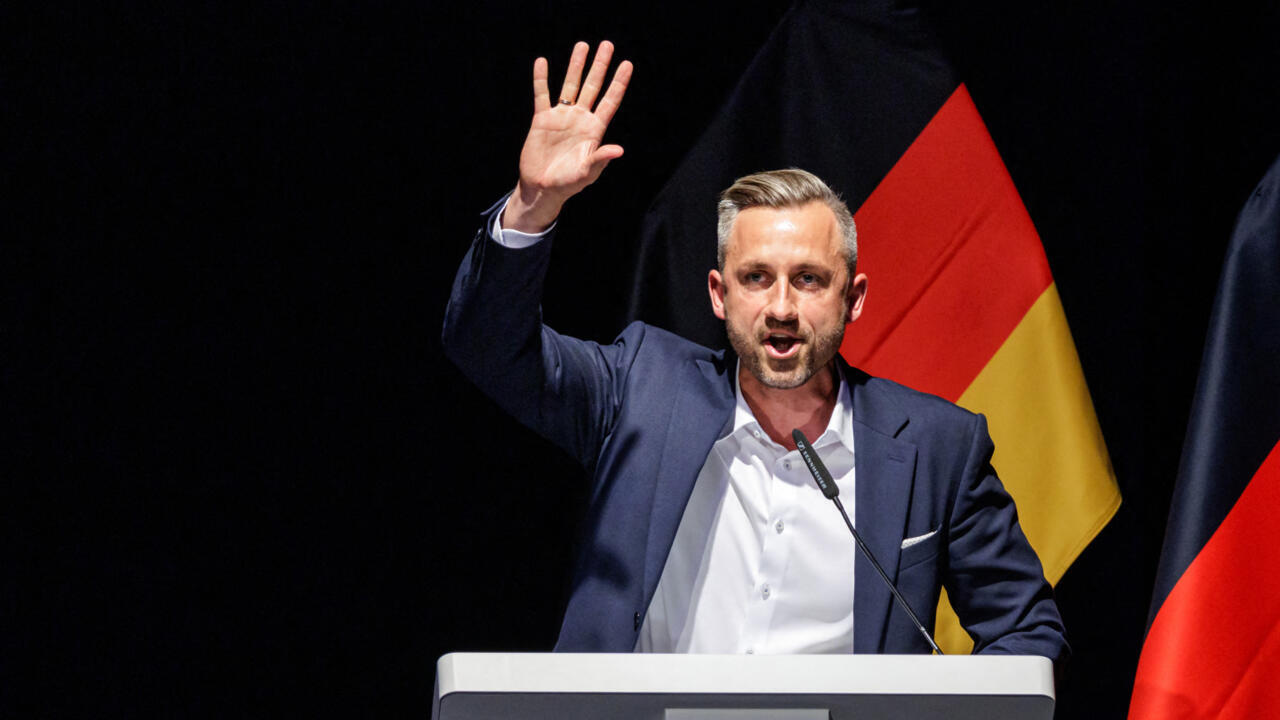
Voters in the eastern German state of Saxony-Anhalt head to the polls on Sunday in an election that could hand the far-right Alternative for Germany (AfD) its biggest political breakthrough yet. Issued on: 06/09/2026 - 10:12 3 min Reading time Opinion polls put the AfD above 40 percent – some 15 to 20 points ahead of Chancellor Friedrich Merz’s conservative Christian Democratic Union (CDU). Ulrich Siegmund, the AfD’s 35-year-old lead candidate, is hoping to become the party’s first state premier. He has spent months campaigning across the largely rural region of former East Germany, drawing crowds to village halls and town squares. “I want my beautiful, old, safe Germany back,” he has told supporters. Germany's anti-immigration AfD elects new leaders amid mass protests Path to power Siegmund rejects the far-right label and presents himself as a more approachable figure than some of the AfD’s harder-line politicians. A prolific social media user, he has built his campaign around immigration, education, energy prices and dissatisfaction with Germany’s political establishment. The German news magazine Der Spiegel recently described him as “Germany’s most dangerous man” – a headline Siegmund embraced as “good advertising”. The AfD has promised tougher immigration rules, including the deportation of undocumented migrants, while calling for closer ties with Russia and challenging Germany’s support for Ukraine. It also wants schools to present what it describes as a more positive view of German history. Migrant centre in Germany feels the heat from rising far right Education concerns Education has become one of the most contentious areas of the campaign. Siegmund has proposed removing teaching linked to inclusion, separating some foreign pupils into different classes and scaling back programmes he considers politically motivated. “Anything to do with political or democratic education should be scaled back, or even scrapped,” secondary school teacher Ulf Klose told RFI in Magdeburg. “At our school, we have a working group called ‘A School Without Racism, A School With Courage’, and that, for example, is something they don’t want. In the AfD’s view, we’re indoctrinating pupils with a certain ideology, but that’s completely absurd. We’re simply passing on values of humanity, solidarity and tolerance.” Universities are also watching closely because regional authorities control substantial parts of their funding. “The German Constitution guarantees us the freedom to teach the sciences, but there is no guarantee that everything we teach at the university will receive sufficient funding from the region,” says Michael Böcher, professor of political science at the University of Magdeburg. “If the AfD comes to power, they have said they would cut funding for the teaching of certain subjects such as gender studies or post-colonialism.” Germany approves factory use for controversial French-Russian nuclear project Eastern discontent Saxony-Anhalt has struggled with population decline and unemployment of around 8 percent, although economists say its economy has performed relatively well over the past decade, helped by investment in logistics, renewable energy and industry. The AfD has nevertheless benefited from persistent dissatisfaction in eastern Germany, where many voters continue to feel they have gained less from reunification than people in the west. The party also increasingly has national ambitions. It won around 20 percent in elections earlier this year in the western states of Baden-Württemberg and Rhineland-Palatinate and sees success in Saxony-Anhalt as a step towards the next federal election in 2029. The result could also affect national politics because Germany’s state governments are represented in the Bundesrat, parliament’s upper chamber, while controlling important areas including education, policing and domestic security. Even if the AfD finishes comfortably first, it may struggle to govern. The other main parties have ruled out cooperation with it, leaving the CDU as the most likely centre of any alternative coalition. An outright AfD majority would allow the party to govern without needing coalition partners. Sunday’s election is “a decision that will set the course for Germany,” outgoing state premier Sven Schulze has said. The result will determine whether the AfD can turn its electoral support into governing power at state level. (with newswires)
Germany’s far-right AfD eyes historic breakthrough in Saxony-Anhalt election
Full Article
Original Source
Read the full article at Rfi →KhanList aggregates and links to publicly available news content. We do not host full articles from third-party sources. Always verify important information with original sources.