
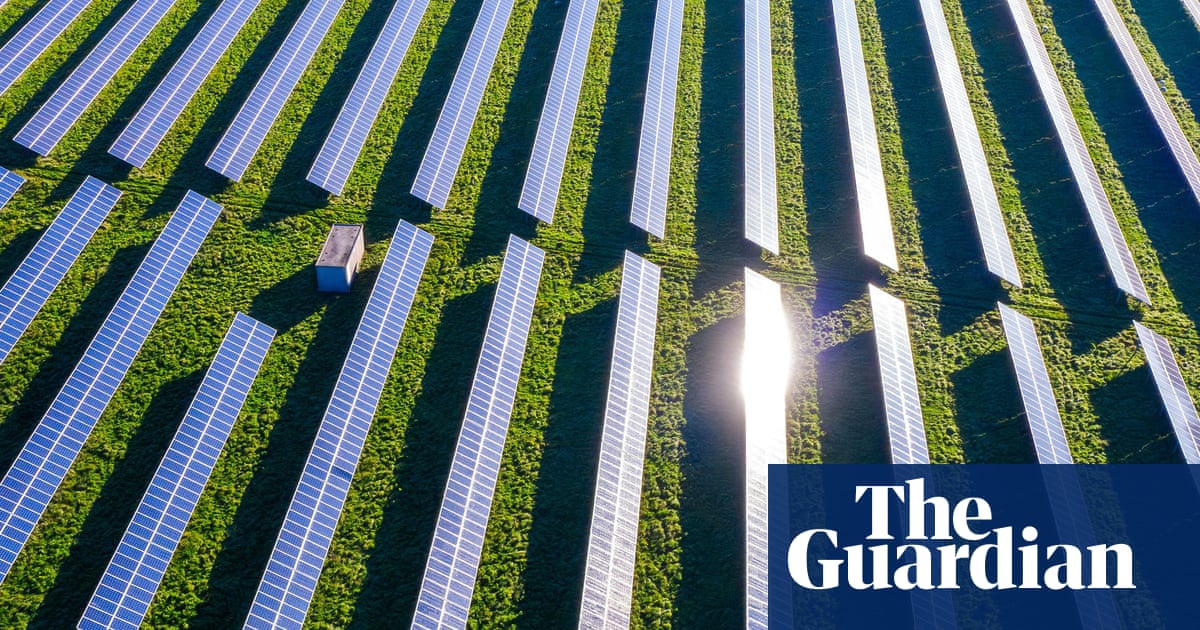
Europe’s biggest economy has committed to phasing out fossil fuels by 2045, despite fierce debate about Germany’s green policies.In a roadmap published on Wednesday, the German government set out for the first time an explicit promise of “transitioning away” from fossil fuels, as previous pledges were only for “carbon neutrality”.The plans include ramping up renewable energy from 55% to 80% of electricity generation by 2030, with an additional 12GW of onshore wind, and a target of 215GW of solar energy by 2030. The previously stated target of winding down coal use in the next decade, with a view to an exit from coal in 2038 was also reaffirmed, with the potential for an earlier target of 2035.Emissions of methane, a greenhouse gas 80 times more powerful than carbon dioxide, will be cut by 30% by 2030, in accordance with a global methane pledge signed in 2021.Andreas Sieber, head of global political strategy at 350.org, said the plan marked a “notable shift” in making the phaseout of fossil fuels an explicit policy goal. But he warned that Germany’s ministry for economic affairs and energy was also pushing intensely for greater use of gas.“The economic ministry keeps sabotaging the transition away from fossil fuels,” he said. “This year has shown in the starkest terms that fossil-fuel dependence is a risk for everyone as it exposes households and businesses in Germany and around the world to price shocks, volatility and geopolitical insecurity.”Jennifer Morgan, Germany’s former climate envoy, said the government must put more effort into electrifying transport and heating. “Accelerating the shift from coal, oil and gas to clean renewables will bolster energy independence and insulate consumers from price shocks at a critical moment,” she said. “However, a roadmap is only the starting line. To truly deliver, this strategy must be backed by a faster, more deliberate and just phaseout paired with the rollout of green electrification.”The push for heat pumps to replace gas boilers came under attack from the right-wing of German politics after a heating law was passed in 2023 that would have banned the installation of most oil and gas heating. Alternative für Deutschland made the issue a key campaigning point and forced a watering down of the rules earlier this year, while the party’s co-leader Alice Weidel has described wind turbines as “windmills of shame”. Heat pumps now make up about half of all new domestic heating systems.Germany is the third major developed economy to publish such a roadmap, after France and the Netherlands, after a major international conference in Colombia in April at which all participants promised to set out plans for a full phaseout of fossil fuels.Publication of the roadmap came as nations debated how to expand their currently inadequate efforts to tackle the climate crisis at the UN general assembly in New York. António Guterres, the UN secretary-general, has been a strong advocate of climate action for his 10 years in office, but the end of his term this December has raised fears that his successor may be less firm.The UK has still not published its roadmap to phase out fossil fuels, and will take up the presidency of the G20 group of developed and developing economies in December, for which the climate and the soaring costs of oil and gas are expected to be key issues.
Germany commits for first time to phasing out fossil fuels by 2045
Full Article
Original Source
Read the full article at Theguardian →KhanList aggregates and links to publicly available news content. We do not host full articles from third-party sources. Always verify important information with original sources.