
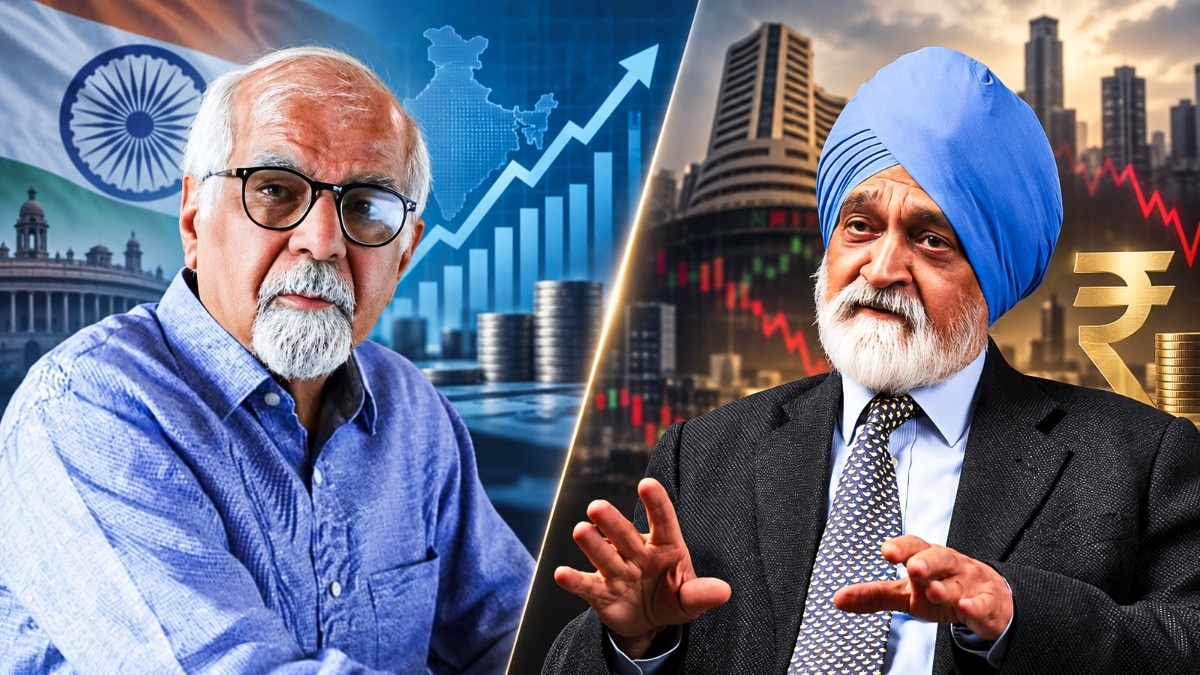
One of the bright spots of the global economy, India posted a stronger-than-expected 7.8% GDP growth for the first quarter of 2026-27 despite global headwinds. Experts have settled the debate over the GDP numbers. However, two of India's best-known economists have expressed doubts that India will be able to become a developed economy by 2047. They say that a much higher rate of growth would be needed to achieve the target.India's Viksit Bharat 2047 vision aims to transform the country into a developed economy by the centenary of its Independence, with higher incomes, better living standards and broad-based economic development. The Viksit Bharat 2047 Vision is the official national policy agenda of the government led by Prime Minister Narendra Modi.Economists Surjit Bhalla and Montek Singh Ahluwalia, while differing on some aspects of India's economic performance in a recent show on India Today TV, arrived at broadly the same conclusion about the government's Viksit Bharat goal. They both believe that India needs a substantially higher and sustained growth trajectory to become a developed economy by 2047."I am still completely of the view that Viksit Bharat by 2047 is not happening," Bhalla, former IMF Executive Director for India, said recently on Rajdeep Sardesai's Roundtable on GDP on India Today TV. Montek Singh Ahluwalia, former deputy chairman of the Planning Commission, was more cautious in his formulation of the 2047 vision, but reached a similar conclusion."If you ask whether we are on track to achieve our long-term objective of Viksit Bharat, the short answer is — not yet," he said, adding, "We need a much higher growth rate in order to do that." The assessment comes even as India's economy recorded 7.8% growth in the latest quarter, a number that triggered a political debate over the reliability of the new GDP series and revisions to earlier data.But the economists' argument is not that the 7.8% figure is fake.In fact, Bhalla, Ahluwalia and economist Neelkanth Mishra — who was also a part of the roundtable on GDP numbers on India Today TV — broadly rejected the claim that India's GDP numbers had been politically manipulated. Mishra is the Executive Director at the World Bank, representing India, Bangladesh, Bhutan, and Sri Lanka.The more important question, according to the economists' assessment, is what the growth number says about India's ability to sustain rapid expansion over the next two decades.7.8% GROWTH RATE IS NOT ENOUGH FOR VIKSIT BHARAT 2047 VISIONSurjit Bhalla said the latest data had changed one part of his earlier assessment because India's investment-to-GDP ratio had risen sharply to around 34%. Bhalla had earlier flagged that FDI in India was in the negative, meaning investments were outbound.But Bhalla said that the improvement hadn't altered his conclusion about 2047. "We would need sustained double-digit growth, and in dollar terms, which is how developed-economy status is ultimately measured, we are not seeing the kind of growth required," he said.A strong quarter is encouraging, but it does not necessarily mean India is growing fast enough over the long term to transform per-capita incomes and living standards.Ahluwalia similarly cautioned against reading too much into a single strong quarter. He had described the economy as more resilient than some pessimistic assessments suggested, but added, "You can't look at these data and say, 'I told you so'."Montek Singh Ahluwalia's broader concern was that India's headline GDP growth does not automatically translate into broad-based economic development."The fact that we are having a reasonably good average growth rate does not confirm that the 'K-shaped phenomenon' isn't relevant," Ahluwalia said. "Some parts of Bharat may be becoming Viksit, but large parts are not benefiting from it," he added.A K-shaped recovery refers to a situation where different sections of the economy recover or grow at sharply different speeds. In India's case, Ahluwalia pointed to disparities between rapidly growing parts of the formal economy and sections involving smaller businesses, informal workers and lower-income households.THE JOBS PROBLEM BEHIND INDIA'S GROWTH NUMBERSEmployment is another reason the 2047 ambition cannot be judged by GDP growth alone, the experts said.Ahluwalia highlighted the difficulty of creating enough jobs, particularly for educated young Indians. He also warned that some of the industries likely to expand rapidly in the coming years, including AI infrastructure and data centres, are relatively capital-intensive and might not generate employment on the scale India needs.Bhalla, however, took a different view of the often-repeated argument that India simply does not have enough jobs."The problem is not that there are no jobs. Salaried jobs are the best jobs available, and they have grown at the fastest rate possible," he said, arguing that salaried employment has been growing at around 4% annually since 2011.Bhalla said the deeper problem is a mismatch between the supply of educated workers and demand for graduate-level employment. The number of educated Indians has expanded faster than the number of jobs requiring their qualifications, he said.For the Viksit Bharat 2047 goal, the challenge is not just to grow the economy, but to ensure that growth creates enough good jobs and raises incomes across the country.INDIA TOOK AN UNUSUAL ROUTE TO GROWTHEconomist Rohit Lamba, an assistant professor of economics at Pennsylvania State University, recently said in a podcast with India Today Digital's sister publication, The Lallantop, that India's economic trajectory has already departed from the conventional path followed by countries such as China and South Korea."The current path of India is not ideal," Lamba said, arguing that the country should aspire to reach at least China's current level of per-capita income as it approaches 2047.India's per-capita GDP was about $2,695 in 2024, against $13,303 in China, according to World Bank data. For developed economies, the figure stood at roughly $53,246 in the UK, and $84,534 in the US.The conventional development model has generally involved moving from agriculture to low-skill manufacturing and then towards high-skill services. China and South Korea compressed that transition over a much shorter period.India, however, largely jumped from an agriculture-heavy economy towards high-skill services without manufacturing becoming the dominant source of either economic value or employment, Lamba said.Lamba described this as an unusual exception in the economic history of the past 200 years.That does not mean manufacturing has no role in India's future. Lamba's argument was that India should be careful about assuming that it can simply recreate China's development path at this stage.WHAT NEEDS TO CHANGE FOR VIKSIT BHARAT 2047 GOAL?For Bhalla and Ahluwalia, the answer lies in moving from general optimism about India's growth potential to concrete economic reforms.Both have argued for greater openness to global trade, lower tariffs and deeper integration with the world economy.Ahluwalia said India should build on its trade agreements with the UK and EU and consider joining the Comprehensive and Progressive Agreement for Trans-Pacific Partnership, while reducing duties on imported inputs and making it easier for medium-sized firms to do business."We ought to be more open than we are," Ahluwalia said. "We should have confidence in our own ability to compete. Any signal that tells Indian industry and the world that we are becoming a more open economy would be very positive," he added.Ahluwalia also argued that India needs to move beyond broad calls for reform. "We need to move from a general call for reforms to a listing of actual reforms," he said.Bhalla also said that India has become more closed to trade even as its potential growth rate has risen.India might be growing rapidly, and the latest data shows an economy more resilient than some had expected.But Bhalla's and Ahluwalia's argument is that rapid growth today is not a proof of developed-country status in two decades from now.For Viksit Bharat 2047, the real test is whether India can sustain a much higher growth rate over a period, create productive jobs, broaden the gains from growth and undertake the reforms needed to raise its long-term economic potential.- EndsPublished By: Anand SinghPublished On: Sep 8, 2026 07:00 IST
GDP numbers good, but not good enough for Viksit Bharat 2047, say top economists
Full Article
Original Source
Read the full article at Indiatoday →KhanList aggregates and links to publicly available news content. We do not host full articles from third-party sources. Always verify important information with original sources.