
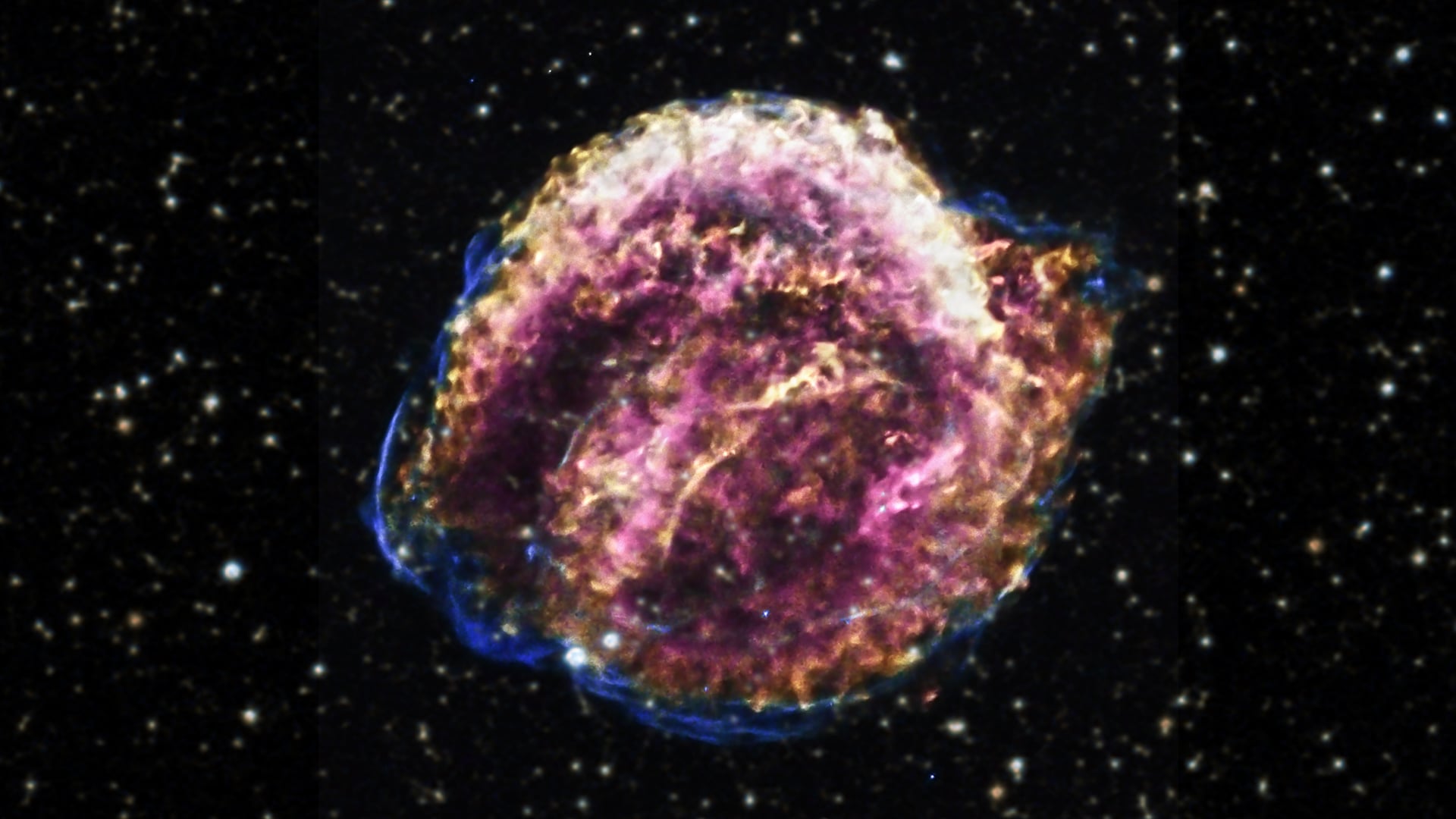
When a meteoroid hits the Moon's surface, it does more than just dig up a little dirt. It actually excavates a little bit of cosmic history that recorded a long-ago supernova explosion. Scientists at the University of Hawaii Institute of Geophysics and Planetology have come up with a way to decode that history and learn something about such energetic events in the Universe. Emily Costello and her team wanted to find a way to let future lunar explorers pick good places for core samples on the Moon. They developed a stochastic model that unscrambles the effects of impact gardening. That's a nearly constant process made by impactors on the Moon. Those events flip, mix, and redistribute the Moon’s regolith over time. Meteorites smashing into the Moon can be as small as a tiny grain of dust to a large asteroid. Because any single lunar core sample is affected by the unique impact history, separating the broader interstellar signals from local variability requires highly sophisticated statistics, which the team's model can help produce. The lunar surface fills the frame in sharp detail, as seen during the Artemis II lunar flyby, while a distant Earth sets in the background. Constant bombardment by meteoroids and bits of asteroids has created a mottled, cratered surface covered by a fine dust called "regolith". Credit: NASA ##Radioactive Remains Record Stellar Destruction When a supermassive star ends as a supernova, the resulting explosion scatters stellar material throughout space. That includes all the materials created in the star's nuclear furnace throughout its lifetime, but also those that are forged during the explosion itself. Included are families of radioactive isotopes of such elements as iron, nickel, zinc, uranium, plutonium, iodine, hafnium, and curium, among others. The material from such events has made its way to the Solar System, where it settled to the bottom of the ocean on Earth and onto the lunar surface. The dust that lands on Earth gets quickly buried on the sea bottom, making the lunar dust a more reliable study medium, according to Costello. “The lunar regolith, however, acts as a long-term cosmic archive that can preserve history spanning 80 to 100 million years or more," she explained. "Understanding the physics of regolith mixing ensures that when future astronauts return deeper cores, we can properly read the scrambled layers to reconstruct the history of our Solar System’s journey through the Galaxy.” A sample of lunar regolith (70050), collected during the Apollo 17 mission. CC BY-SA 3.0 Wknight94 Costello explained the complexity of creating a model to reproduce and predict the results of such impact gardening. "We have to balance a complex web of physical mechanisms, including impact compaction, excavation, radioactive decay, and space weathering, all operating simultaneously within a single elegant continuum model,” she said. “Our mathematical model treats lunar impact gardening as a competition between forces burying the soil and impacts digging it back up. It also accounts for radioactive decay of the star remnants while mapping exactly when and where new stardust was delivered by episodic supernovas.” Modeling the Lunar Samples for Isotopes The team's model was aimed at reproducing what are called "depth-concentration" profiles using Apollo samples from the Moon. Then they compared what they found with timelines of known supernova pulses "felt" on Earth to see how those might line up with model predictions. It turns out that the model can predict the depth concentration profile of the isotope Iron-60 based on the Apollo regolith materials. They also found that the model can predict similar profiles for Plutonium-244, Iodine-129, Hafnium-182, and Curium-247 that get gardened into the lunar regolith over time. “When I first shared my model results, my colleagues were surprised by how well-matched the model and the measurements were,” Costello said. “This level of fidelity between empirical observations and a physics model is exciting and remarkable.” Future Missions to the Moon Could Collect More Data With the upcoming missions to the Moon planned by NASA, the Chinese Space Agency and others, taking samples of lunar dust is an important step. Not only will it help scientists understand the history of the lunar surface, but it will shed new light on the history of the stardust that rains down on the surface each day. “These future samples taken from the moon, when considered in conjunction with our gardening model, could reveal new insights into an untold chapter of supernova history!” Costello shared. “I think it’s beautiful that the remains of past stars can be used to navigate the vast history of our Earth-Moon neighborhood, if we have knowledge of how to read the stardust.” For More Information Lunar Soil Reads as a Cosmic Time Capsule for Exploding Stars Gardening on the Moon: An Advection-Diffusion Model to Guide the Search for Supernova Debris in the Lunar Regolith
Gardening the Moon's Cosmic Archives
Full Article
Original Source
Read the full article at Universetoday →KhanList aggregates and links to publicly available news content. We do not host full articles from third-party sources. Always verify important information with original sources.