
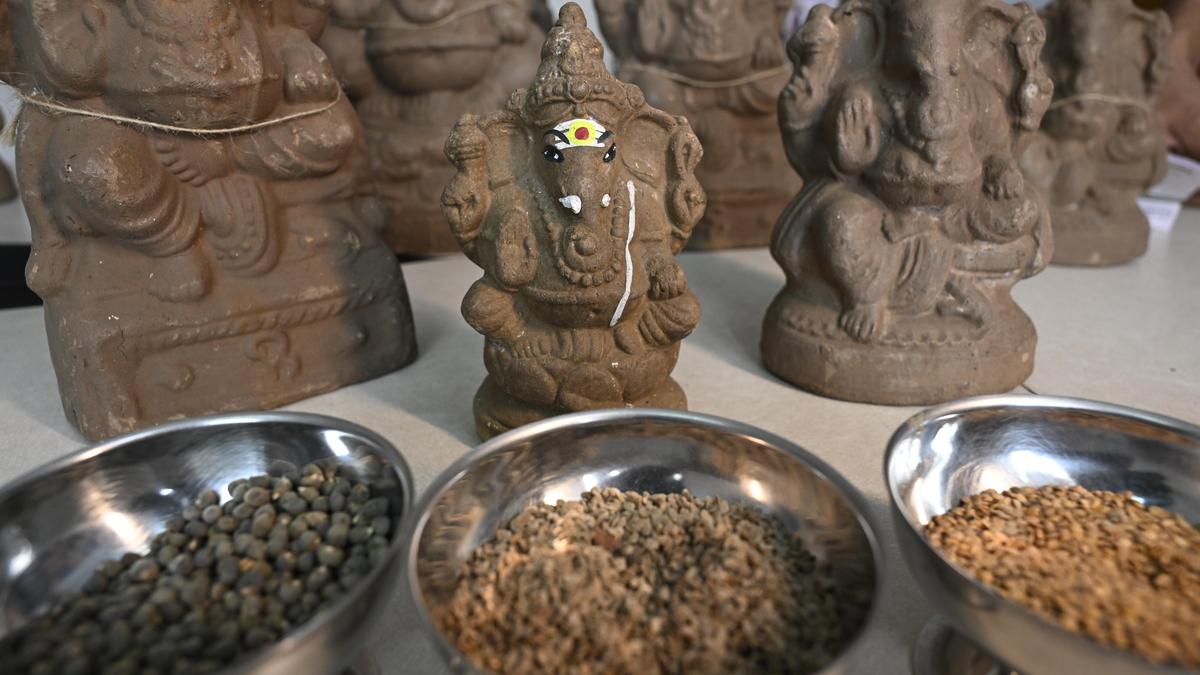
When Swarajit Alakananda was passing by Flower Market around Ganesh Chaturthi in 2017, the colourful clay idols for sale by the roadside made him pause. “They looked beautiful, but I wondered if there was danger lurking behind, as the Tamil proverb goes,” recalls the 32-year-old. Swarajit has always been a Nature lover and was involved in lake clean-ups even back then. “I wondered what the idols might do to our waterbodies once they were submerged,” he says.What if the idols were made of nothing but pure earth? What if they came to life once they touched water? Thus was born the idea of ‘seed Ganesha’, one that took the city by storm in 2017. Swarajit, who runs an NGO called So Aware, worked with potters in places such as Edayarpalayam, Selvapuram, and Sundakkamuthur to come up with eco-friendly variations of Ganesha idols. The best part: they could be submerged at home in a bucket of water and once they dissolved, the vegetable seeds in them sprouted forth. If cared for, they yielded vegetables for the entire family. Swarajit Alakananda is seen with seed Ganesha idols ahead of Ganesh Chaturthi. | Photo Credit: PERIASAMY M Swarajit’s idea was welcomed by consumers and the city corporation alike, and he and his team worked round the clock to deliver the idols themselves. He recalls that the K Vijayakarthikeyan, who served as the Commissioner of the Coimbatore Corporation back then, was especially supportive. “We made idols with two tonnes of clay,” he says. The following year, they set up a distribution network in the city and have been popularising seed Ganeshas ever since. Today, their idols are available at around 15 shops in Coimbatore. So Aware, an NGO in Coimbatore makes clay Ganeshas embedded with vegetable seeds that can sprout once submerged at home. | Photo Credit: PERIASAMY M The making of a seed Ganesha begins with convincing potters to refrain from using harsh chemicals to paint the finished product. Swarajit says that most of them have been following a particular style for years and were at first hesitant to venture into something new. Today though, many of them are embracing the trend. “I work with artisans who are able to offer a nice finish,” says Swarajit, pointing to the features of the Ganesha idols. “Since they cannot be accentuated by paint, they have to be shaped well by hand,” he says. Eco friendly seed Ganeshas in the making in Coimbatore | Photo Credit: PERIASAMY M Once the idols are made and dried in shade for over 30 days, they are ready for the next step. All of them are hollow, and come with a small opening at the back, through which seeds are dropped. For this, Swarajit employs student volunteers from the city. They gather at his office in Ramnagar — he runs a company called Fix Your Gadgets — a few days before the festival to do so. Swarajit Alakananda fills seeds into Ganesha idols | Photo Credit: PERIASAMY M Volunteers drop a pinch of the seeds — there is ladiesfinger, tomato, beans, brinjal, radish, tulsi, and cucumber — into the opening, along with a small pinch of seeds of greens. The team also adds a handful of red soil and manure before sealing the opening with a small amount of clay. The greens, explains Swarajit, go into every idol by default. “This is to remind people to water the plants a few days after the idol is submerged,” he explains. Greens will automatically sprout, signalling the presence of a lifeform inside, in case people forget they exist. The seeds, Swarajit says, are native varieties that he sources from farmers in Thiruvannamalai.“The core philosophy is to send back to the soil what was taken from it,” he says, speaking about the clay that goes into the idols, adding, “Hopefully, reducing substances such as Plaster of Paris from polluting our waterbodies.” Swarajit offers seed Ganeshas ranging from four inches onwards to those as tall as two and a half feet.The taller ones are filled with wheat, rava, corn and aval inside, and can be submerged with a clean conscience in lakes. “The grains will be eaten by fish and birds,” says Swarajit. The initiative is not driven by profit. Swarajit says the idols are priced such that the potters who crafted them get up to 60% of the profit. Even as the city prepares itself for Ganesh Chaturthi, Swarajit is readying seeds and calling for volunteers, who will soon get to work. Ganeshas the colour of earth will start arriving from potter colonies, ready to carry a beating heart that will sprout forth with life. For details, call 9655667775. Visit soaware.org.inIdols with water-based coloursRajavalli Shanmugam Arts’ 40,000 sqft godown is filled with Ganesha idols in various sizes and colours. While the tall idols — those ranging from three and a half to 10 feet — are made of paper mache, the smaller ones are made with clay. “We’ve made 20,000 clay idols this year,” says S Saravana Kumar, who owns the crafts venture in Selvapuram. Ganesh idols at Rajavalli Shanmugam Arts, Selvapuram | Photo Credit: PERIASAMY M Saravana Kumar knows that the chemicals from the paint he uses on the idols can pollute our waterbodies. “Five years ago, I made the switch to water-based paints,” says the 56-year-old, adding that until then, his team used enamel-based paint. “Water-based paints are mainly composed of limestone and hence will not cause much harm to our lakes once the idols are submerged,” he says. Artisans now use water-based colours | Photo Credit: PERIASAMY M Ganesha idols, unlike golu dolls, are not fired at the kiln. “They are made with pachai mann [raw soil] and are painted once they are completely dry,” says Saravana Kumar. He also makes idols that are brown in colour bearing a coating of varnish. Idols made by Rajavalli Shanmugam Arts’ team are available at Poompuhar and Gandhi Sarvodaya Sangh in the city. Saravana Kumar is packing bulk orders for customers as we speak. “I send idols to wholesale dealers in Tiruppur, Mettupalayam, Pollachi and Udumalpet,” he says.For details, call 9894395589
Ganesh idols that grow after immersion
Full Article
Original Source
Read the full article at Thehindu →KhanList aggregates and links to publicly available news content. We do not host full articles from third-party sources. Always verify important information with original sources.