
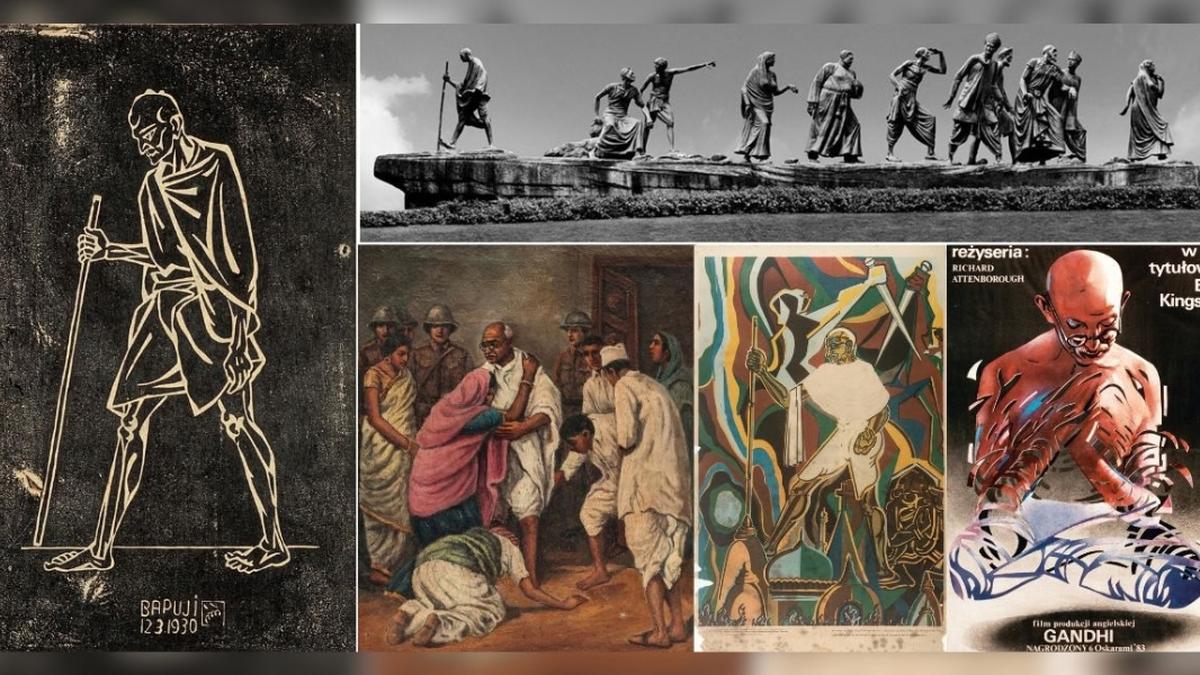
Our artistic imagery of Gandhi mostly begins with the aura of his relentless stamina and determination as he marches towards Dandi, where a man without weapon but a staff for balance, fearlessly fights against an infinite darkness with compassion and non-violence.Nandalal Bose made his iconic linocut of Gandhi in 1930 as he embarked on his Salt Satyagraha, becoming the first to lead a mass civil disobedience movement in India, even though Hungary and South Africa had witnessed civil disobedience earlier. Today, Gandhi lives in the protest. Within the satyagrahi, his eternal significance and inspiration abides.Bapuji - Dandi March (1930) by Nandalal Bose. | Photo Credit: Courtesy Tuli Research Centre for India Studies Gandhiji at Dandi, late 1930s, by Ramendranath Chakravorty. | Photo Credit: Courtesy Tuli Research Centre for India Studies “Familiarity is always a double-edged sword. However, for ‘Bapu’ or ‘Father of the Nation’, or any relationship rooted in a deep love and respect, the familiarity is critical, and it has to regularly fight for its historical relevance. This is essential for his credibility; otherwise it becomes a cliché.”Swaraj Mandir, 1945, lithographic print by Brij Lal. | Photo Credit: Courtesy Tuli Research Centre for India Studies Over the years, virtually every artist has tried to express Gandhi’s unique personality or his ideas with some creative insight.Arrest of Gandhiji at Mani Bhavan in 1932, by Hemendranath Mazumdar. | Photo Credit: Courtesy Tuli Research Centre for India Studies “Gandhi is by a very long way the most reproduced visual image, not only as a portrait but because of the legend of his deeds, events and the many landmark mass mobilisation attempts for humanity, inspiring children to merchants, women to warriors.”He lived among usDuring the heady 1930-40s, we saw Hemendranath Mazumdar ironically using the Western academic tradition of oil-on-canvas painting to arouse poignancy depicting Gandhi’s arrest at Bombay’s Mani Bhavan in 1932. And artist-journalist Chittaprosad’s iconic graphic depiction of children transforming the street into a symbol of Quit India in 1942, even though the Communist Party of India, with which he was associated, opposed the movement.Quit India, 1942, linocut on paper by Chittaprosad. | Photo Credit: Courtesy Tuli Research Centre for India Studies “No human being has managed to push the introspective bounds of living your idealism with integrity coupled with fulfilling your duties to your community, nation, and civilisation, as Gandhi’s example. This dual duty, at the heart of Indian philosophical systems for centuries, is the struggle of all living souls, and each creative mind at some stage connects to this struggle. It is an abiding universal emotion that needs to find constant expression.”Galaxy of Congress Leaders Who Fought For Independence For Sixty Years, oleographic print on paper, 1946, published by Raghavaiah & Pentaiah, Secunderabad. | Photo Credit: Courtesy Tuli Research Centre for India Studies The famous photojournalist Henri Cartier-Bresson captured Gandhi’s last days for a global audience, such as Bapu stepping out of the dargah of Sufi saint Bakhtiar Kaki in Delhi’s Mehrauli with his grandnieces Abha and Manu shouldering him with care on January 27, 1948. All these images created that magnificent visual base of a noble existence.The Last Days of Mahatma Gandhiji's Life as captured by the French photo-journalist Henri Cartier-Bresson, in the last week of January 1948. | Photo Credit: Courtesy Tuli Research Centre for India Studies In 1969, on Gandhi’s birth centenary celebrations, we saw Anil Sengupta’s brilliantly expressive series of 30 images narrating Bapu’s life using colour, line and dynamic compositions to remind the public of his inspirational life. An image, by Anil Sengupta, from the Series of 30 lithographs on The Life of Gandhiji published by the Gandhigram Centenary Committee, 1969. | Photo Credit: Courtesy Tuli Research Centre for India Studies By 1982, the world was being inspired by his unique legacy and life, as seen in the Polish poster of the film Gandhi, in a land where Lech Walesa’s ‘Solidarity’ movement had begun barely a few years earlier. The Polish poster of Richard Attenborough’s film Gandhi (1982), made by Maciej Woltman in 1984. | Photo Credit: Courtesy Tuli Research Centre for India Studies SWARAJ: Revisualising India’s Political History, 2026The seventh exhibition by the Tuli Research Centre for India Studies (T.R.I.S.), was curated by Neville Tuli and held at Delhi’s Visual Arts Gallery, India Habitat Centre, from August 12-16, 2026. It brought together a cornucopia of rare modern and contemporary artworks by 21 artists, alongside archival photographs, political cartoons, prints, books, film publicity, memorabilia and visual-textual-audio archives. The show examined India’s journey towards political self-rule (aka swaraj) and national identity through visual culture. History was not presented merely as a chronology, but through art and archival material, political events, ideas and recorded collective memory were brought to life and reimagined. “The excitement of revolution, violence and ultimate sacrifice of one’s life are abiding deep emotions, but are incomplete in themselves, and so even though great love and reverence exists for the visual journeys of Chandrashekar Azad, Shaheed Bhagat Singh and Netaji Subhash Chandra Bose, among others, the creative energies of our inner spirit yearn for the fullness that our consciousness demands. It seeks a truth to know the meaning of life, why are we here, how can we be the best versions of ourselves and revel in this great gift of life. The inspirational power of a compassionate non-violent life led with stubborn purpose and fearlessness will always trump any other artistic muse over time.”Follow, unfollowAs the Gen-Z age unfolded, with an increasing questioning of Gandhi’s relevance, as it must be with all great legacies wishing to continue meaningfully, many new creative interpretations have emerged.Who Deviated First? inkjet print on archival paper, 2010, by Gigi Scaria, is a satirical take on Gyarah Murti, Debiprosad Roy Chowdhury’s iconic sculpture in Delhi. | Photo Credit: Courtesy Tuli Research Centre for India Studies Contemporary artist Gigi Scaria’s Who Deviated First? was the finest example of this turn of perception. Taking Gyarah Murti, Debiprosad Roy Chowdhury’s iconic commissioned sculpture at Delhi’s Sardar Patel Marg, as the historic foundation, Scaria posed the question: who is following Gandhi today? Have they all turned away in other directions or failed to keep up the march on the terms that non-violence, compassion and idealism demand? ‘Rabindranath Tagore, Mahatma Gandhi & Kasturba Gandhi with Others at Santiniketan’, February, 1940; photographer unknown. | Photo Credit: Courtesy Tuli Research Centre for India Studies Booklet cover image of Master Vinayak’s film Brandy Ki Bottle (1939), based on prohibition. | Photo Credit: Courtesy Tuli Research Centre for India Studies Yet this questioning is critical, for all truth lies in the ‘question-answer-question’ continuity. Gandhi’s vision of a full life, embracing all facets in one’s search for truth, albeit risking many omissions and blind spots, is an enduring inspiration for all living souls. The artistic fraternity will always rise with loving and critical eyes to do justice to his meaningful existence.Gandhi And The Laptop by by Debanjan Roy. | Photo Credit: Courtesy Tuli Research Centre for India Studies The writer is the founder and trustee of The Tuli Research Centre for India Studies
Gandhi through the eye of the artist
Full Article
Original Source
Read the full article at Thehindu →KhanList aggregates and links to publicly available news content. We do not host full articles from third-party sources. Always verify important information with original sources.