
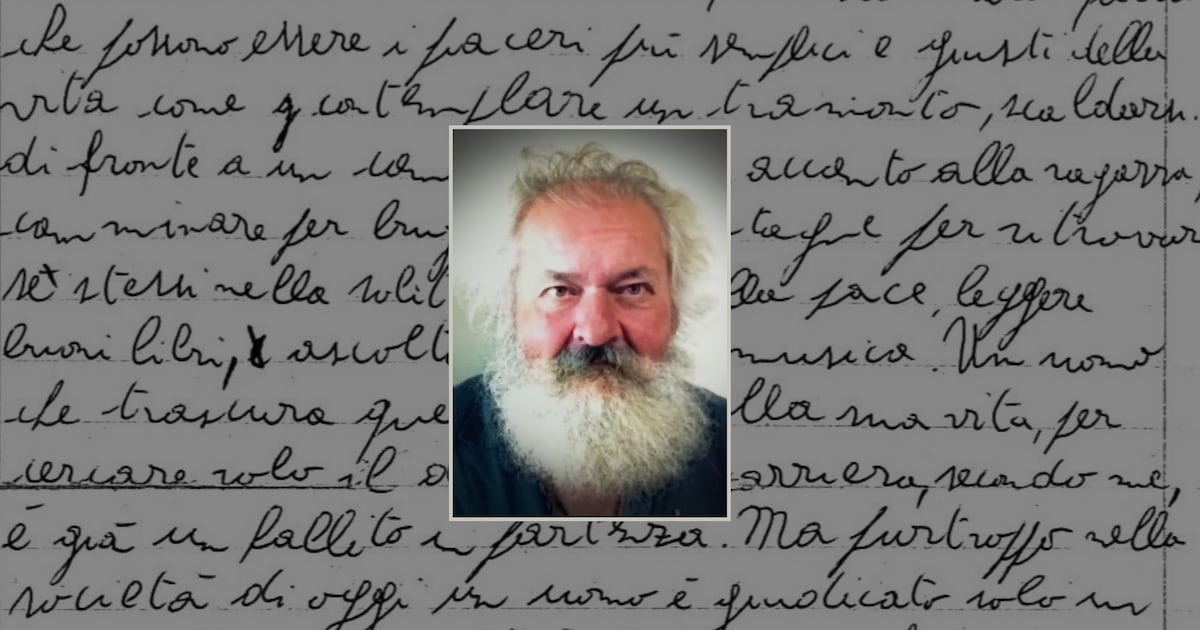
He inherited an estate worth €1.29 million, yet he never accessed the money. Instead, he chose to remain living in a homeless hostel in Galway city centre, where he stayed for more than 10 years. His name was Victor Spaggiari. He was an Italian citizen, and a long-term resident of Galway. He died aged 65 on May 22nd, 2024. Why did a man with access to significant means spend the last 10 years of his life in a homeless hostel? Who was Victor Spaggiari and what led him to make these choices?“I’ve never considered money to be an important thing, and I don’t think any intelligent person should,” Victor Spaggiari wrote as a 14-year-old schoolboy in Milan in 1975.READ MOREPeople spend “empty lives in the continual search for it”, his cursive handwriting reads in an essay kept by his family. “You could say that it was one of the worst inventions in the history of humanity.“Unfortunately in this society a man is only judged for the basis of the amount of money he can produce and accumulate, and not for his moral and intellectual qualities,” he wrote.Victor Spaggiari was drawn to Galway for a very specific reason.“He wanted to learn Irish,” says his cousin Alberto Tota, his closest living relative and the head of a family-owned chemical manufacturing company outside Milan.“That’s why he ended up in Galway, because as you know, in that area it’s widely spoken.”An extract from an essay Victor Spaggiari wrote as a teenager in Milan, which was kept by his family, outlining his attitude to money. An extract from an essay Victor Spaggiari wrote as a teenager in Milan, which was kept by his family, outlining his attitude to money An only child, Spaggiari grew up in a spacious top-floor apartment in central Milan. His father was a successful architect who had designed the building the family lived in; his mother loved high society.It was a comfortable background, but not a happy one.“The relationship with his parents was not the best,” Tota says. “It was a very conflictual relationship with his mother.”When Spaggiari turned 18 he moved into a smaller Milan flat owned by their grandmother, “to be as independent as possible”.“He was very intelligent. He read a lot,” Tota says. “He was probably shy.”He began travelling, primarily to Ireland, drawn by a fascination with all things Celtic.“He went through a very wide range of religions when he was younger, from Hare Krishna to Scientology,” Tota says.[ Polish chocolatier in Clare: ‘There’s something very special about Irish people’Opens in new window ]One day in the 2000s, he left Italy never to return. His Milan flat was “abandoned”, only opened up again many years later, coated in dust.“His parents never knew where exactly he was living,” Tota says. “But they were always ready to help him when he phoned and asked for money. After all, he was their son.” The first news about Spaggiari’s difficult circumstances came with a telephone call to his mother in 2007.“The police phoned my aunt, saying that he had been taken to the hospital because they found him sleeping on the street,” says Tota, who flew to Ireland to see his cousin in hospital in Tralee, Co Kerry. “At that time, he was drinking heavily, and the doctors were afraid he could die.“Ireland was a good choice, I have to say. When I went to Tralee to meet him, even if he was in the hospital and not very present, I told him: ‘Victor, you chose a really nice place to stay,’” Tota says. “It was wonderful there in Tralee, and all around there was the Ring of Kerry. The landscape was really marvellous. That was my first contact with Ireland. Not for nice reasons, but I said: ‘Wow, beautiful. I have to come back.’ And I did.”Spaggiari recovered and moved in to a bed-and-breakfast in Tralee. The owners kept in touch with Tota, trying to encourage a family reconciliation as they grew concerned about their guest’s declining hygiene and the condition of his room.In 2012, Tota called Spaggiari’s lodgings from a Milan hospital and asked to be put on to Victor. He informed his cousin that his father had died.“He told me: that’s impossible,” Tota says. Spaggiari’s mother died a year later. Once again, “he didn’t want to believe me”, Tota says.With the deaths of his parents, Spaggiari became the principal heir of his parents’ combined fortune, mostly accumulated through his father’s work as an architect. Under Italian law, a sole surviving child must inherit at least 50 per cent.He never had a real house because he didn’t want any responsibilities— Alberto TotaWhether Spaggiari was aware of the inheritance but rejected it, was in denial about it, or was incapable of dealing with it is unclear.“Even if he lived as a homeless person, he was probably happy like that. He never had a real house because he didn’t want any responsibilities,” Tota says.Spaggiari seemed to live out the credo he had expressed as a teenager, when he wrote in his essay that wealth and fine clothes held no appeal for him.“To find oneself in solitude and peace, read good books and listen to good music,” he wrote. From Tralee, Spaggiari moved on to Galway. There, he could be found most days sitting on a long wooden bench in the corner of the covered Cornstore Mall.“I’d say hello to Victor every morning like I’d say hello to my colleagues,” says Vinny Browne, manager of the nearby Charlie Byrne’s Bookshop.“He would be here in the morning from about nine o’clock, usually until six o’clock when the mall gets locked up.”Browne knew him only as “Victor”. Vinny Browne in Charlie Byrne's Bookshop, Galway. Photograph: Joe O'Shaughnessy/The Irish Times “Victor usually had a plastic bag. He would often have the paper with him; Le Figaro and The Irish Times. I don’t think you can buy an Italian newspaper in Galway. A bottle of water, maybe vodka sometimes. You would sometimes see him drinking but I don’t think drinking was his problem. He wasn’t a wino. That wasn’t his thing. He was more controlled than that.”He recalls Spaggiari as routinely wearing jeans, variations of a plaid shirt, and rotating a black jacket and a blue denim jacket. “He didn’t encourage contact with people. He didn’t seek it. I think he had opted out. Initially he used to smoke. In recent years he didn’t smoke any more, and I think I had some kind of interaction with him one day when someone offered him a cigarette and he said ‘I quit’. “There was something very likeable about him, I respected him. I thought he was an intelligent, interesting, nonconformist man.”Charlie Byrne’s Bookshop has an exterior wall in the mall, lined with shelves of books that are usually cheaper or more worn than the books inside the shop. Spaggiari often took books from these shelves to read during the day, returning them before he left. He occasionally went inside the bookshop too and bought books “at neighbourhood rates”, as owner Charlie Byrne puts it. “Archaeology and folklore. That was his special interest. Irish fairy tales. Mythology,” Browne says. “There was always an air of mystery about him.”“I sometimes got him a small naggin of vodka,” Byrne says. “He’d be tipping away at the vodka very discreetly. You’d never know that he had drink on him. He never begged for money. I gave it to him a few times – he always took it when I gave it to him, but he never asked for it.”“He used to stand down by O’Brien’s Bridge and people would give him money but he never asked for it,” Browne adds.O'Brien's Bridge where Victor used to stand a lot. Photograph: Joe O'Shaughnessy/The Irish Times The Café Temple in the Cornstore Mall is gone now, but back when Spaggiari frequented the bench, he visited it once a week or so. Steve Taylor, now retired, ran the cafe as a non-profit.“He used to come in and just sit down. Once we saw him, one of our staff would say, ‘Victor’s here,’” he says. The first time Spaggiari asked for a sandwich, he specified chicken and cheese. Ever afterwards, he simply requested “that sandwich”. He drank only sparkling water. The cafe always gave him the items for free. At the start of his time in Galway, he was sleeping rough at a bus shelter near Spanish Arch. He would occasionally avail of the cold-weather response initiative of Cope Galway, a long-standing social services and homeless charity that provides additional emergency beds during winter months.Over a decade ago, the Galway 2020 organisation, then based in the Cornstore Mall, noted Spaggiari’s frequent presence by their office, and brought him to the attention of Cope, which runs the 26-bed Fairgreen Hostel for homeless men not far from Ceannt railway station. The seat inside the Cornstore Mall where Victor sat most days. Photograph: Joe O'Shaughnessy/The Irish Times Spaggiari would end up spending the last 10 years of his life in the hostel.“First you try and understand what their situation and circumstance was, and that took time, to build up a relationship and build up trust with him,” says Cope Galway assistant chief executive and team leader Martin O’Connor. “If that outreach bit hadn’t happened, he would have carried on sleeping rough.”“He never told us why he came to Galway,” says Paudie Cunningham, who also works at Cope. “He had a real connection with the land ... He was real spiritual.” [ Ardmore receives Ireland’s Greenest Places award from Eamon RyanOpens in new window ]The Fairgreen Hostel does not generally provide long-term accommodation. Each man has his own single room, and is provided with three meals a day. They do not have to vacate the premises during the day if they don’t wish to. The reasons men come to the Fairgreen Hostel vary, but the most common two are mental health challenges and addiction issues.Each resident also has a key worker who spends time with them to build a trusted connection, and try to figure out what particular support that person needs, whether it’s access to things such as medical care or help with the paperwork that can lead to a way out of homelessness. The residents pay rent of €10 a night for the hostel. “The ultimate goal is for them to move on from services to a better place,” says Cunningham.“Victor was atypical of people you would see who use our homeless service,” says O’Connor. Referring to the unusual length of his stay, he says: “That would have been exceptional. But it was based on vulnerability. There wasn’t another option for him.”“There was nothing conventional about Victor,” Cunningham says. “He was an enigma; a very private man. He very rarely spoke to anyone. He was very much into his books. He had his own personal library down there in Charlie Byrne’s. He was into Celtic history, shamans, he was very alternative. He told us he had been a yoga master. He never had a phone. He was not connected to that side of the world at all. He wasn’t in touch with society at all. He was living in his own head. That’s the way I would describe Victor. He didn’t communicate with anyone, and if you’re not communicating with anyone, you’re going to go internal.”“He liked his Perrier water,” O’Connor says.“He wouldn’t drink anything else,” Cunningham says.[ Travel ‘I’m swooning as I come in the door’: A trip to Milan to buy cottons, linens and silksOpens in new window ]The Cope team deduced over time that there had been some unspecified trauma in Spaggiari’s life that had led him to leave Italy and become homeless in Galway.“Whatever had happened to him was still going on for him,” O’Connor says. “And the fact that he was accommodated in a shelter was an improvement in his circumstances.”Everyone who comes through the Fairgreen Hostel is asked to provide some basic information about themselves. “We would sit with them and do paperwork: name, surname, date of birth, place of origin, next of kin, mobile number, why are you presenting to the service, your GP, medication you may be on, addictions, mental health,” says O’Connor. Over time, in the course of assessing Spaggiari’s housing needs and using information he had provided them with, Cope did their usual research into his background. “That gave rise to it becoming known he had access to funds,” O’Connor says. So Spaggiari knew he had considerable means?“He knew,” O’Connor says. “I know some people out there would look at this case and say, here you had somebody who had what most people can only dream about, in terms of the kind of wealth he had, and there he was occupying a space in a homeless service that someone else could have benefited from.“Standing back and looking at his access to all that money, you’d think he should be on his way, get his own housing sorted, because he had the means to do that. The reality was that he would most likely have simply returned to the street in that situation. He wasn’t able. He had this inheritance but it didn’t change anything.”“He would have died on the streets if we didn’t keep him,” Cunningham says. “That’s the reality of it. He didn’t have the skill set to survive. He was an old young man.”Cross on Victor Spaggiari's grave at Rahoon Cemetery. Photograph: Joe O'Shaughnessy/The Irish Times Spaggiari was buried at Rahoon Cemetery in Galway, in Section W, Row 25, Plot 10. The graveyard’s caretaker, Michael Davoren points out a fresh pink rose that someone left on the grave recently. Davoren was one of a handful of people who attended the funeral. The others included his cousin Tota, staff from Cope Galway, the undertakers conducting the funeral, and a couple of members of the public who had heard on the Galway grapevine that the familiar figure with the Italian accent and bushy white beard had died.Vinny Browne and Charlie Byrne, who attended the reposal at Conneely’s on Flood Street, helped carry Spaggiari’s coffin. He died intestate; probate was granted to Tota.Tota has wondered whether Spaggiari had autism. He is not aware that his cousin had any diagnosis for any condition. To his knowledge Spaggiari never had a job, or any romantic partner.He thinks back to the 1990s, when the two cousins bonded as young men in conversations about Spaggiari’s Celtic interests.“For sure, he passed to me some of his love for the Celtic culture, history, and Ireland,” Tota says. On Spaggiari’s recommendation, he visited a shop in Milan, Ceilt Siopa, and bought a triple-spiral necklace. “I still wear it,” Tota says. “Slán.”Information about Cope Galway can be found at copegalway.ie
Galway’s homeless millionaire: The story of an Italian man who died in a city hostel
Full Article
Original Source
Read the full article at Irishtimes →KhanList aggregates and links to publicly available news content. We do not host full articles from third-party sources. Always verify important information with original sources.