
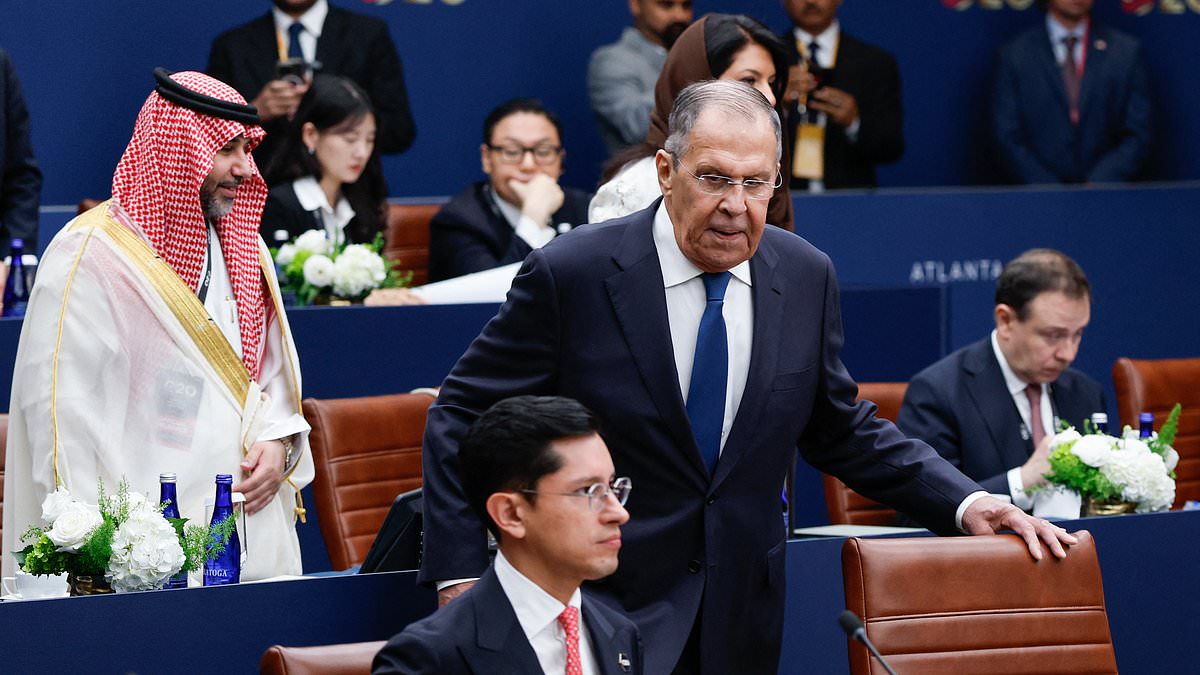
A photo of diplomats from the world's 20 largest economies was reportedly scrapped after ministers refused to stand beside Russia's Sergey Lavrov. G20 officials, including envoys from Russia and China, are meeting in Atlanta, US, as they face deep rifts over multiple wars and other global crises that threaten international security and trade.But plans for a group photo were axed after foreign ministers objected to being photographed with Mr Lavrov, Russia's top diplomat, according to a report by Associated Press.G20 participants even threatened to walk out of the summit if the photo op went ahead, according to US officials. Prior to these reports, British Foreign Secretary Ed Miliband had planned to boycott the 'family photo' and had asked for a separate photograph to be staged with close allies instead. When asked on Tuesday whether he would shake hands with Mr Lavrov at the G20 summit, Mr Miliband, citing the war in Ukraine, replied: 'We do not engage in that way with the Russians and have not for a number of years.US Secretary of State Marco Rubio is chairing the gathering on Friday and Saturday that will set the stage for a G20 leaders' summit hosted by Donald Trump at his Miami golf club in December.There appears to be little chance that the group will come to a consensus on many of the most contentious issues. Diplomats from the world's 20 largest economies reportedly refused to stand next to Russian foreign minister Sergei Lavrov (pictured) on 30 October Secretary of State Marco Rubio, center rear, heads the opening plenary session of the G20 Foreign Ministers meeting on FridayAmong those are the Russia-Ukraine war, the US-Israeli war on Iran, US tariffs and Chinese machinations in the South China Sea. All have contributed to spikes in the global cost of fuel as well as uncertainty about trade.US officials say their top priority for the meeting is resolving differences over issues related to freedom of navigation, particularly in the Strait of Hormuz, the Red Sea, the Black Sea and the South China Sea. The topic will include discussions on Iran, Russia-Ukraine and China and its smaller neighbors.But hanging over the meeting is the prospect of new US military intervention in Iran, which has put the region, including G20 member Saudi Arabia, on edge.The Associated Press has reported that US officials have told several Middle East countries and regional allies to be prepared for potential renewed military strikes against Iran after Tuesday's midterm elections and the possibility that Iran will retaliate against them.Some G20 countries have expressed concern that the US invited Russia, which will be represented in Atlanta by Mr Lavrov, during its heightened attacks on Ukraine. China will be represented by a deputy foreign minister, but most other countries have sent their top diplomat, US officials say.The US on Thursday scrapped plans for the family photo with G20 participants, according to two officials who spoke on the condition of anonymity due to the sensitivity of the matter. The incident has endangered prospects for the world's largest economies to reach consensus on a number of global crises, especially the Russia-Ukraine conflict. The US officials said Mr Rubio decided to cancel the photograph after determining that controversy over it would be a distraction.It is unclear if Russian president Vladimir Putin will accept Mr Trump's invitation to the December summit in Florida. US allies in Europe are uneasy with Russia's presence, especially after Mr Trump pushed ties with Ukraine to new lows by waiving fresh sanctions on Moscow and temporarily limiting logistical and intelligence assistance.Russia's foreign ministry complained of issues securing visas for its delegation that were only resolved at the last minute. Those complications had created the impression that 'not everyone in Washington is happy' about Mr Lavrov attending, ministry spokeswoman Maria Zakharova said.But he would use the meeting to advocate for the 'swift reform of global economic institutions' and to promote Russia's vision of a 'multipolar world', she said.Mr Lavrov has travelled very infrequently to Nato member states since Russia invaded Ukraine in February 2022 and the resulting severe sanctions were imposed on Moscow. His presence in Atlanta is likely to cause both domestic political problems for Mr Trump just days before the midterm elections and roil at least the G20's Western participants, according to Ian Kelly, a US ambassador to Georgia during Mr Trump's first term.'It seems politically boneheaded to invite him,' said Mr Kelly, who now teaches international relations and diplomacy at Northwestern University outside Chicago.Mr Kelly noted that many Republican lawmakers, who are already fearful of losing their congressional majorities, are 'cranky' with Mr Trump's conciliatory approach to Mr Putin. Democrats, he added, could use the invitation to bash the GOP ahead of Tuesday's vote.In terms of the G20 itself, Mr Lavrov's attendance will almost certainly hurt efforts to produce a unified approach on the Russia-Ukraine war, Mr Kelly said. 'It will definitely take away from the message that at least the Western members want to send,' he said.Ukraine, which is not a G20 member but was invited to attend previous such meetings, was not invited this year as US officials said they made a conscious choice to only include formal members of the group.Also missing from the Atlanta invitee list is South Africa, a G20 founding member and the only African country in the group. South Africa is embroiled in several bitter disputes with the Trump administration, and when it chaired the G20 last year, top US officials, including Mr Trump and Mr Rubio, shunned the meetings it hosted.South Africa said on Friday its absence from the meetings was not voluntary. 'We have consistently maintained that our nonparticipation is not voluntary,' Phindile Kunene, spokesman for South African foreign minister Ronald Lamola, told The Associated Press.Kunene welcomed support from other G20 members that had expressed reservations about the exclusion and said South Africa was ready to participate 'on an equal footing with other members' when Britain takes over the presidency next year.The State Department said Rubio sees the event as a way 'to advance practical cooperation on shared economic and security challenges' and his priority is for the group to seek solutions to 'geopolitical crises contributing to global economic shocks'. It pointed to threats to freedom of navigation, energy and food security and preserving supply chains of critical minerals.However, there is scepticism that the G20 members will be able to overcome their substantial differences.It will be less of a meeting and more of a test, said Elaine Dezenski, the head of the Center on Economic and Financial Power at the Foundation for Defense of Democracies, a Washington think-tank that is hawkish on Iran and other issues.'The Atlanta meeting takes place within an environment of widening disagreement over the global economic order, and the right test is whether the US can build cooperation with partners when all member consensus appears to be out of reach,' she said during a conference call with reporters.She said the Trump administration had shown a willingness to work – and not insignificant success – outside the G20 framework to build coalitions that advance its foreign policy goals.'The meeting offers a chance to assess whether the US can turn shared economic security concerns into more meaningful cooperation with partners even without the consensus,' she said.Prior to reports that the G20 'family photo' had been axed over Russia's presence at the summit, British Foreign Secretary Ed Miliband said he would boycott any photo op involving Mr Lavrov. He is said to have asked US Secretary of State Marco Rubio to stage a separate photograph just with close allies instead.This would allow him to avoid a row like that which accompanied his decision to meet and shake hands with his Iranian counterpart at the UN general assembly in New York in September.On Tuesday Mr Miliband was asked by Tory frontbencher Dame Harriett Baldwin if he would shake hands with Mr Lavrov if their paths cross in Georgia.He replied: 'We do not engage in that way with the Russians and have not for a number of years.'As I have said throughout this session, we are absolutely clear about the need to counter the Russian hybrid threat.'The event could also see a wider row over support for Ukraine in Mr Lavrov's presence.The European Union's foreign policy chief Kaja Kallas said last night she would urge partners there and at a separate EU-Canada summit to strengthen support for Ukraine.She would also urge to advance accountability through the Special Tribunal and Claims Commission, writing on X: 'Russia must be accountable.'It came as former chancellor Rachel Reeves urged Brussels to seize control of £175billion in frozen Russian assets to help Ukraine defend against Kremlin aggression in the face of 'a desperate winter'.In her first significant intervention since leaving Government, the Labour former Cabinet minister told the European Union that 'the time to act is now', with Kyiv confronting a funding black hole and Donald Trump seeking to pressure the embattled country 'to cut a deal with Moscow'.She warned without the funding Ukraine's 'capacity to sustain its defence will be gravely impaired', which in turn would 'undermine Europe's security'.Ms Reeves, who was sacked as chancellor by Andy Burnham when he took office, issued the rallying call for urgent action in an article in The Times penned along with three other senior politicians from Germany, France and Canada.It said: 'We are coming together to say we need to stand by Ukraine in its time of need.'A critical next step should be for the EU to take custody of the 210 billion euros of sovereign Russian assets it immobilised in 2022 so it can use them to help Kyiv in its defence.'The quartet pointed out the funding would be enough to bankroll Ukraine's defence into 2029.The article said: 'This eliminates the risk that elections in key EU member states next year may halt financial support for Kyiv.'The assets would also fund Ukraine's defence until after the next US presidential election, at which point Washington may be more supportive than it is today.'
G20 group photo of diplomats 'is scrapped after ministers refused to stand beside Russia's Sergey Lavrov'
Full Article
Original Source
Read the full article at Dailymail →KhanList aggregates and links to publicly available news content. We do not host full articles from third-party sources. Always verify important information with original sources.