
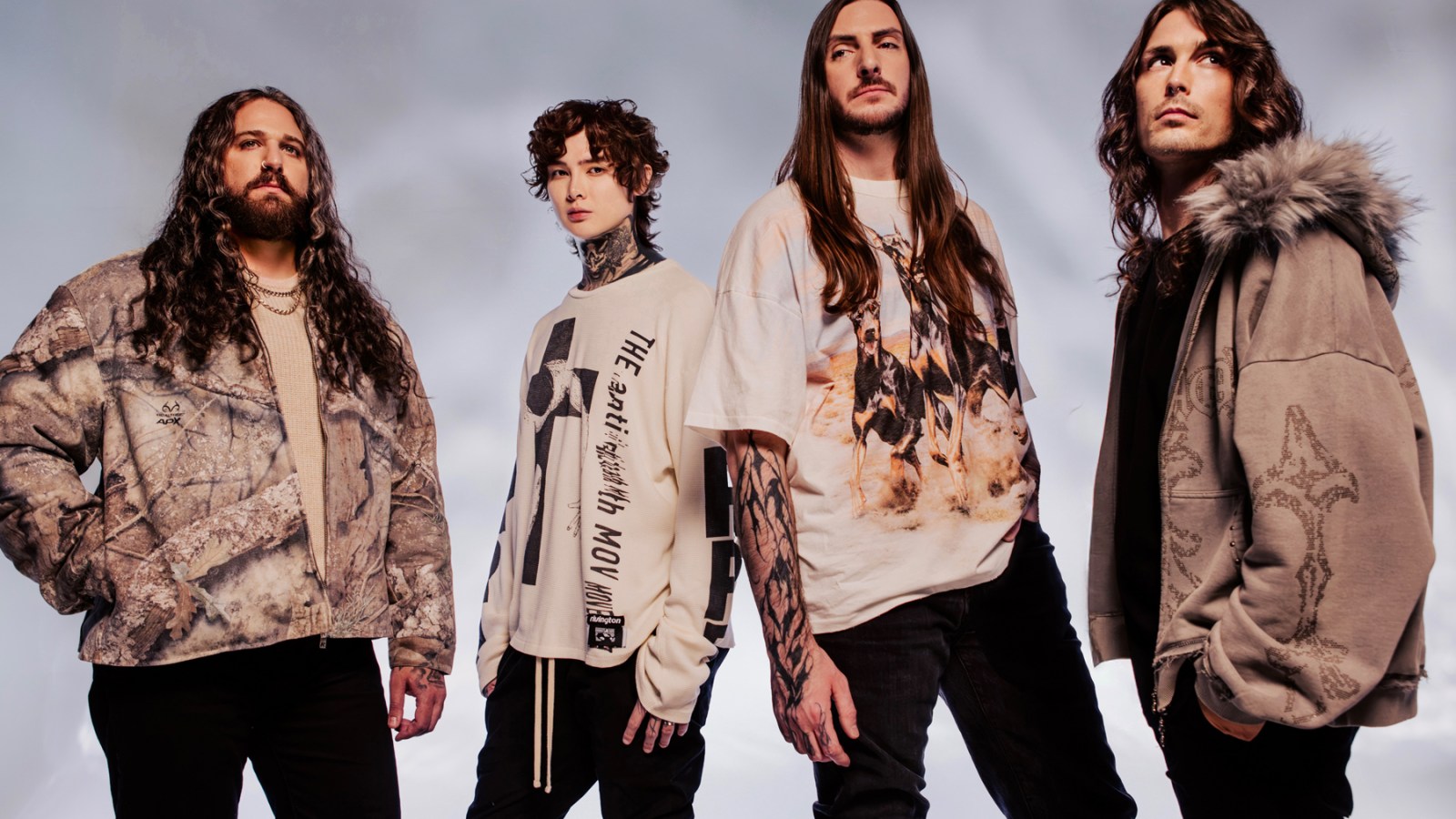
If the term “post-rock” wasn’t already taken, it would be a perfect descriptor for the fractured, future-warped music of Polyphia, a largely instrumental foursome who take virtuosic guitar music into places that would melt older shredders’ minds. Even as fleet-fingered guitarists Tim Henson and Scott LePage keep pushing guitar technique forward, they’ve evinced minimal interest in carrying on any rock lineage, and are instead obsessed with bringing influences from pop, EDM, hip-hop, and video-game soundtracks into a ferocious live-band context. Older-school shredder Steve Vai paid his respects with a guest appearance on their last album, 2022’s Remember That You Will Die, and longtime Kanye West producer Mike Dean is one of their heroes and a fan in his own right — he had Henson and LePage open for him at a rare live show in 2024. The band’s just-released new album, Be Not Afraid, is as quirky as ever, but it has some of their heaviest songs yet, with more overt nods to metal than usual. Henson and LePage hopped on a Zoom with Rolling Stone to dig into their latest influences, the making of the album, and how they get their rhythm section (bassist Clay Gober and drummer Clay Aeschliman — yes, they’re both named Clay) to sound inhuman. They also weigh in on the rise of fellow instrumental oddballs Angine de la Poitrine. Tim was way ahead of a huge trend in guitar playing — ditching physical, tube amps for digital modeling. Scott, are you post-amp as well?Scott LePage: Yeah. When we were kids, digital amp modeling was kind of coming up, and we were like, “Huh, we can buy this one thing and not have a bunch of other things that are massive and heavy and expensive.” It almost wasn’t even an option to have a bunch of amps as a 16-year-old kid. So having the fake version of all the things is kind of sick. My dad got me this DigiTech thing. It was an effects thingy that had some amp modeling in it, but the main thing was [the 2009 software plug-in] POD Farm. Some of those models still hold up now. We still use it from time to time — that Angel P-Ball one that they have, Big Bottom, that’s a classic and everyone knows that one. Editor’s picks Did you ever try a real amp in the studio on this album?LePage: There was one time we re-amped with an amp, and we were like, “This sounds worse.” It was just whatever random amp that guy had in his studio. Tim Henson: Everything that was captured on the record is the exact way that it was in the studio, where all the magic and the mojo was done from that particular sound. And when trying to re-amp it, it just takes away the magic and the mojo. It’s been a while since your last album. What was the gap about?Henson: Remember That You Will Die came out in ’22, and we spent all of ’22 and ’23 touring, and in between tours, making demos. The very first song on the record, “Let There Be Light,” was the very first song that we started for this album, around the end of ’23, going into ’24. It took a lot of demos to get to that demo and realize, “Yo, this is the sound of the album.” Once we realized what the sound of the album was, we took off most of ’24 from touring, and all of ’25, to dive deep into it. Our last record before Remember That You Will Die was New Levels, and that came out in 2018. So we’re slowly but surely trying to train our fan base to not expect music [sooner than] every four years. Hopefully five — maybe 12, like Tool! You gotta give us time to cook. LePage: And you gotta tour on the things you cook. You gotta do that for, like, two years. And we’ve written an album on tour before, and it’s just a lot. So for this one, taking ’25 off was the best thing for this record, and we really just sat down and locked in with it. Of course, we had the demos, and the idea of what the record was gonna sound like, but a lot of what you’re hearing happened last year. “Let There Be Light” is heavy as hell, and the whole record leans into your heavier, darker side. What did that song open up?Henson: Definitely, definitely the heaviness. “Let There Be Light” is kind of like [Polyphia’s 2018 song] “G.O.A.T.” and “Fear God” is kind of like the [2022 Polyphia song] “Ego Death” of this record. Related Content Those are the two songs that we can liken to other ones in our discography on this record. The other 10, I wouldn’t liken them to anything of our discography. Originally the plan was, “OK, here’s our lead single. Let’s craft an album around it.” And of course, we made things that were so far different from it that it was like, “OK, this is no longer our lead single.” But it was the evolution of “G.O.A.T.,” but in a very heavy style. When in the process do your drummer and bassist come in?Henson: They come in towards the end. It’s just like, “Here’s the demo. Play this how you’re going to do it live.” And then what’s so funny to me is that a criticism is like, “I didn’t even know there were drums.” Everything that you’re hearing was played by a human. That’s the beauty of sound design. We have one of the best drummers and bass players in the world. Absolutely we want to utilize them to their full potential. So that’s the beauty of the whole record, is it’s done by humans, and it sounds nothing like humans. What do you use when you program beats for the demos?Henson: Samples. Oh, really?Henson: Yeah, and just copy-pasting a million hi-hats in a row. It’s speed programming, where it’s like get the idea out as quick as possible so that other ideas can birth, and we can just keep the momentum. This is how songs like “Can You Feel It” and “With Eyes to See” are born in a single day. As soon as the idea’s out, it’s like, “OK, that sounds fire. Let’s move on to the next thing.” And every choice becomes extremely obvious. “Can You Feel It” is like your version of Disclosure — live metal house. What was the thinking there?Henson: You know that [2002 electrohouse] song “Satisfaction” [by Italian producer Benny Benassi]? There’s some incredible riffs from those super iconic dance tracks from the ’90s and 2000s, and it’s just like, let’s touch on these incredible, iconic moments. I guess my introduction to house has always been through Kanye, where he’ll just take a house sample… or a gospel sample even, and just make it house, and just hit the button over and over and over again. So just kind of playing off of how Ye would do it, but in the context of, OK, we’re gonna perform this with the energy of a metal band. The song and most of the album doesn’t focus at all on the technicality of music. We have an entire discography of technical crazy playing. Let’s focus on melody, groove, and vibe. How do the two of you write? Separately, or together?LePage: A lot of ’23 and ’24, I can tell you that I had started experimenting with different kinds of scotch. I don’t condone this, but a lot of the demos that ended up being on this record was because I was just on my fifth glass of scotch just being like, “How can I do this cool thing?” Or, “What’s going on here with this idea?” Of course, Tim brought plenty of ideas that we ended up using in the session. Basically me and Tim go off on our own thing, and we’re always creating something, and it’s just kinda trading off: “OK, show me what you’ve made this month, bro.” That kinda kicks off the start of the record, and then the bulk of it is the momentum that we build doing sessions for three weeks at a time, standing or sitting in the same room and working on all these things, and having several brains riff off of each other. The analogy that I used for something else was throwing a ball at a wall in a very large room. It’ll bounce on the wall and then go to the floor, whereas you have a bunch of walls close together in a little cube and you throw the ball, it goes all over the place. The walls are our brains and the ball is the idea. One thing that this record has over all the other records is the speed of getting those ideas out. Henson: The funny thing is most of the demos that I brought to this record did not make it. I like a lot of those demos. I think they’re all cool. They’re very classical Polyphia, and they didn’t make it to this record because they were very classical Polyphia. Most of my contributions to this record were on the spot, just kind of vibing out as the beat is playing, pretending I’m Ye and just humming a melody out, and it’s like, “OK, that’s the melody right there.” And then moving it over to a guitar. LePage: Tell him about the hook zone. Henson: So in Scott’s room, behind his desk is an area that you can walk back, and we would have a beat playing, and I would just go stand in the hook zone and pace. Not stand, but pace in the hook zone. All the hooks from this record were written in that spot. It just comes from a simple singing idea, and it’s just like, “That’s fire as fuck. I know that’s fire as fuck because it’s fire as fuck for me singing it badly. Imagine it on a guitar, that’s sick.” Where did the grinding main drop in “Mark of the Beast,” around 1:04, come from?LePage: It was something I heard on TikTok or something, and it was just one of those, I have to fucking hear this with guitars. Another example is, we just talked about this earlier today, it was a Charli XCX song with Billie Eilish on it, and the version with Billie Eilish on it has a section in there that is like a four-on-the-floor head bang to the fucking quarter notes of the song. Like, oh my God, this is so hard. And to that I was like, dude, imagine fucking Meshuggah guitar on that shit following those quarter notes. I guess my influence for thinking like that is Meshuggah did a cover of a Rammstein song. They did “Benzin,” and it was a remix by Meshuggah. If you listen to the original Rammstein song, it is nothing like that. I would never have guessed that came out of it. So it’s really just Meshuggah writing a song with the influence of the Rammstein song, which is fucking cool to me because now there are two things on earth that exist that I like instead of just one. So taking things that I hear and being like, “How would my brain process this?” is what “Mark of the Beast,” specifically that part, is. What did you hear on TikTok?LePage: It was some beat and a rapper or something like that. And I was like, “Oh, that’s cool.” So part of the key is hearing all kinds of music and imagining it with your crazy guitars.Henson: That’s the question that we always ask ourselves: “That’s sick, but what if it did this?” That’s how you end up with a record like Be Not Afraid, because it’s just chasing that excitement of, “Well, yeah, that’s sick as fuck. Let’s do that.” And then after we do that it’s like, “OK, that’s sick, but what if it did this?” It’s just this feedback loop that just keeps going until it’s like, “Well, the song’s done. Let’s move on to the next.” Scott, “Fear God” began as one of your demos?LePage: That one started off with just the fifth glass of scotch type of thing. I remember specifically thinking with that one, I don’t wanna do a chord progression where I would think it would go normally. So I kind of purposely did different shit. For whatever reason I can never really fully complete an idea. Tim, you can attest to, the fourth section of any part of anything I write is usually guitar-less. So when I’m handing these ideas off, it’s usually Tim being like, “Oh, this is an excellent idea and an excellent theme. Let me fucking just take this to the finish line.” The one at the end with the tremolo guitars and shit — we were doing a session in Miami in an Airbnb, and I just clicked play on some random demo thing that I was just doing ’cause I got an idea, and Tim came in my room and he was like, “Yo, what the fuck is that?” And I was like, “Oh, just some shit that I was fucking with.” The God-and-devil theme runs through the whole track list. How did that become part of it?Henson: Let me give you some context to how we made the record. We modeled the sessions after Kanye’s My Beautiful Dark Twisted Fantasy sessions, where he would fly everybody out to Hawaii. He would make them all wear suits when coming to the studio. He would post rules on the studio wall of, like, no Twitter, no this, no that. He’d just make the studio a super sacred space. He would make everybody wake up at the same time. He would make everybody eat at the same time. He would make everybody work out at the same time, and then he would make everybody work at the same time. And so that’s how these sessions went about. We did it in Miami, we did it in L.A., and then we did a bunch in Texas, for weeks at a time. And the beautiful part about that is you get so in tune with each other, and part of the discussion that was happening during these sessions was the nitty-gritty details of all the super heinous, horrendous things that came out in a certain set of files this year. And so when you find out the gory, gory details… you have this feeling of disgust and anger that is so hard to place anywhere, and it makes you feel like, “What, as a species, what the fuck are we doing? Why isn’t anybody doing anything about this?” And as us being musicians and songwriters, the only thing that we can do is do what we do, but now there’s intent and purpose behind it. And part of the reason it is so intense is to capture that intense feeling of anger and disgust of what’s happening. It is a Jesus record. We put Jesus on the cover. Every song title is biblical. And because every song title is biblical, it’s just layered with meaning, both metaphorical and literal. Because it’s all deeply layered with meaning, everything from the composition to the melodies to the sample choices to the song titles to the art, it all has double meaning, triple meaning, quadruple meaning. How does that intensity show up in the music?Henson: You know how in heavy music a singer will often scream to convey that emotion? It was like, how do we convey that, screaming ’til your vocal cords tear, but on a guitar? And it’s like, OK, well, playing so hard that your string snaps isn’t very useful in a musical context. So let’s sound-design the shit out of these frequencies and push it so hard that it feels like your eardrum is going to burst. It’s very much like a breaking of the fourth wall for the listener. And again, what we’re trying to draw attention to is exactly what this record is about. I feel like we’re the only band on the planet talking about this shit. Everybody is trying to say, “Our music is an escape from all the darkness of the world.” It’s like, have more bread for your circus. This is the opposite of that. This is a “wake the fuck up and look what is happening.” We’ve made two videos about it: “Can You Feel It,” the original visualizer, and “With Eyes to See.” They drop files, and the next weekend it’s the fucking Super Bowl, and no one gives a fuck. What the fuck are we doing? This album is based off of, to not be afraid to sit with it and to feel it and to fucking, once you feel it, then to get up and do something about it. So instead of cheering people up out of the darkness, you’re diving into it.Henson: Yes. You have to face it if you want anything to happen. Otherwise, it’s just, oh, another distraction so I don’t have to deal with it because, oh, there’s nothing I can do. Well, yeah, if you feel that way, you could do nothing. But there’s a clip that I included in “Can You Feel It,” the visualizer, and it’s of Hopper from A Bug’s Life, and it’s at the moment where he’s telling the other grasshoppers, “If the ants find out that there are more of them than there are of us, that is very bad for us.” Paraphrased. The idea is to keep us all divided so we don’t actually do anything. And part of that is with artists that are out here pacifying the fucking listeners, almost sedating them into just dealing with the shit, and that’s the opposite of what this record is to do. It’s to shake the listener, again, almost a breaking of the fourth wall with the mix and how intense the moments get on this and how uncomfortable they are and how jarring it is. Everyone says you’re genreless. How do you think of yourselves in terms of genre now?Henson: I don’t think we do. LePage: Yeah, I never know how to answer that. In every Uber I’ve ever been in, where the small talk has gone to, “What do you do for work?” And I have to be truthful. They’re like, “Oh, what genre?” I’m like, “You know, man, it’d be easier if you just listened to it after the ride,” when I’m out of the car. I guess I just go with what I like, which is, like, metal. But it’s not, is it? It’s not just metal. Henson: I mean, this record has metal on it. Our previous records had dabbles of metal on it. Other records had no metal on it. LePage: It’s kind of a better way to put it is like, “What does it have?” Instead of “What is it?” This one does move further toward rock and metal.LePage: The genre thing is, maybe in my brain if I knew that we were one genre, I wonder if I would feel like I have to write just only that. So maybe there’s something to be said about not calling ourselves a thing. Not us — I guess I’m only speaking in terms of my own brain — but I know that there’s no boundary… because there’s not a definitive label on it. But maybe subconsciously there’s something there where I’m just like, “Oh, I’m free to do whatever the fuck I was gonna do, and I don’t have to make this thing metal if I don’t want to.” Tim could write something super nice and peaceful, and then if I was in a “I’ve been listening to Pantera all month” zone and he gave it to me, I might make it heavy, and then that’s an idea. Maybe we go somewhere with that, maybe we don’t. Henson: Another easy way to put it is we’re just chasing excitement. Whatever excites us, whatever is the most fun. LePage: There’s a much easier way to put it, yeah. Henson: It doesn’t matter what it is as long as we’re stoked about it. What do you think of Angine de Poitrine, the instrumental band from Quebec?Henson: I’m not one to give my opinions on music in the press. So I will say that I think it’s cool that they exist. I think it’s cool that they make instrumental music, and more power to them, and I’m just stoked for them. LePage: I’ve seen this. I agree with Tim. I think it’s cool. I will say my dad fucks with this a lot. He’s really into it, so I’ve definitely heard stuff, and it passes the head-bob test. ‘Cause my dad really likes Meshuggah also, that rhythmic kinda fucking stuff, which this has. My favorite track on your album that we didn’t talk about is “J-Bomb.”Henson: That’s a fun one. Our wives hate that song. LePage: The women in our lives, they don’t know why we like the song so much. They don’t get it. Henson: But this is a vibe. Do you hear the Lil Wayne Young Money influence? I kinda do. Henson: It’s that era of Young Money when all the beats were super triumphant and used horns, and it was melodic and triumphant. Trending Stories LePage: Oh, yeah. Dude, the horn era. Henson: And we were just like, “Yo, let’s hit that era of Young Money beat.”
Future-Prog Foursome Polyphia Want to Freak You Out on Their New Album
Full Article
Original Source
Read the full article at Rollingstone →KhanList aggregates and links to publicly available news content. We do not host full articles from third-party sources. Always verify important information with original sources.