
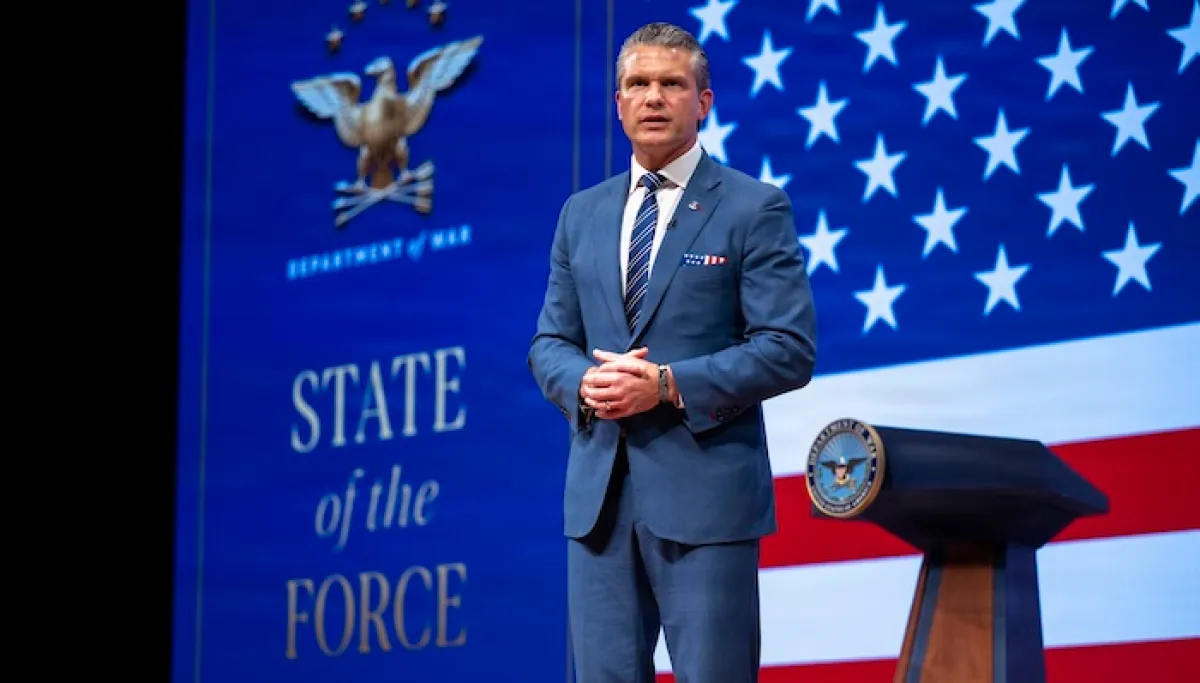
Secretary of War Pete Hegseth believes the department needs a “generational” investment to spark the department’s revolution into the next era of warfighting, but it’s unclear if he can get Congress on board to turn that vision into a reality.The department’s $1.5 trillion defense budget request was broken in two; a base budget of $1.15 trillion, and a reconciliation bill for $350 billion, which could be passed with only Republican support, though Hegseth noted this week that the reconciliation figure of $350 billion was “a minimum” and that there could be “potentially more” requested.“We’re lockstep on that with the White House,” he said on Wednesday at the Association of the U.S. Army convention. “We will ensure, regardless of what happens in the midterms, we’re running fast immediately with the committees to ensure that [the] reconciliation bill, at a minimum of 350 [billion dollars], potentially more, ultimately fills up what this department needs.” The Pentagon would also get $67 billion to cover the cost of the Iran war in an $87 billion supplemental request package.Under Hegseth’s leadership, the department is trying to revolutionize its procurement process to match the new phenomena in which evolutions in technology and weaponry happen over weeks and months instead of over several years. The new, much faster iterative cycle primarily involves autonomous and artificial intelligence platforms and weapons, which will play a defining role in the future of warfare.“We’re in a different moment,” Hegseth said. “We’ve got a near-peer adversary who’s building the most historic military buildup, potentially in world history. That’s not hyperbole, that’s just objective truth. You add it with the step changes in autonomy, in robotics, in space, AI, whoever’s ahead now is going to get much further ahead. Whoever’s behind now is going to fall even further behind. And so investments now are going to matter, and they’re going to ripple not just for years but for decades across our joint force.”He and his team will need congressional support to accomplish these goals. That’s easier said than done, and it’s unclear how willing lawmakers will be to work with him given the fractious relationship that has persisted throughout his tenure.“I think there’s plenty of blame to grow around,” Elaine McCusker, who served as deputy and then acting undersecretary of defense comptroller from 2017 through 2020, told the Washington Examiner. “What frustrates me is they focus more on who gets the blame than what the consequences are.”Drones synchronize before a swarm flight during the XVIII Airborne Corps’ Scarlet Dragon 26-3 at Fort Bragg, N.C., Sept. 16, 2026. Coordinated swarms of 25 to 100 drones flew in tactical formations to stress sensors, software and air defense crews. Scarlet Dragon’s operational stress test stacked those threats with other unmanned aircraft system profiles to evaluate the network under battlefield-like pressure. (U.S. Army photo by Sgt. Noe Cork) “The primary responsibility of the federal government, and the one mandatory job of the U.S. Congress each year is to fund the federal government,” McCusker, who is now with the American Enterprise Institute, added. “So it’s an embarrassing, self-inflicted shameful situation for the United States.”The Pentagon is opening the defense industrial base to new and emerging companies, including smaller businesses that may not have a traditional defense background, to cultivate more partners and build a bigger defense base. The department also intends to work with Congress to legislate the creation of a 4-star functional combatant command named Autonomous Warfare Command to lead the department’s efforts in autonomy.Hegseth said there’s about $50 billion allocated for autonomous and robotic systems in the reconciliation bill.“When you think about the fact that the Biden administration invested I think 200 million max, we supercharged it with 1.2 billion initially in one big beautiful bill, and now 50 billion,” he said. “Scaling that quickly requires the architecture of an AutoWarCom, and the service is flowing in the same direction. That’s how we get from 1,000 drones to 100,000 to a million.”In the first two years of the Trump administration, the department has also unveiled the Golden Dome for America plan to build a comprehensive air defense system to protect the entire country, and the Navy has proposed a “Golden Fleet” that will be in the Trump-class of ships, on top of continued military operations in the Middle East that have also degraded U.S. stockpiles and equipment.All of these programs and plans could be at risk, however, without the reconciliation bill, and it’s unknown whether Republicans would be able to pass it in a lame-duck session of Congress after the midterm elections.Bradley Bowman, a senior director at the Foundation for Defense of Democracies, told the Washington Examiner: “We have many Democrats who are, I’d say, understandably upset about not being respected by the administration in terms of the conflict with Iran and respecting Congress’s constitutional role and and kind of treating them like a potted plant or an afterthought. So they’re upset about that. But it’s not smart to respond to that understandable disappointment by depriving our war fighters of what they need.”Congressional Democrats and Hegseth have a long-standing mutual disdain that dates back to his time as a political commentator on Fox News and came to a head during his confirmation hearing, during which he was asked about his marriage infidelity, a sexual assault allegation from his past, and claims of excessive alcohol consumption. Democrats have criticized Hegseth for firing several military leaders with little explanation; the Iran war; the use of lethal force against alleged drug smuggling vessels in the Caribbean Sea and Eastern Pacific Ocean, among a long list.NAVY CONFIRMS SAILOR’S DEATH IN MIDDLE EAST ONE MONTH LATER, BUT STILL WON’T REVEAL IDENTITY OR WHAT HAPPENEDDemocrats could pursue his impeachment if they win back one or both chambers of Congress and provide much more aggressive oversight and investigations.McCusker, the former Pentagon official, said the annual defense budget “brinksmanship” is “like shooting the hostage,” in that “the people who get hurt by the inability to reach a budget agreement are not the people who have the authority to make the decision.”If Congress does not pass reconciliation, the department could try to reshuffle the base budget to account for the most pressing funding needs.The Pentagon has never had a trillion-dollar budget before, though it has had a higher defense budget as a percentage of gross domestic product. The $1.5 trillion budget would come in at around 4.4% of GDP. The budget accounted for more than 11% of GDP at the end of the Korean War in 1953 and exceeded 8% GDP during the Vietnam War.The Pentagon is currently operating on a short-term continuing resolution that Congress passed in September that will fund the department through Dec. 11. Operating under a CR locks in spending at the previous year’s levels and does not allow the department to start any new programs, which would endanger several efforts that the Pentagon is currently pursuing for its “generational” investment.Keeping the budget the same as last year’s would not only prevent many of Hegseth’s initiatives but also make it harder to replace the equipment damaged or expended in the Iran war.
Future of Pentagon’s AI and autonomy push is in limbo without reconciliation: ‘Plenty of blame to go around’
Full Article
Original Source
Read the full article at Washingtonexaminer →KhanList aggregates and links to publicly available news content. We do not host full articles from third-party sources. Always verify important information with original sources.