
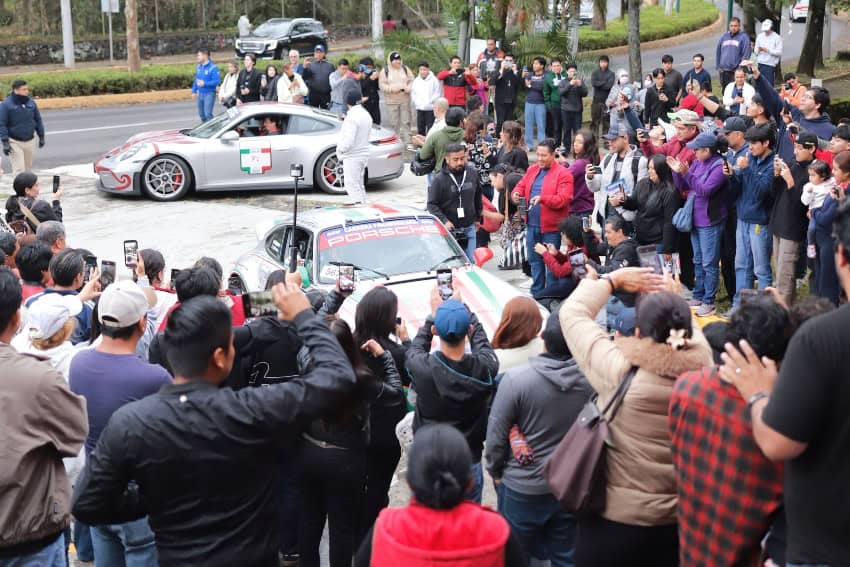
“Mexico is the only place in the world where you can pass the police while going 180 mph, and they’ll smile and wave at you,” said Jan Bednar, a professional race car driver who made his debut in Mexico. “I love it. I’m having the best time.” A few days prior, Bednar had arrived in Mexico from Czechia to compete in the legendary La Carrera Panamericana, or the Pan-American Race. It’s not every year that Mexico’s legendary Carrera Panamericana makes a pit stop in Veracruz. (Alan Chazaro) The Czech driver brought a restored 1969 BMW 3.0 CS that once competed in the Pan-Am over a decade ago. He even gathered the original team that had once raced in Mexico with the same vehicle — a classic German speedster that he said he found collecting dust in a forlorn garage in Eastern Europe. He was inspired when, after asking around, he found out about its former days in the Pan-Am. Bednar was one of many international motorists from 15 countries to have saved up enough resources — upwards of $75,000 — to race in the 39th edition of La Carrera Panamericana. A deadly origin story on the open highway The race has developed a notorious reputation as one of the most dangerous, even deadly, open-road endurance rallies in the world. It launched in 1950 as part of an initiative from the Mexican government to highlight its completion of the Pan-American Highway. Mexico’s greatest race: The 1950 Carrera Panamericana The highway itself, which spans 19,000 miles, was proposed by the United States as a railroad in 1889. In 1923, that idea evolved into an automobile thoroughfare and was revisited at the International Conference of American States in Santiago, Chile. It took 13 years for the 21 involved nations to sign on to build their respective sections, a sprawling agreement finalized at the Convention on the Pan-American Highway in Buenos Aires, Argentina. In 1936, the highway — heralded as an international diplomatic success — announced the completion of its first section from Laredo, Texas, to Mexico City. Eventually, Mexico became the first country to finish its border-to-border commitment, prompting the idea for the inaugural Pan-Am race. The race has since had a controversial, albeit exhilarating, history that brings professional racers, amateurs and hobbyists to Mexico for the landmark event. Known for its high death toll, with more than 30 fatalities in the first five years of its existence, the race was canceled in 1955 and remained dormant until 1988, when it returned in a modernized and regulated format. A modern course winding through mountain passes Today, the course extends from Chiapas to Chihuahua, covering eight states and nearly 2,400 miles for a seven-day haul across Mexico’s public roads. It is sectioned into timed portions and various classifications. While Mexican road conditions have significantly improved since the 1950s, the race is still seen as a perilous task and offers a highly coveted trophy. The longest open-road race in the world, La Carrera Panamericana winds nearly 2,400 miles across much of Mexico. (Alan Chazaro) After kicking off on Friday, Oct. 16, in Tuxtla Gutiérrez, the 50 registered crews and their vehicles — mostly vintage Porsches, Fords, Studebakers and Chevrolets — flock northward along the coast of Veracruz and up to the state’s port city before banking inland and ascending up the rainy highway into the Sierra Madre mountains toward Puebla. The 100 drivers made a colorful pit stop in Xalapa, where hundreds of local fans gathered in the parking lot of a science museum to cheer on the competitors, who drove through the city’s avenues as a caravan. Many drivers got out to mingle with supporters and took a smoke break before blazing off in an impressive procession of throttling engines. The loudest applause came when Xalapa’s first local team, Don Justo, made its anticipated debut. Its two Mexican drivers, Iván Martínez and Salvador Aburto, received a hero’s welcome on their home turf. Local fandom and international drivers unite Fans of all ages gathered to witness La Carrera Panamericana in person, which has only passed through Veracruz a handful of times because the route continuously shifts with each edition. “Motorsports have had a major boom in Mexico since Checo Pérez (debuted in Formula One in 2013),” said Arturo Ibáñez Gómez, a fan from Xalapa. “But it’s not common to always see these racers up close, especially in smaller cities.” Despite a busy work schedule, Ibáñez Gómez said he wouldn’t miss the rare chance to see the race cars up close, even braving the scattered rain and high winds that morning. He certainly wasn’t alone in his dedicated fandom. Ramsés López and his father, Alejandro, were in attendance among hundreds of others as car enthusiasts and vintage collectors. For them, having the race in their hometown was a blessing. Although contemporary performance cars like this BMW are welcome, much of the race’s legendary allure comes from the numerous vintage vehicles that participate. (Alan Chazaro) For others, being in Xalapa — let alone Mexico — was an unlikely yet thrilling moment. Carter Fournier of Dallas, Texas, entered the race with his 1970 Porsche 911. Like many participants, it was his first time racing south of the U.S. border. “This is the last road race like this of its kind in the world. It’s special,” Fournier said. “There’s nothing like it left. This is the best of the best. It doesn’t get any better.” A timeless tradition in North American racing Notable racers included former Production World Rally Championship champion Benito Guerra Jr., a Mexican legend who was swarmed by fans in his 1983 Porsche 911. His small but muscular car was tailored with RSR specs built specifically for tarmac rally racing. Did ‘The Formula 1 Exhibition’ in Coyoacán live up to its flashy namesake? Though the race has lost some of its universal fame over the decades, it still evokes a sense of romantic timelessness from a renegade era of Mexican motorsports. For those in the know, it’s a holy grail event in North American racing lore — and worth standing around in inclement weather as part of a large crowd just to give a driver a thumbs-up (trust me, they’ll always give you one back). Alan Chazaro is the author of “These Spaceships Weren’t Built For Us” (Tia Chucha Press, 2026), “Notes from the Eastern Span of the Bay Bridge” (Ghost City Press, 2021), “Piñata Theory” (Black Lawrence Press, 2020), and “This Is Not a Frank Ocean Cover Album” (Black Lawrence Press, 2019). He is a graduate of June Jordan’s Poetry for the People program at UC Berkeley and was selected as a Lawrence Ferlinghetti Poetry Fellow at the University of San Francisco. His work can be found in NPR, The Guardian, SLAM, GQ, L.A. Times, and more. He is currently based in Veracruz.
Full speed ahead: The 39th Carrera Panamericana lives up to its billing
Full Article
Original Source
Read the full article at Mexiconewsdaily →KhanList aggregates and links to publicly available news content. We do not host full articles from third-party sources. Always verify important information with original sources.