
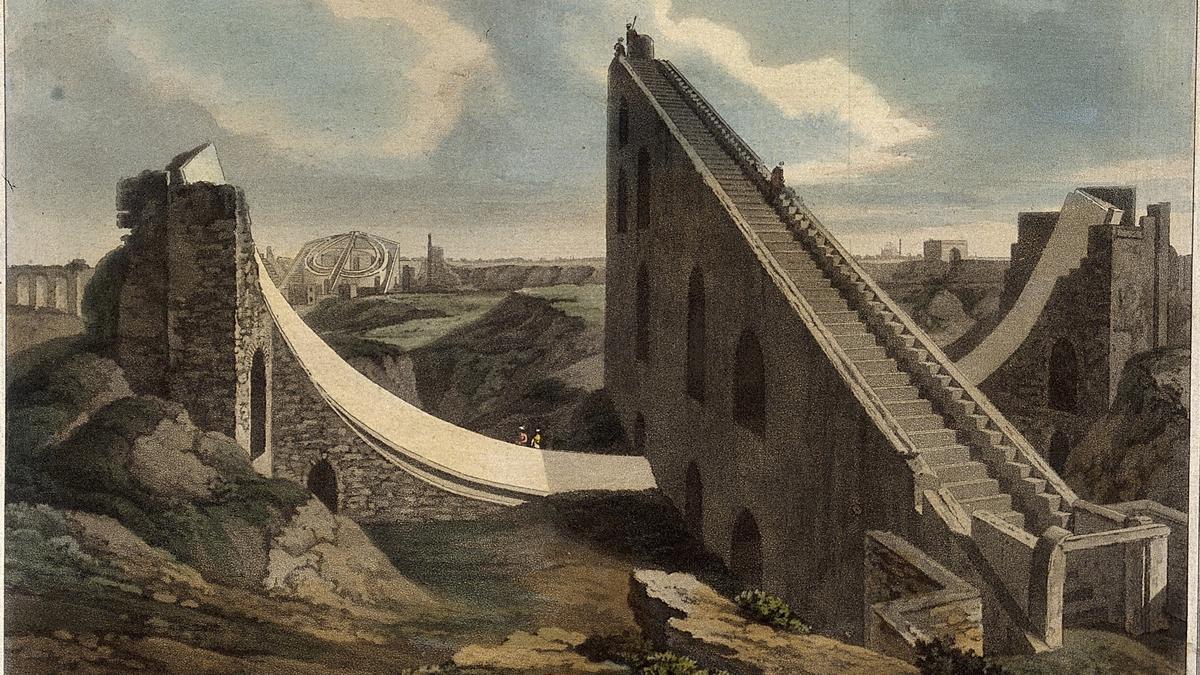
In January 2026, I visited Jantar Mantar, the open observatory in Delhi. It is a quaint place, with odd-looking structures decorating the complex. Most visitors to this ticketed monument are tourists from outside Delhi and it draws only a few thousands. Yet this monument, which most people skip on their itinerary, becomes one of the most Google-searched monuments in Delhi whenever there is political unrest.As crowds have been swelling at Jantar Mantar over the past few weeks, demanding the resignation of the Chief Election Commissioner, Gyanesh Kumar, a recent update has de-notified Jantar Mantar as the official protest site.Three new places, the Ramlila Ground, Burari Ground, and CBD Ground, East of Delhi, have been designated for organising demonstrations in the city.But this was not always the epicentre of demonstrations in Delhi. In 1988 the capital city was rocked by a nearly week-long farmers’ protest, attended by tens of thousands at Boat Club lawn near India Gate and Rajpath (now Kartavya Path). The lawn’s proximity to Government buildings, and the sheer size of the crowds alarmed the authorities. Jantar Mantar, Delhi Observatory, by William Daniell (late 18th Century) | Photo Credit: Special Arrangement After the Babri Masjid demolition in December 1992, protests were moved to Jantar Mantar, almost two kilometres away. NEW DELHI, 07/02/2023: Visitors enjoys near Misra Yantra is one of the four unique astronomical instruments of the Jantar Mantar in New Delhi on Tuesday, February 7, 2023. . Photo: SHIV KUMAR PUSHPAKAR / The Hindu (To go with Alisha's story) | Photo Credit: SHIV KUMAR PUSHPAKAR While the Boat Club lawn was open Jantar Mantar was a contained road between Ashoka Road and Parliament Road. Police authorities felt its linear layout would allow fewer crowds and make traffic easier to manage. In the summer of 2026, Jantar Mantar became the site of what was arguably India’s biggest street protest of the century, supported by the Cockroach Janta Party, founded by Abhijeet Dipke, 30, a political communications strategist.Tracing the journeyTo understand how Jantar Mantar acquired this unlikely identity, we need to go back in time, to its origins in 18th-Century Delhi when it had little to do with protest and everything to do with the pursuit of astronomical knowledge. The monument was born of intellectual curiosity and a versatile set of ideas aimed at reforming society. Jantar Mantar, or Yantar Mantar, was built around 1724 by the founder of the city of Jaipur, Maharaja Sawai Jai Singh II (1693-1744), with permission from Mughal Emperor Muhammad Shah ‘Rangeela’.Jai Singh was an able statesman, scholar, architect and planner. He was well educated in astronomy and observation, drawing on both eastern and western traditions.According to popular legend, Muhammad Shah Rangeela was about to embark on a long journey, and an auspicious day had to be fixed. Muslim and Hindu astrologers could not agree on the planetary movements best suited for the journey. Jai Singh suggested the issue stemmed from inaccurate astrological tables. The idea of building an observatory dawned on him and he went on to build Delhi’s Jantar Mantar, the first observatory, followed by observatories in Jaipur, Ujjain, Mathura, and Varanasi. Cockroach Janta Party supporters gather at Jantar Mantar in New Delhi on June 6, 2026, at the group’s first protest over the NEET paper leak | Photo Credit: Muzzamil Bashir Jantar Mantar is an open-air observatory with an unbelievable collection of instruments that scientifically carry out organised study of celestial bodies without a telescope. The heritage site is popular amongst school students and science enthusiasts. While leading history walking tours at Jantar Mantar, I feel dwarfed by the imposing structures built almost three hundred years ago.The 13 instruments here are painted red and white and are well maintained given their age. The astronomical instruments were made on a large scale using bricks and lime. Their scale and permanence ensured accurate calculations, something the smaller instruments of the time could not achieve. NEW DELHI, 14/10/2026: Students protest march against CEC Gyanesh Kumar near Jantar Mantar, New Delhi on Wednesday. Photo: Sushil Kumar Verma / The Hindu | Photo Credit: SUSHIL KUMAR VERMA Inside Jantar Mantar there are unfamiliar structures: Samrat Yantra, Jai Prakash Yantra, Ram Yantra and Shashthamsa Yantra. Only Samrat Yantra was reproduced elsewhere; the rest are specific to Delhi and Jaipur. The Misra Yantra, the most visually famous structure in the complex, consists of five instruments. It can track the shortest and longest days of the year and measure equinoxes. Samrat Yantra, the supreme instrument, is a sundial that can accurately measure the time of day to half a second. The Jai Prakash Yantra looks like two complementary stone bowls, each wider than a classroom, sunk into the ground. Each structure, is a map of the sky turned inside out. The Ram Yantra is a huge circular stone structure with no roof, with a single pillar in the centre. Astronomers stood inside it to calculate the position of the stars. A drainage system ensures rainwater does not collect and damage the instruments. Jai Singh worked at the Delhi observatory for seven years, and finally compiled a catalogue of 1,018 star positions. The Delhi observatory saw two major renovations — one in 1852 and the other in 1910, both by the royal family of Jaipur.The earlier shining white limestone colour of the instruments gave way to the crimson red of today. A nod to the place’s political history, where countless individuals have sat in hunger and solidarity. Anoushka Jain is a historian and the author of Badass Begums: The Incredible Women Who Shaped Mughal India.
From stars to streets: The history of Jantar Mantar in New Delhi
Full Article
Original Source
Read the full article at Thehindu →KhanList aggregates and links to publicly available news content. We do not host full articles from third-party sources. Always verify important information with original sources.