
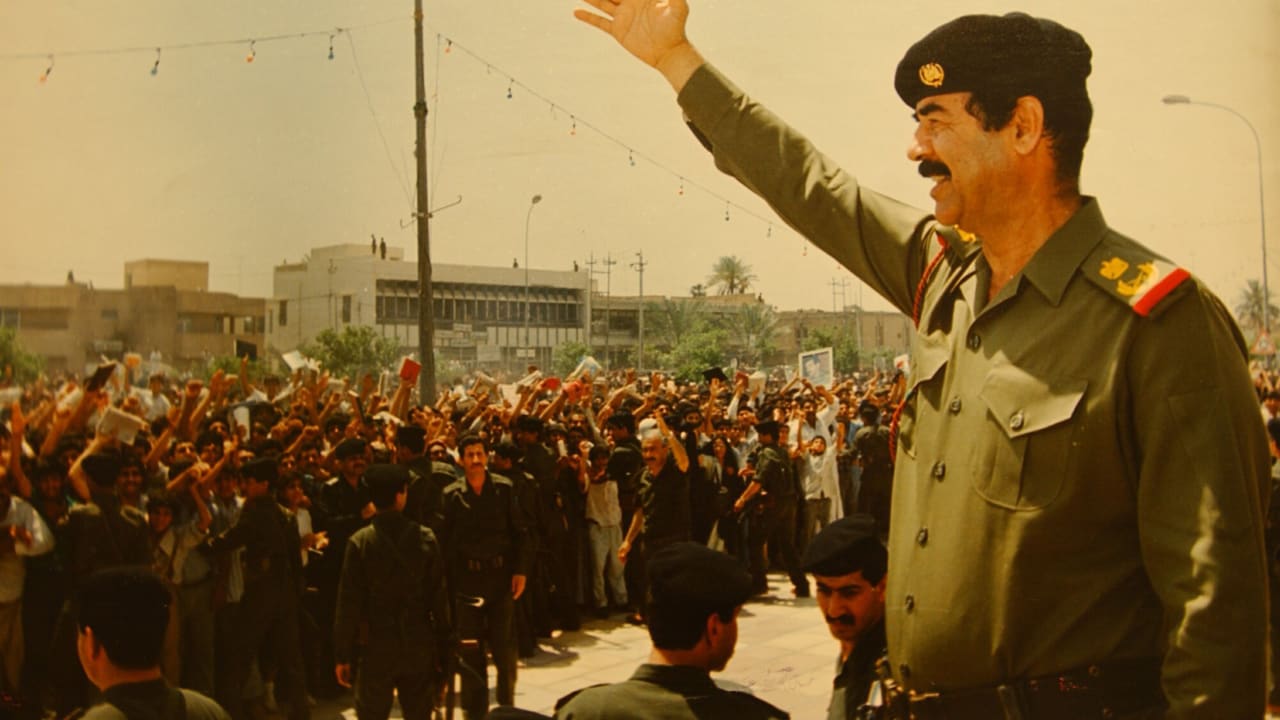
OCTOBER 14, 2026 11:44On September 22, 1980, as Iraqi warplanes bombed Iranian airfields and Saddam Hussein's tanks crossed the Iranian border, Supreme Leader Ayatollah Ruhollah Khomeini appeared remarkably unconcerned by what was unfolding in the fledgling Islamic Republic.Iraq’s attack, he told the Iranian people, was little more than “a thief throwing a stone” before running away. There was no reason to panic, he insisted, and certainly no reason to believe that Iran had entered a major war. The country's armed forces were perfectly capable of dealing with the threat.History, of course, would prove him spectacularly wrong as the war dragged on for eight long years and left an estimated half a million people dead.Saddam's invasion brought together a deeply fractured Iranian nationHowever, for all the destruction that followed, Saddam's invasion also achieved something that the Islamic Republic, barely a year and a half old, could scarcely have accomplished on its own. It brought together a deeply fractured Iranian nation, many of whose people had little affection for Khomeini or the clerical establishment that had seized power in Tehran.Nearly half a century later, with Iran engaging twice in the space of one year against Israel and the United States, the question of how Iranians respond to an external enemy has returned to the fore. And while Iran's leaders have spent much of the past year insisting that the country stands united behind them, the events unfolding inside Iran tell a considerably more complicated story.Still from a video purporting to show an Iranian drone launch, released by Iran August 31, 2026. (credit: SCREENSHOT/X/@IRANinMumbai)When Saddam launched his invasion, Iran was still struggling to come to terms with the revolution that had overthrown Shah Mohammad Reza Pahlavi in February 1979. The revolutionary government had barely established control over the country, while competing political factions were fighting for influence, and the military, once among the most powerful in the Middle East, had been weakened by purges of officers associated with the former monarchy.There was unrest in the provinces and among different ethnic groups, opposition to clerical rule was growing, and the new Islamic Republic was still engaged in the bloody business of eliminating its political rivals.From Baghdad, Hussein believed he had found his moment to strike and take, among other things, the Shatt al-Arab waterway and its key oil installations.The Iraqi dictator calculated that Iran's internal turmoil would make a swift military victory possible, particularly if he could exploit the country's ethnic divisions. Hussein hoped that the Sunni-majority Arab population of Khuzestan, the oil-rich Iranian province bordering Iraq, would welcome his troops as liberators against their Shi’a oppressors.. He was very much mistaken.Rather than embracing the invading Iraqi army, many Iranian Arabs joined their compatriots in defending their homeland. Political opponents of Khomeini, including supporters of the ousted monarchy, similarly recognized that whatever their differences with the new government, the country's territorial integrity was at stake. Crown Prince Reza Pahlavi, a trained fighter pilot and son of the exiled Shah, even extended an offer to his country’s new rulers to return and fight for Iran.Iranian patriotism, it turned out, extended considerably further than loyalty to the Islamic Republic."We are ready to send all our children to battle the thugs,” Khomeini stated just days after the invasion.For Khomeini, the war provided an opportunity to harness that patriotism and place the defense of the nation at the center of his revolutionary government's struggle for survival. As the fighting dragged on, the regime more and more associated resistance to the Iraqis and Hussein with support for the Islamic Republic itself, while the demands of wartime offered further opportunities to silence domestic opposition and consolidate clerical rule. This was also the period of massive expansion in the Islamic Revolutionary Guards Corps - originally formed to safeguard the revolution domestically.By the time the guns finally stopped in August 1988, the Islamic Republic had survived its greatest external challenge and emerged with a far stronger grip on power than it had possessed when Iraqi troops first crossed the border.If the 1980-88 war, however, was relatively successful in its ability to get Iranians to “rally around the flag,” the wars of 2025 and 2026 proved more difficult for the Iranian regime to succeed in garnering nationalist fervor.Unlike Iraq, American and Israeli military campaigns were conducted from the airUnlike Saddam's invasion, which involved Iraqi ground forces attempting to capture and occupy Iranian territory, the American and Israeli military campaigns were conducted overwhelmingly from the air, targeting nuclear facilities, missile installations, military infrastructure, and senior figures within the Islamic Republic's security establishment.Neither the US nor Israel attempted a comparable occupation of Iranian territory, and both countries repeatedly presented their military operations as directed against the regime and the threat posed by its military capabilities, rather than against the Iranian people themselves.The reaction this time around, from Iranians, was very different.There were, of course, civilian casualties, and considerable anger at the attacks, including among Iranians who have little sympathy for the government. The bombing of one's country by foreign powers is hardly a straightforward proposition, regardless of how deeply one despises those who govern it.But Iran in 2026 is also a country that has endured almost five decades of Islamic Republic rule, successive waves of protests, deteriorating economic conditions, and increasingly brutal attempts by the authorities to suppress opposition.The nationwide uprising that began in December 2025, and the massacres that followed in January, which left an estimated 40,000 people killed in two days, added another devastating chapter to that history. Security forces sought to crush demonstrations that had spread across the country, leaving families mourning their dead and an already profound divide between the population and the political establishment even deeper.It is against this background that Iranians' response is even more powerful.During Iraq’s invasion, Iranians from across the political spectrum rallied to defend their country against a foreign army. In 2026, footage emerging from inside Iran has shown people thanking the leaders of the very countries carrying out strikes against the Islamic Republic.Graffiti appealing directly to US President Donald Trump and Prime Minister Benjamin Netanyahu began appearing during the January uprising, including messages pleading with them to intervene as protesters faced the security forces. Following the American and Israeli military operations, other messages went considerably further, thanking Trump and Netanyahu for their actions.In Karaj, west of Tehran, graffiti reading "We love you BB," a reference to Netanyahu, appeared on a wall, while videos circulated by Iran International showed Iranians expressing gratitude toward both leaders.The sight of Iranians publicly thanking an Israeli prime minister and an American president for military action against targets inside their own country would have been almost inconceivable during the Iran-Iraq War.Such expressions are not representative of the entire population, but the fact they are seen and they are there is crucial in understanding the standing of the Islamic Republic currently. Many Iranians oppose foreign military intervention, including those who are bitterly opposed to the Islamic Republic, and the continued appearance of pro-government rallies (however falsified their attendance numbers) demonstrates that the authorities retain a constituency prepared to mobilize in their support.Nevertheless, the messages of gratitude, particularly those directed toward Netanyahu, offer an astonishing illustration of how far relations between sections of Iranian society and their rulers have deteriorated.The Islamic Republic, meanwhile, sought to portray the wars as further proof of the country's enduring national unity.Following the Twelve-Day War in June 2025, senior military and political officials repeatedly praised the solidarity of the Iranian people, with IRGC spokesman Brigadier-General Ali Mohammad Naeini declaring that Israel had encountered the "ironclad unity of the Iranian people."Similar declarations accompanied the renewed conflict in 2026. In September, IRGC Aerospace Force commander Brigadier-General Majid Mousavi praised the nightly pro-government gatherings, describing them as a demonstration of the Iranian people's commitment to defending their country's identity, independence, and very existence, while urging continued support for the Islamic Republic and its armed forces. Later that month, President Masoud Pezeshkian accused the US and Israel of attempting to sow divisions within Iranian society, insisting that the country was experiencing "unprecedented unity and cohesion."Such language would have been familiar to Khomeini, who spent much of the Iran-Iraq War portraying the sacrifices of ordinary Iranians as evidence of the nation's commitment to the revolution. But to proclaim national unity is one thing. Demonstrating that the population remains united behind those making the proclamations is quite another.An incident in Tehran last Friday evening provided a particularly interesting example.Foreign Ministry spokesman Esmail Baghaei, one of the Islamic Republic's most recognizable diplomatic voices throughout the conflict, was booed by members of an audience attending a performance of Arash, an orchestral theatrical production based on the legendary Iranian archer who sacrificed himself to protect his homeland.According to footage circulated by Iranian media, Baghaei had taken a microphone to address the audience when some spectators began booing him.Arash occupies a special place in Iranian mythology, a patriotic figure immersed in the defense of the nation's territorial integrity. That a senior representative of the Islamic Republic should encounter such a hostile reception at a production celebrating one of Iran's most enduring national heroes speaks to the complicated relationship between Iranian national identity and the clerical government that claims to represent it.It also lets us see into a small window of the current feelings of the Iranian people compared to 1980.Hussein invaded an Iran was still coming to terms with the upheaval of revolutionSaddam Hussein invaded a country that was bitterly divided, politically unstable, and still coming to terms with the upheaval of revolution. His expectation that those divisions would make Iran easy prey proved disastrous, as Iranians who disagreed profoundly about their country's future nevertheless found common cause in defending its borders.Khomeini was able to capitalize on that national resistance, using the war to strengthen the very political system whose future had appeared so uncertain when the fighting began.The Islamic Republic's present leadership has sought to draw upon much the same sentiment, invoking the nationalistic language of sacrifice, sovereignty, and resistance, while insisting that the nation stands firmly behind its armed forces. For those who know Iranians, love of their homeland is one thing that can bring them together.But the Iran of 2026 is a very different country from the one Saddam invaded. Its people have lived under the Islamic Republic for almost half a century, and for a substantial section of the population, the government itself has become inseparable from the grievances that have repeatedly brought Iranians onto the streets.Forty-six years ago, Saddam discovered that Iranians were prepared to put aside their differences to defend their country, allowing Khomeini to transform a war for national survival into a foundation for the Islamic Republic's consolidation. Today, the same government continues to invoke the patriotism of the Iranian people, but after decades of repression, revolution, and economic uncertainty, it can no longer assume that those who love their country are still loyal to those who rule it.Follow us on Google
From Saddam Hussein to Israel: How Iran's wars have divided a nation - analysis
Full Article
Original Source
Read the full article at Jpost →KhanList aggregates and links to publicly available news content. We do not host full articles from third-party sources. Always verify important information with original sources.