
In Sarkar (the movie), Vijay broke a free television and delivered a lecture.In Vijay’s sarkar (the administration), the television has returned as electricity, bus travel, breakfast, gold, gas and governance. Two hundred units of free electricity. Free bus travel extended and renamed Vetri Payanam. Breakfast enlarged. Crop loans waived within limits. Three LPG cylinders promised through reimbursement. Gold rings placed upon the fingers of mothers of newborn babies.Superstar Vijay broke the television. Chief Minister Vijay inherited the connection.Tamil Nadu goes to the polls on October 6 in two constituencies, but almost every political meaning in circulation is contesting: welfare against freebie, freshness against inheritance, mandate against defection, achievement against announcement, cinema against administration. Madurantakam and Dharapuram are merely the booths. The whole state has entered the argument.MUCH ADO ABOUT TWO SEATSThese by-elections were not caused by death, disqualification or democratic calamity. They were manufactured by political migration. K Maragatham Kumaravel and P Sathyabama won Madurantakam and Dharapuram for the AIADMK in April. They resigned, entered the TVK and now seek election again from the same voters under a different banner.The Constitution provides a law against defection. Politics discovered that resignation is the side entrance. The MLA leaves the House, switches the flag and asks the public to pay for the return journey.Resignation followed by re-election is constitutionally cleaner than retaining the seat while secretly crossing the floor. But cleanliness is not innocence. Two legislators exercised their freedom of movement; two constituencies received the bill.The voters had already spoken. Politics disliked the answer and ordered a supplementary examination—with the same questions, the same candidates and only the party symbols rearranged.Democracy has become a repeat telecast for which the viewer must again leave home, stand in a queue and provide the rating.ALL THE STATE'S A STAGEAll Tamil Nadu’s a stage, and all its leaders merely campaigners.Vijay drives a tractor through Madurantakam, stops for tea and travels through 30 villages. Stalin attacks reels, prices and alleged MLA-shopping. Edappadi Palaniswami accuses Vijay of governing through clips. Vijay invokes MGR and Jayalalithaa and charges Palaniswami with betraying both.One drives the tractor. Another claims the farmer. A third inherits the plough. The actual cultivator continues waiting for water in Uppar Dam.Dharapuram asks for dependable irrigation, a new bus terminus and relief from congestion. The leaders arrive in convoys to discuss all three. The constituency receives traffic immediately.The Left supplies the campaign’s most advanced political philosophy. It supports Vijay’s government in the Assembly, opposes his candidates at the booth and may return after counting day to support what it opposed. Dialectics has finally acquired an electoral symbol.The PMK remains officially neutral. The AIADMK asks why its MLAs have been appropriated. The DMK asks whether TVK is genuinely new. TVK asks why the old parties are asking questions.To contest or not to contest was never the question. The question was who could change sides before nominations closed.THE BODY AND THE BODY POLITICStalin possessed a legitimate political target: defection. He had allegations of inducement, the “suitcase” epithet and Sathyabama’s spectacular somersault from the AIADMK to TVK.He still found it necessary to refer to her physical appearance.In one careless sentence, the prosecutor misplaced the case and placed himself in the dock. The political accusation became a body-shaming controversy; the defector became the injured party; and the campaign forgot what it had gathered to discuss.When politics runs out of restraint, it begins measuring the opponent.TVK complained to the Election Commission. Its indignation was justified. But Tamil Nadu’s campaign culture has long granted every party freedom of expression and every speaker freedom from editing.It is a free-for-all State: free electricity, free travel, free invective and, occasionally, freedom from good sense.FREEBIE BY ANY OTHER NAMEA freebie is what the Opposition calls your welfare scheme. Welfare is what a government calls its freebie after attaching an eligibility certificate.The distinction matters. Free bus travel can widen access to employment. School breakfast can improve attendance and nutrition. Electricity relief can protect vulnerable households. Crop-loan assistance can prevent distress from becoming ruin. These are not automatically equivalent to election-time gifts.But attaching a halo to every handout does not make it sustainable. Who qualifies? Who pays? Does it create capability or dependency? Is it an entitlement supported by fiscal design—or electoral affection charged to the future?Vijay’s government has done more than issue trailers. Electricity relief is operational within an eligibility ceiling. The DMK’s breakfast programme has been extended to Classes VI–VIII. Free bus travel, another inherited scheme, has been widened under Vetri Payanam.Closing 717 TASMAC outlets near sensitive locations is measurable action, though not prohibition. Anti-narcotics teams and the Singappen women’s-safety mechanism create structures whose worth must eventually be judged by outcomes.Continuity is not plagiarism when public policy benefits. But repainting the predecessor’s scheme and unveiling the nameplate is not an invention either.Renaming a bus does not move it faster. Expanding its route does.The three-cylinder reimbursement remains scheduled for Pongal 2027. It belongs in the promise column, not the achievement column. The gold-ring scheme has begun, glittering with sentiment, spectacle and the Tamil kinship vocabulary of the thaai maaman (maternal uncle).The gold ring is new. The political circle is not.GOVERNMENT IN FUTURE TENSEThe investment record deserves fair credit. Ninety-seven agreements worth roughly 67,452 crore, carrying the prospect of more than one lakh jobs, indicate business confidence and governmental activity.They are also agreements.A memorandum of understanding is industry in the future tense. It becomes an achievement only when capital arrives, factories rise and appointment orders replace publicity pamphlets.The same test applies to Rule 110 declarations. An announcement is a cheque written by politics and post-dated by administration. Rule 110 can launch a promise. Only Rule One of governance—delivery—can land it.Vijay’s government has not been motionless. Nor has it travelled as far as its publicity. It has moved—and filmed the movement from three angles.Its withdrawal of the attempted RTI exemption for the law-and-order wing of the Public Department deserves notice too. The original decision was indefensible; reversing it showed responsiveness. Government is allowed to correct itself. Only insecure governments convert every error into an ideological monument.A ROAD BY ANY OTHER SCRIPTThen came a State Highways signboard near Sathankulam bearing Tamil, English and Hindi. Hindi was erased, two engineers were suspended and Tamil civilisation was pronounced up and running by evening.Tamil Nadu is right to resist compulsory Hindi and the use of Union funds as linguistic leverage. But a direction board is not a constitutional amendment. It neither alters State policy nor enrols the passing motorist in a Hindi class.A road written in another script still leads to the same town.If Malayalam helps travellers near Kerala, Kannada near Karnataka or Telugu near Andhra Pradesh, practicality should prevail. Where migrant workers and visitors use Hindi, limited inclusion need not amount to surrender—provided Tamil remains primary and local need determines the additional language.Hindi is heard without alarm at worksites, markets and railway stations. Paint it on a signboard and the administration reaches for suspension orders.A language becomes imposition when power compels its acquisition. It does not become an invader merely by supplying directions to Tiruchendur.Vijay entered government as the emissary of a new political generation. Yet when the oldest Dravidian reflex was activated, his administration responded with the reflexes of its predecessors.The board showed three languages. The politics spoke only one: continuity. Here, you might want to check out my detailed commentary on the pointlessness of the Sathankulam signboard row.THE FUTURE MISSING FROM THE CAMPAIGNTamil Nadu’s foundational battles over language, social justice, education, welfare and State autonomy altered lives and enlarged democracy.But what was revolutionary in the 1950s and 1960s cannot remain a complete programme for 2026. Much of that inheritance is now embedded in the political consensus. No major party proposes abolishing reservation, abandoning welfare, degrading Tamil or restoring the social order against which the Dravidian movement rebelled.The argument has moved. The campaign has not.Today’s Tamil Nadu wants employable graduates, reliable cities, productive agriculture, safer women, cleaner politics, competitive industry and welfare that creates mobility rather than gratitude.It wants a future, not merely a more polished narration of the past.This was Vijay’s opportunity: to retain the humane core of the Dravidian inheritance while breaking out of its exhausted mould; to speak of skills, local government, artificial intelligence, climate resilience and institutional reform.Instead, the campaign returned to MGR, Jayalalithaa, Periyar, Anna, Hindi, freebies, defections, reels, suitcases and somersaults.The man advertised as fast-forward conducted a campaign in rewind.Fresh politics cannot mean younger faces reciting older lines under brighter lights. The electorate does not reject history. It has simply finished that chapter and is waiting for the next one.THE VOTER OUTSIDE THE SCRIPTSomewhere beyond this drama stands the voter who elected the two defecting legislators only months ago.Citizens do not experience government through legislative arithmetic or memoranda of understanding. They encounter it as a bus that arrives, a school that teaches, a hospital that admits, an electricity bill that falls—or an official who refuses to answer.Politics debates the mandate over the voter’s head. The voter measures government at ground level, often without enough information to distinguish delivery from declaration.The smartphone has placed the world in the citizen’s palm. It has also allowed politics to arrive already clipped, captioned and interpreted. The politician increasingly governs through the 40-second extract.Visibility is mistaken for transparency. Virality becomes verification. The reel impersonates the record.THE FAMILIAR NEW WORLDVijay changed the cast, widened the screen and improved the trailer. But the screenplay still carries familiar fingerprints: leader-centred welfare, symbolic naming, linguistic alarm, cinematic staging, defections, borrowed icons and inherited schemes beneath new neons.TVK did not demolish the Dravidian house. It installed vertical screens and invited a new generation to the house-warming.That does not make Vijay’s government a failure. Four months is too short for a verdict. Bus travel has expanded, breakfast reaches more children, selected TASMAC shops have closed, new enforcement machinery exists, investment commitments are substantial and the administration has shown that it can reverse an error.But two constituencies cannot certify a government any more than two defeats can condemn it. A bypoll is not a referendum; it is a magnifying glass held over a small portion of the map.The results will indicate whether voters forgive the vacancies imposed upon them; whether the AIADMK can defend its plundered inheritance; whether the DMK has regained relevance; and whether Vijay’s popularity can be transferred to candidates carrying yesterday’s luggage.In Sarkar, Vijay riled against freebies because politics had reduced citizenship to a gift. In his sarkar, he has discovered that citizenship also carries claims—to food, mobility, electricity, safety and relief. That is not surrender. It is education.The danger begins when every entitlement becomes a leader’s largesse, every inherited scheme receives a fresh label, every announcement becomes an achievement and every voter is treated once again as an audience.On October 6, Madurantakam and Dharapuram will not decide whether welfare is free. They will decide whether political movement itself should remain free of cost—to the politician who changes sides, but never to the citizen summoned back to the booth.Vijay once broke the free television. Tamil Nadu will now discover whether his government has changed the channel—or merely taken possession of the remote.- Ends
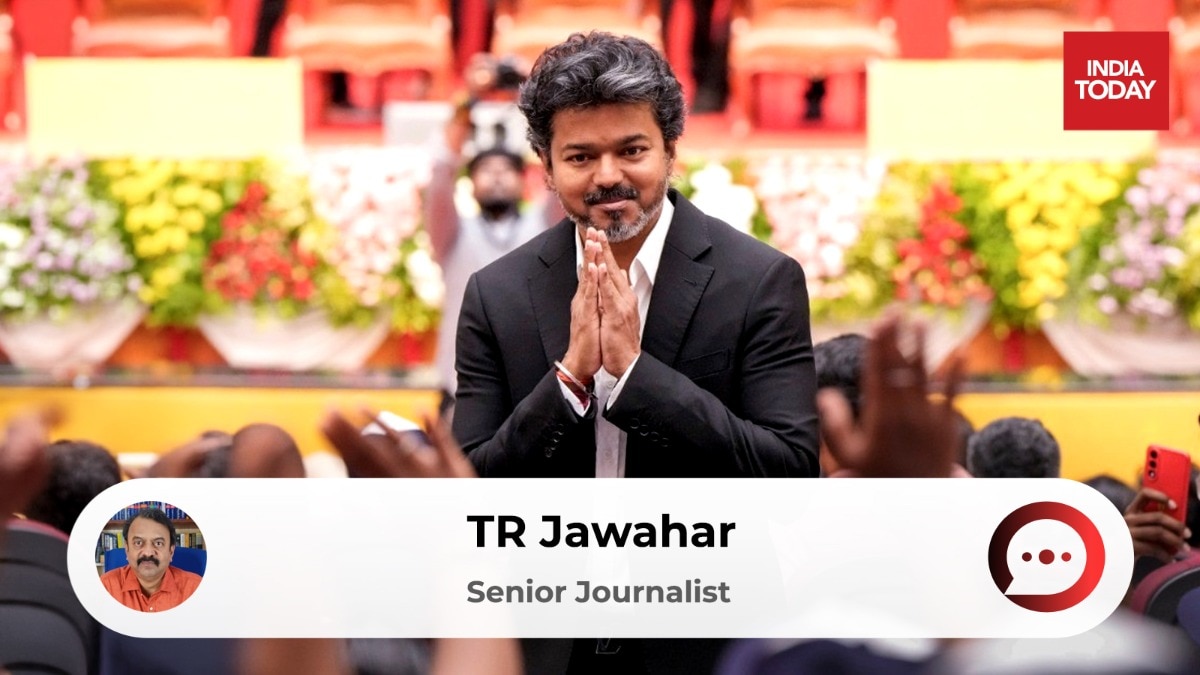
From reel sarkar to real sarkar, has Vijay really moved the cheese in Tamil Nadu?
Full Article
Original Source
Read the full article at Indiatoday →KhanList aggregates and links to publicly available news content. We do not host full articles from third-party sources. Always verify important information with original sources.