
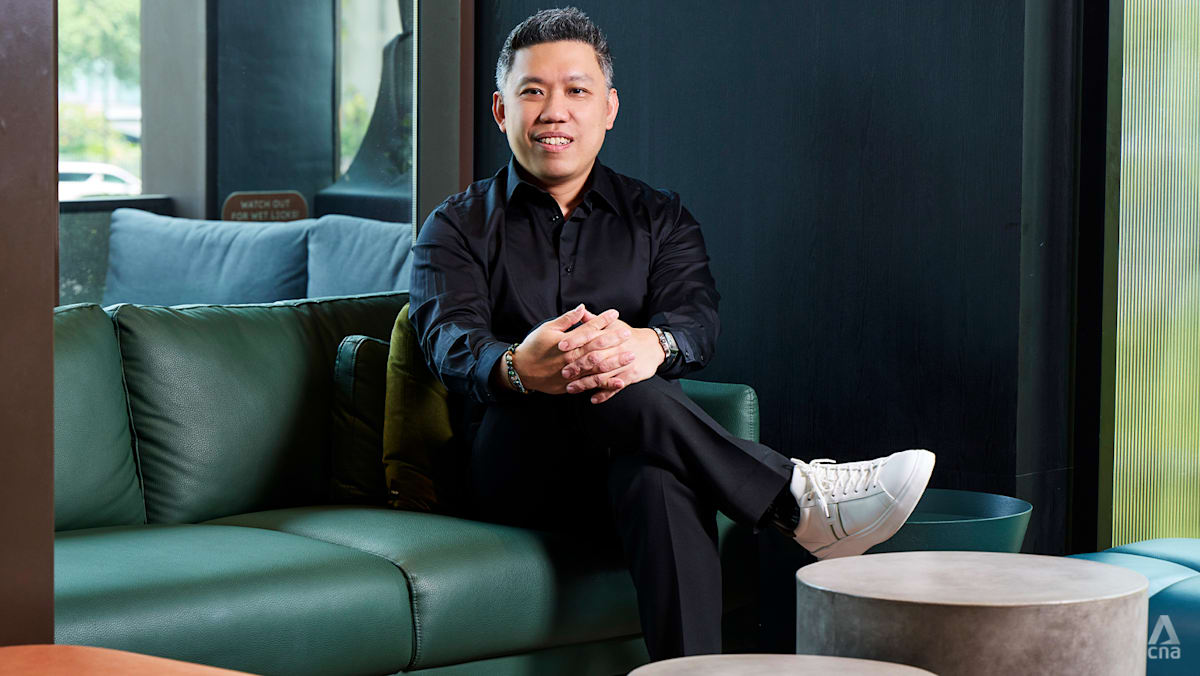
There is something mildly amusing about being a third-generation heir but having people mistake you for a professional manager. Josh Hu, 44, experiences this all the time. The most likely reason? His surname.“Hu” is the Hanyu Pinyin form of “Aw”, the surname under which his family is better known. Hu was born during Singapore’s early-1980s push to adopt Hanyu Pinyin names, an initiative that was later rolled back. The result has given him a convenient way to obscure the family connection rather than announce it. And he rather likes it that way.The Aw family is notoriously media shy. Hu himself, though friendly and perfectly happy to discuss his latest project – Mber, a hybrid of co-living rooms and serviced apartments – remains reserved.You get the sense that you are being given precisely as much of the family story as he has decided you need. There is a wall, and it’s a well-built one. Mber reflects Josh Hu’s push for residential spaces that retain some of the character of a boutique hotel without sacrificing liveability. (Photo: Mber) Established in 1971, AW & Sons Group – a boutique real estate developer and investment firm – traces its origins to the late patriarch Aw Kim Chen, who expanded his rubber-trading business into real estate. Today, the family office is headquartered at The Offshore, the group’s property on North Canal Road, with residential holdings in London.Three generations of the Aw family remain involved in stewarding the business. Hu is managing director of AW & Sons Capital, one arm of the group.During our hour-long chat at Mber, Hu recalled that he had never planned to join the family business. He was more interested in becoming a photojournalist, with stints at the now-defunct Wine & Dine and NewMan magazines, as well as watch publication Revolution. He even entertained ambitions of going into diplomacy.Then his grandfather summoned him. Mber’s communal library forms part of the development’s shared spaces for residents. (Photo: Mber) “I think he had a premonition that his health was failing, so he called me. He said, ‘It’s time to come back and help your dad’.”That might sound like the setup for a high-society K-drama, but Hu stressed that he was under no pressure to follow a predetermined path. In the Aw family, each generation is given room to explore its own interests.And when Hu did return, his grandfather didn’t simply give him a title and a place in the business. He gave him a piece of land instead.Specifically, it was a plot of family land in the Jalan Jurong Kechil area, measuring just under 270 sq m, where Hu believes his father grew up. It became Hu’s first redevelopment project: two semi-detached houses, which his grandfather dubbed his “rites of passage”.The houses were eventually sold. But the more important transaction had already taken place: Hu had discovered that property could be more than an asset class; it could be a creative medium.PROPERTY, BUT MAKE IT PERSONAL The Offshore on North Canal Road was one of Josh Hu’s early projects, conceived as a design-conscious hub for businesses and lifestyle brands. (Photo: The Offshore) Ask Hu what makes a good development and the answer isn’t simply yield, square footage or exit value. The numbers, naturally, have to make sense.“At the end of the day, our numbers still have to work. We can't work on a site where the numbers don't stack up.”But once the financials make sense, something less easily quantifiable comes into play. “You have to look at the value proposition. And when you try to delve into the value proposition, then it becomes the gut and the instinct for the place.”That thinking goes some way towards explaining why AW & Sons’ projects do not look like the output of a conventional property machine.For Hu, location, design, brand, customer and financial viability have to converge. The project is shaped by the place rather than the other way around – an approach to an industry that can sometimes feel overly formulaic.Hu is particularly wary of Singapore’s “cookie-cutter” development culture. His response has been to experiment with different formats – and, crucially, not assume that what worked once should simply be repeated. Josh Hu says his grandfather taught him to approach the family business “step by step, project by project” – part of the family’s preference for steady, patient growth. (Photo: CNA/Kelvin Chia) Hu described his family’s approach as “patient capital”. “My parents are very prudent and thrifty. They are not chasing quick returns or the goose that lays the golden eggs.”Instead, the idea is to acquire good land in good locations and give those assets time to grow. “From my granddad to my dad, I think it's always been that we want to do things in a stable sense. My granddad’s famous words to me are that we do it step by step, project by project. And in that way, we can secure the family legacy as well.”There is a second lesson embedded in that philosophy: nothing is guaranteed simply because you were born into the family.“Nothing is handed on a silver platter,” said Hu. “I'll give you a bit to try. You have to prove to me that with whatever that you're given, you start small, but whatever you're given, you have to make the best of it.”The implication was clear: inheritance gets you a seat at the table. What you do with it is another matter.FROM THE OFFSHORE TO SOLOHA Opened in 2019, Hotel Soloha was one of Josh Hu’s experiments with a more design-led approach to hospitality. (Photo: AW & Sons) If the Jalan Jurong Kechil project was Hu’s baptism, The Offshore was where things got more ambitious.The family’s three-storey North Canal Road development opened in 2012, when Singapore’s CBD did not have quite the same ecosystem of lifestyle-led commercial spaces it does today.The concept was closer to what you might encounter in London or New York: a slightly masculine, design-conscious hub where businesses and lifestyle brands could coexist.Tenants included barbershop Sultans of Shave, tailors and the first local outpost of Ritual Gym – back when boutique HIIT-style fitness was just taking root in Singapore.The gamble worked. “It's still fully occupied,” Hu said. “It's been more than 10 years.”Hu’s approach to choosing tenants is revealing, too. In a market where landlords may prioritise maximising rental returns, he takes a longer view. “We have been quite supportive of our tenants, because to me there's no point chasing a tenant out to get a higher rent, and then the whole tenant mix gets thrown off.”It is another example of his belief that the individual components of a property matter less than the experience they create collectively.Then came Hotel Soloha. Josh Hu with his father, AW & Sons Group chairman Aw Chye Wee, at the opening of Hotel Soloha. (Photo: AW & Sons) Located on Teck Lim Road, just off the Keong Saik stretch, the boutique hotel opened in 2019, shortly before the COVID-19 pandemic. It was decidedly neither beige nor bland. Local artists created punchy murals and lift artwork; a funky noodle bar occupied the ground floor; even the reception desk doubled as a bar.Hu acknowledged that Singapore’s boutique-hotel pioneers had already laid the groundwork – Unlisted Collection founder Loh Lik Peng, for one, was “way ahead of us” – but Soloha represented an opportunity for his family to combine its property know-how with design and heritage.“We wanted it to be something more short-term, something more sexy and cool as well.”It was also, he admitted, a steep learning curve. After the pandemic, the family received an offer it decided was too good to refuse and sold the property.For a developer looking to replicate a formula, that might have been the end of the story. For Hu, it was the beginning of another experiment.FROM HOTEL TO HOME Mber’s facade along Teck Chye Terrace reflects the development’s attempt to respond to the history and streetscape of Upper Serangoon. (Photo: Mber) Mber, his latest project in Upper Serangoon, grew partly out of what Hu thought Soloha had got wrong.The issue was space. Boutique hotels might be aesthetically appealing, but applying the economics of a conservation property to a residential concept could mean carving rooms into sizes that were financially efficient but not necessarily pleasant to live in.Hu wanted something different. “After Soloha, we realised that we wanted a product whereby the rooms are not too small, but yet you can retain the character of a boutique hotel within a residential setting,” he said. “I think that element is lacking in Singapore.”Enter Mber, with 125 units comprising 78 co-living rooms and 47 serviced apartments. “The room sizes are within 18 to 20 sq m, on average. And to me, that is the minimum livable space,” he said.Mber stands on the site of the former Lim Tua Tow Market, also known as Gor Kok Jiok, or “fifth milestone”, after this stretch of Upper Serangoon Road. The market served the surrounding community from the 1950s, while neighbouring Teck Chye Terrace dates to 1928.Rather than attempting to recreate the old market as a nostalgia exercise, Formwerkz Architects took cues from the area’s shophouse language – sheltered five-foot ways and ground-floor eateries – and translated them into a contemporary building. Again, the place dictated the product.There is also a practical business logic to the concept. While much of Singapore’s co-living inventory is concentrated in central areas, Hu saw an underserved market in the north-east.He pointed to families needing temporary accommodation while their HDB flats undergo the Home Improvement Programme (HIP) or home renovations, as well as expatriates moving to the area for work and families seeking proximity to international schools.The potential catchment is changing, too, stretching from Paya Lebar and Punggol Digital District to Seletar, as employment nodes and international schools draw more people to the wider north-east.“We're also seeing more foreign nationals relocating to Singapore, to work in the tech companies and MNCs being set up in Punggol. And then there are the mainland Chinese who are coming in because of international schools,” he said. For Hu, these shifts add up to an underserved market. What began as an unexpected return to the family business became, for Josh Hu, another way to express his creative instincts. (Photo: CNA/Kelvin Chia) A PORTFOLIO, NOT A FORMULAThere is a neat progression to Hu’s projects. The Offshore was a lifestyle hub. Soloha was a boutique hotel. Mber is a co-living and serviced-apartment concept shaped around its neighbourhood.Each one borrows something from the last without simply copying it. Hu said the group has now “come full circle”. Along the way, it has developed a portfolio of concepts and brands that could be adapted for future projects.That sounds less like a series of one-off experiments and more like the beginnings of a creative property playbook. Perhaps that is the unexpected path of the reluctant heir. Hu may have started out wanting to tell stories through media, images or diplomacy.Instead, he found another medium: buildings, brands and the spaces between them. As it turned out, he didn’t have to leave the family business to find his creative voice. He found it inside.
From photojournalism ambitions to property, Josh Hu took an unexpected route into the family business
Full Article
Original Source
Read the full article at Cnaluxury →KhanList aggregates and links to publicly available news content. We do not host full articles from third-party sources. Always verify important information with original sources.