
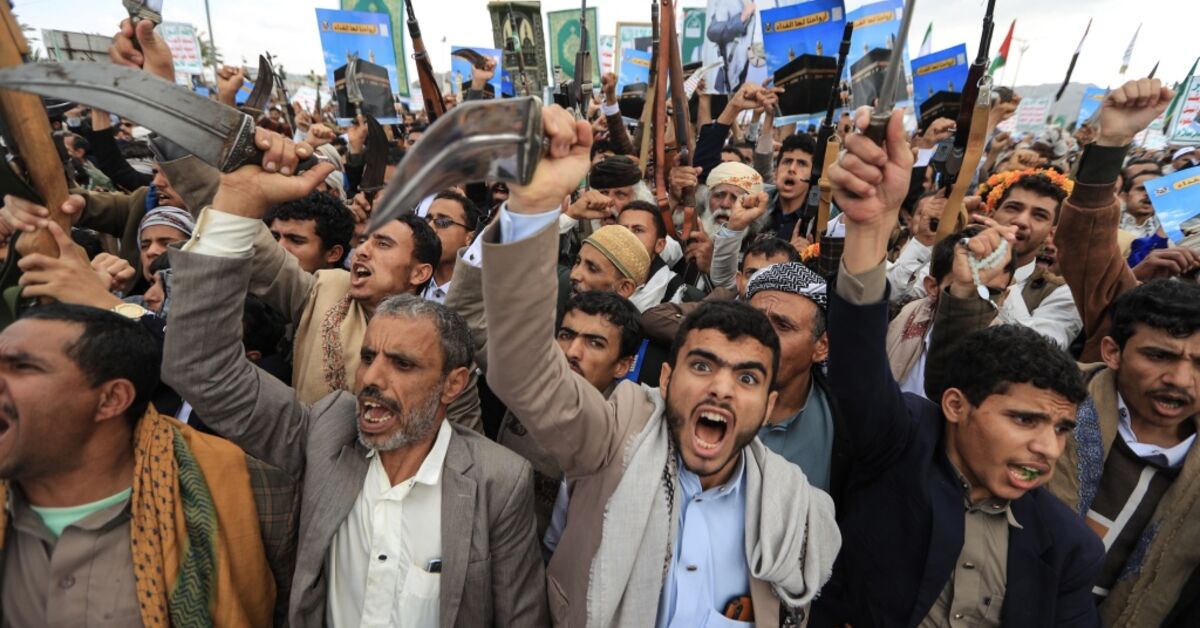
The Houthis emerged from obscurity in Yemen's hardscrabble north to control swathes of the country and pose a perennial threat to neighbouring Saudi Arabia, the world's top oil exporter. From their origins in the 1990s, the Iran-backed former mountain fighters now command the status of regional players capable of inflicting pain on global shipping and oil prices. Like the other armed members of Iran's "Axis of Resistance", the Houthis are hostile to the West, as befits their slogan: "Death to America, death to Israel." But unlike Lebanon's Hezbollah, the Houthis, who took the capital Sanaa in 2014 and have weathered a long-running war with a Saudi-led coalition, were not created by Iran. - 'Not taking orders' - "At the beginning, there were no structured ties between Iran and the movement," explains Mohammed Azzan, a scholar of Islamic thought who witnessed the Houthis' emergence in Saada, northern Yemen, in the 1990s. "Relations developed gradually as both sides discovered common interests." Their bond has strengthened since the Gaza war, which weakened the Palestinian movement Hamas and Tehran's other allies in the Middle East. The Houthis have been "drawing closer to Iran in pursuit of their own ambitions, without necessarily being under its orders", says Maysaa Shuja al-Deen, a researcher at the Sanaa Center for Strategic Studies think-tank. Their lightning offensive in September, when they captured the parts of the Red Sea coast not already under their control, illustrates the alignment of interests. Control of the strategic Bab el-Mandeb strait, the Red Sea's southern gateway, while Tehran is choking the Strait of Hormuz on the other side of the Arabian Peninsula, "increases Iran's bargaining power," while giving the Houthis "enormous leverage" over Riyadh, says Thomas Juneau of the University of Ottawa. - The road to Sanaa - When it was launched in 2001, the movement styled itself as representing Saada, the cradle of Zaydism -- a branch of Shia Islam, but different to that favoured in Iran. The northern city, the centre of Yemeni power for centuries, had become marginalised by the central government in Sanaa. The movement's founder, Hussein Badreddin al-Houthi, the son of a prominent religious figure, was already denouncing Israel and the US, using rhetoric inspired by Iran's Islamic revolution. After he was killed by Yemeni authorities in 2004 the group, later named Ansar Allah ("Supporters of God"), became more radical under his brother, Abdulmalik al-Houthi. Holed up in the northern mountains, his followers waged six wars against President Ali Abdullah Saleh before joining the uprising that drove him from power in 2012. In 2014, the Houthis nonetheless allied with Saleh and seized the reins of power in Sanaa, marking the start of their conquest of large parts of Yemen. Saleh was killed three years later, after turning against the Houthis. Saudi Arabia intervened at the head of a military coalition supporting the exiled government in early 2015, increasing Iran's interest in the Houthis. Although Iran denies giving support, Yemen's government announced the first seizure of arms destined for the Houthis in 2013. Deen said Iranian assistance grew from 2016, including the transfer of military expertise as well as communication and negotiation techniques, first through Hezbollah and then directly from Iran. The Al-Masirah TV channel was launched in Hezbollah's stronghold of southern Beirut before moving to Sanaa, broadcasting Houthi propaganda and Abdulmalik al-Houthi's speeches. Rarely appearing in public, he cultivates the image of a spiritual guide and defender of the Muslim world against the West and the Gulf countries, which he accuses of serving American interests. - 'Disproportionate pain' - Thanks to Iran, the Houthis have acquired drones and long-range missiles, allowing them to establish an "asymmetric balance of power" with Saudi Arabia, says Juneau. For years, they absorbed Saudi airstrikes by "exploiting Yemen's geography" while "inflicting disproportionate pain" on their neighbour by targeting its infrastructure. After a truce in 2022 calmed fighting, the movement built up its military production capacity and diversified its arms supply chain, sourcing from China and Russia via smuggling networks in the Horn of Africa. A report published by The Century Foundation think-tank in February said 35 percent of arms and materials intercepted en route to the Houthis between 2021 and 2025 originated in China. Iran was the next biggest supplier with 21 percent. "Without Iranian assistance, the Houthis would not be a regional power today," says Juneau. The Houthis have also benefited from recruiting elements of the former national army, forging alliances with tribes and, most importantly, the "weakness" of the government, which is plagued with internal divisions. "This has been as essential as Iranian assistance to the story of the Houthis' rise," Juneau says. saa/anb/th
From mountain fighters to 'regional power': the rise of Yemen's Houthis
Full Article
Original Source
Read the full article at Al-monitor →KhanList aggregates and links to publicly available news content. We do not host full articles from third-party sources. Always verify important information with original sources.