
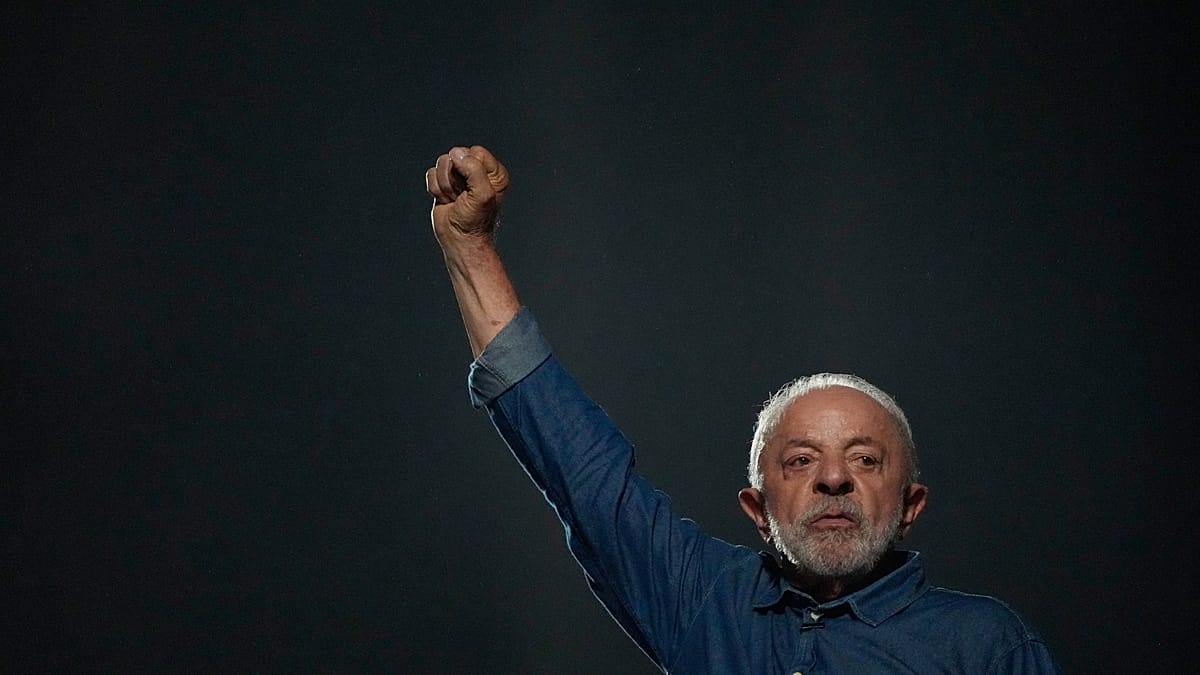
After losing in the first round, Lula da Silva pulled off a historic comeback to be re-elected president of Brazil in the second round. Back in the Palácio do Planalto, which he had never left, the leader of the Workers' Party (PT) defied unfavourable precedent: since 1989, the year when Brazil returned to direct presidential elections and introduced the two-round system**,** no candidate trailing after the first round had ever gone on to win the second. ADVERTISEMENT ADVERTISEMENT "I owe this to you. I have always thought that God has been very generous to me, because there are so many people better prepared than I am, so many people with more diplomas than I have, so many people who have read more books than I have, so many people who have studied more than I have," he said in his victory speech, his fourth after a presidential election. It was a first for Lula, too. In 1989, he finished 13.3 points behind his rival Fernando Collor de Mello in the first round and failed to close the gap in the second. From factory worker to trade unionist, from trade unionist to politician, from politician to president of Brazil. Nothing has ever seemed impossible for Lula, who once again showed with this election that adversity is not always insurmountable. "I want to tell you that I am enormously proud. First, because I am the only president of the Republic, a metalworker without a university degree, elected four times, democratically, to call for peace," he told the crowd. Lula, who turns 81 on Tuesday, promised "the best term" in Brazilian history. "The day after tomorrow, on the 27th, I will turn 81. And I want to make a pledge in front of the press and in front of you. I am going to deliver the best term any president has ever served in the history of this country," he vowed. The seventh child of illiterate farmer parents, Luiz Inácio Lula da Silva was born on 27 October 1945 in the Brazilian city of Garanhuns, in the north-eastern state of Pernambuco. He was only seven when he moved with his family to São Paulo, and 14 when he was admitted to a technical course in metalworking. Before that, he had already worked as a street vendor, shoeshine boy, and dye-shop assistant. He went on to become a metalworker, a profession he later defended as a trade unionist. "Lula" began as a nickname and was later officially incorporated into his name – he is the epitome of the worker who becomes a politician: it was as a union leader and organiser of metalworkers' strikes in the São Paulo region, during the military dictatorship, that he made his name. During his years as a metalworker, he lost a finger in a workplace accident, which later earned him the disparaging nickname “nine fingers” among opponents. It was these strikes, which he led between 1978 and 1980, that paved the way for the founding of the Workers' Party (PT) in 1980. The party would go on to emerge as the main force on Brazil's left after the country's democratisation between 1985 and 1988, with Lula as its leading figure. After losing the presidential elections of 1989, 1994 and 1998, he finally reached the presidency in 2002, where he remained for two terms. He was the first trade union leader and manual worker to enter the Palácio do Planalto. Supporters of his political legacy point to the transformation of a country marked by extreme poverty and illiteracy into a more prosperous and more equal Brazil, through social policy measures such as the introduction of the "Bolsa Família" in 2003 and the creation of the "Zero Hunger" programme. Lula ended his first term with an approval rating of 57% and was re-elected in 2006 with more than 58 million votes, the highest tally in Brazil's history. The results would ultimately bolster Lula's narrative that the state can play a decisive role in reducing poverty and hunger. In 2014, under the government of Dilma Rousseff, Lula's political successor, Brazil left the United Nations' Hunger Map after a significant reduction in undernourishment in the country. The shift was linked to a package of social and economic policies. Politically, he has always presented himself as a defender of multilateralism, diplomacy and an international order in which decisions are not determined solely by the power of the major powers. "War is not the continuation of politics by other means. It is the total failure of politics. In an interdependent world, to lead is to reconcile the interests of the homeland with those of humanity. That is the reflection of someone who represents a nation that cherishes peace and freedom. Someone who fought against a military dictatorship and defended his country against an attempted coup. It is the conviction of a worker elected three times as president who took Brazil off the Hunger Map," he declared on 22 September 2026 in his speech to the 81st United Nations General Assembly in New York. But the corruption scandals engulfing Lula and the PT would catch up with him, temporarily curtailing his political career. The "Car Wash" investigation and subsequent trials led by judge Sérgio Moro (later Bolsonaro's justice minister) dominated the second half of the 2010s. It brought down numerous heavyweights and sent dozens of politicians from across the spectrum to prison. The investigation, which exposed a complex bribery and kickback scheme centred on the semi-state oil company Petrobras and the construction giant Odebrecht, was central to fuelling distrust of Brazil's political class and the rise of right-wing populism embodied by Jair Bolsonaro. Lula was jailed in March 2018, after being sentenced to nine years in prison for allegedly receiving a flat in exchange for political favours. After 580 days in custody, Lula was released in November 2019, following a change in Supreme Federal Court case law on when a sentence may begin to be served. In 2021, the Supreme Court went further and annulled the former president's convictions in the case, ruling that the court in Curitiba lacked jurisdiction to try him. This cleared the way for the PT founder to return to the presidential race, which he went on to win in 2022. His victory in the 2026 election marks a new phase in a political story defined by his ability to return to power, even if the road ahead now appears somewhat steeper. The Brazil Lula now governs is not the one he led in the 2000s: the country remains deeply polarised, Congress is dominated by the centre-right and Bolsonarism still commands significant electoral strength.
From metalworker to Brazil's president: Lula da Silva's rise
Full Article
Original Source
Read the full article at Euronews →KhanList aggregates and links to publicly available news content. We do not host full articles from third-party sources. Always verify important information with original sources.