
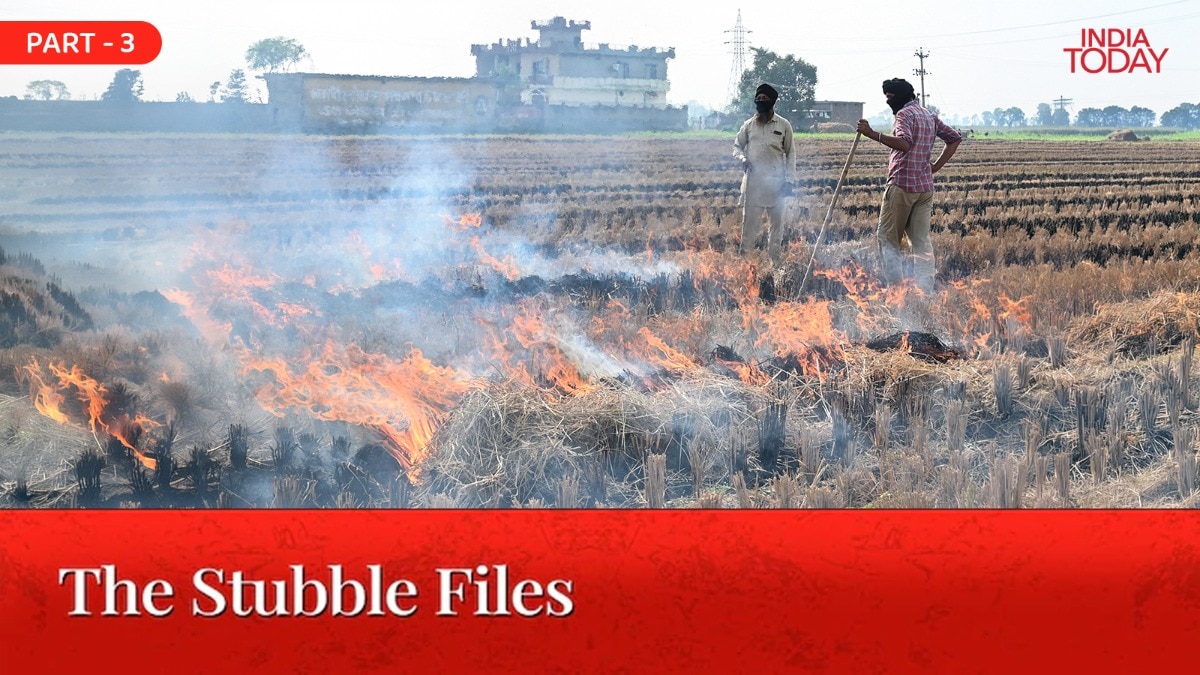
In a village near Sonipat, a farmer who once burned his straw now stacks it. Two balers, machines that squeeze loose straw into dense rectangular blocks, stand in his yard, and the blocks sit in front of them like giant bricks. He sows paddy on 15 acres.The farmer now sells the bales to a company at Rs 1,500 an acre instead of lighting a match, he told Kisan Tak.Part 2 of The Stubble Files ended with a question: if straw cannot always be buried, can it be sold? In that yard, the answer is yes. The harder question is why that yard is still the exception, and what stands between one tidy stack of bales and the 35 to 40 million tonnes of paddy straw that India burns each year.THE BALE THAT PAYS BY THE ACREThe Sonipat story is not a one-off. A manager at a baby corn processing unit told Kisan Tak that his factory buys straw from farmers at Rs 1,000 to Rs 1,500 an acre and feeds it to a boiler, a furnace that makes steam for the factory's machines. For the factory, straw replaces wood as fuel. For the farmer, a problem becomes an income. Scientists call this route ex-situ management, Latin for off-site: the straw leaves the field instead of staying in it. It is the mirror image of the in-situ methods, such as the Happy Seeder, in Part 2.Dr BL Attri, acting director of the ICAR-Directorate of Mushroom Research in Solan, estimates that India produces 125 to 140 million tonnes of paddy straw a year and burns 35 to 40 million tonnes of it. Those tonnes must go somewhere, and the money must come from somebody.WHY STRAW IS A DIFFICULT PRODUCT Straw looks like an easy commodity. It is free, plentiful and arrives every autumn. But it has awkward habits.It is bulky, so it is costly to move. It arrives all at once, in the same 15 to 20 days across a state, because the next crop is waiting. And it is stubbornly tough.Dr Sandeep Sharma, a soil microbiologist at Punjab Agricultural University (PAU), told India Today Digital that paddy straw decomposes slowly because it "contains resistant lignin and silica, has a high C:N ratio."Lignin is the woody glue that stiffens plant stems, and silica is a glass-like mineral that paddy stores in its stalks. The C:N ratio compares carbon with nitrogen. Straw is rich in the first and poor in the second, so the microbes that feed on it run short of nitrogen.These traits matter beyond the field. A material that resists soil microbes also resists a factory's machinery, as the biogas industry knows well.THE STOREHOUSE PROBLEMThe Council on Energy, Environment and Water (CEEW), a policy research institute, looked at what happens between the baler and the factory gate. Its September 2025 report on paddy straw storage, by Ayushman Saboo, Kurinji Kemanth and Harsha Arya, surveyed eight companies in Punjab that buy and store straw.Seven of the eight reported losing 15 to 25 per cent of their straw each year, mostly in storage. Five had suffered fires, and four of those did not know what lit them. The companies reported these losses verbally and did not measure them, so they are best read as indications.Moisture is a problem too: industries want straw below 20 per cent moisture, but some companies received bales at up to 40 per cent.Then comes the part that bears on the farmer. Storage costs are not built into the price companies pay for straw, and CEEW says farmers often receive little or no payment for it at all. That sits oddly beside the Rs 1,000 to Rs 1,500 an acre of the Sonipat yard. One farmer's contract does not describe a whole state.Punjab aims to manage six million tonnes of straw ex-situ out of about 20 million tonnes a year, CEEW reports, which would need roughly 4,200 to 5,580 acres of storage yards. It is a very large barn for a very short harvest.THE MATHS OF DISTANCEWhy not carry all of it to the nearest factory? Because distance eats the profit.In CEEW's 2021 Punjab case study, LS Kurinji and Sankalp Kumar counted what it costs to move straw. Baling it and carrying it to a straw bank, a local storage yard, within about 15 km cost around Rs 1,330 a tonne. Delivering bales to a buyer 50 km away came to roughly Rs 2,950 a tonne. Beyond 50 km, the authors found, the trade is often uneconomic.The report also showed how lopsided the system was. In 2018, Punjab produced about 20 million tonnes of paddy straw. About 13 million tonnes, or 65 per cent, was burned in fields, and only about 1.1 million tonnes found an ex-situ buyer. These are older figures, but the shape holds: straw is everywhere, buyers are few, and the road between them is expensive.THE GAS THAT STRAW MAKESOne buyer deserves a closer look: the biogas plant. Biogas is a mixture of methane and carbon dioxide made when microbes digest organic matter in a sealed tank without oxygen, a process called anaerobic digestion. Cleaned and compressed, it becomes compressed biogas, a fuel that can run vehicles. CEEW's 2021 study counted eight bio-CNG projects in Punjab that could use about 3 lakh tonnes of straw a year.It sounds like a perfect circle, but straw resists this too. A 2022 review in Environmental Research on making biogas from paddy straw notes that straw has low natural digestibility because of its high lignin and silica content. Capacity is the other limit: 3 lakh tonnes a year is a small slice of the 13 million tonnes that burned in 2018.THE MUSHROOM THAT EATS WOODY STUFFMushrooms look more modest, and in some ways they are smarter. "Fungi break down tough lignocellulosic compounds that other microbes cannot touch," Dr Attri said in his written reply. Lignocellulosic means made of lignin and the fibres around it. He says paddy straw mushroom, Volvariella volvacea, is the main species grown on straw, and oyster and button mushrooms can be raised on it as well.A typical 30 kg bed of dry paddy straw gives about 4 to 5 kg of fresh mushrooms, he says. Scientists call this biological efficiency, the weight of fresh mushrooms grown for every 100 kg of dry straw. For this species it is roughly 12 to 16 per cent. Oyster mushrooms reach 70 to 80 per cent, depending on the species, and button mushrooms 20 to 25 per cent.The straw is soaked to about 65 to 70 per cent moisture and pasteurised, meaning heated gently to kill competing moulds, before the mushroom seed, called spawn, goes in. The spent substrate can become compost, he says.For farmers, he sees an economic logic. "Mushroom cultivation flips the economics," he said, because raw paddy straw "can be bought cheaply or gathered freely." Scientists at the ICAR-National Rice Research Institute in Cuttack reported in Indian Farming in 2022 that a farmer growing paddy straw mushroom on 4,000 beds a year can net Rs 3 lakh, with another Rs 1.36 lakh from vermicompost made from the spent substrate. Dr Attri adds that in some villages, mushroom farming has lifted incomes by 50 per cent or more.THE LIMITS OF THE MUSHROOMIt would be easy to stop there and call mushrooms the answer. The evidence does not allow it.Paddy straw mushrooms are tropical and need about 30 to 35°C, so they suit coastal Odisha, West Bengal and Andhra Pradesh, Dr Attri says, and not Punjab's cooler autumn. A 2019 survey in Mushroom Research found that Odisha produced 9,550 tonnes of straw mushroom in 2015-16, about 60 per cent of the state's mushrooms. But growers averaged only about 10 per cent biological efficiency, held back by poor spawn, mould contamination of the beds and unorganised marketing of a perishable crop.Safety matters too. Dr Attri warned that "mushrooms and other fungi are aggressive bio-accumulators", meaning they absorb and concentrate what is in their growing material. Straw from fields treated with persistent herbicides, or exposed to heavy metals such as lead, cadmium and arsenic, can pass these into the mushrooms.And there is scale. India's entire mushroom production, he says, is about 4.27 lakh tonnes, 70 per cent of it button mushrooms. Strongly supported mushroom farming could clear 8 to 12 per cent of a region's straw burden, he estimates. "To absorb the remaining tens of millions of tonnes," he said, mushrooms "must be paired with other mass-scale straw utilities like biomass palletisation, second-generation biofuels, and industrial bio-packaging materials."WHAT THE FIELD LOSES WHEN STRAW LEAVESTaking straw away looks tidy, but the field pays a price too. The director of the Agricultural Technology Application Research Institute (ATARI) in Ludhiana, part of the Indian Council of Agricultural Research (ICAR), told India Today Digital that "paddy straw retention enhances soil health, promotes microbial activity, conserves soil moisture, and improves nutrient cycling." He added that "long-term field trials have demonstrated improvements in crop productivity and soil health" under straw retention and incorporation. Removing the straw gives some of that up.Retention has its own cost, though. "Yes, incorporating straw can increase methane emissions when rice fields are flooded, because methanogens decompose organic matter under oxygen-poor conditions," Dr Sharma said. Methanogens are microbes that make methane, a potent greenhouse gas. A 2023 review in Nature Reviews Earth & Environment found that adding straw raised methane from rice fields by 92 per cent on average, compared with removing it.Dr Sharma stresses that the net benefit depends on "water management and the full balance of greenhouse gases, air pollution and soil-carbon gains." He also points to a 2024 study in BioResources, on which he is a co-author, which reports that soil's own microbes can break down incorporated straw if farmers have a window of about three weeks. So no route is free, and the right one differs from field to field.DELHI'S AIR WILL NOT WAIT FOR THE BALESuppose every bale found a buyer. Would Delhi breathe easily? A 2025 study of north-west India's air put crop burning's share of PM2.5, fine particles small enough to travel deep into the lungs, in Delhi and its surroundings at 18 per cent between October 16 and November 30 in 2022, 16 per cent in 2023 and 9 per cent in 2024. On days when winds carried plumes straight from the burning regions, the share rose to about 50 per cent, though only for two or three days at a time.Delhi's vehicles rose from 3.4 million in 2000 to 11.8 million in 2020, Kisan Tak reported, and the city makes pollution on all 365 days. Ending the fires would clear the worst days, but it would not make Delhi's air clean.THE ANSWER IS A MARKET, NOT A MACHINESo can India turn its burning straw into a business? The evidence says yes, but only if someone builds the unglamorous parts: the yards, the dry bales, the roads, the contracts and a price that reaches the farmer.The ATARI director's warning about seeders applies here too. He said "merely ensuring machinery availability is not sufficient" and that the emphasis "must shift towards timely access, reliable functionality, optimal utilization". He listed "high operational and rental costs" and "a narrow sowing window" among the constraints, and said the right technology depends on straw load, soil moisture, soil texture and field conditions. A bale in Sonipat, a mushroom bed in Odisha and a biogas tank are not rivals. They are different answers to different fields.In Part 2, a machine waited in a shed for October. In Part 3, a bale waits in a yard for a buyer. Neither will end the fires alone. Together, with a price that makes the match costlier than the bale, they might.- Ends
From fire to fuel to mushrooms: Can India turn burning straw into a business?
Full Article
Original Source
Read the full article at Indiatoday →KhanList aggregates and links to publicly available news content. We do not host full articles from third-party sources. Always verify important information with original sources.