
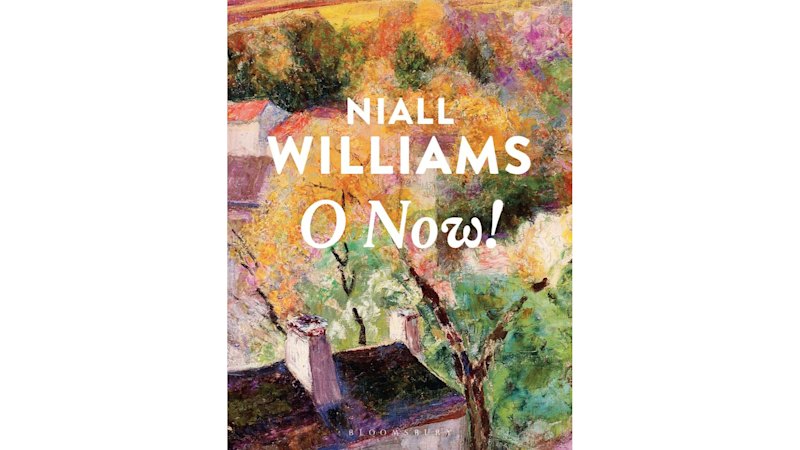
There’s no shortage of strange goings-on in this week’s books. Fairies are laying siege to Durham, a time traveller is playing havoc with Napoleon’s plans and two elderly Irishmen are expecting answers from the afterlife. And that’s just the fiction. In non-fiction, we encounter some very spooky ladies, a parade of political performers and a world order that’s looking decidedly disorderly.Fiction Photo: O Now! by Niall Williams (Bloomsbury, $23)The power of this book belies its short-story length – just 57 pages. Set in the fictional Irish village of Faha, which Williams has explored in previous novels, the novella centres on two lifelong friends, elderly Ganga Crowe and Bat Considine. Four times a week, Bat visits Ganga’s home; though their conversation is sparse, they take comfort in each other’s company through a well-worn ritual of tea, newspapers and staring into the fire.The two have made a pact: whoever dies first must let the survivor know why the world exists and what lies in the mind of God. When death finally claims one of them, the survivor initially refuses to leave his side, faithfully waiting for word from the afterlife. The remainder of the story traces the customs and traditions of Irish mourning as neighbours gather to celebrate a life, proving true the local adage that “in Faha, a funeral beat two weddings”.Williams also appends an essay detailing the genesis of the story, which, though interesting, feels somewhat unnecessary. Ultimately, the work is infused with lyricism, beauty and quiet spirituality, its sadness gently balanced by the warmth and solidarity of a tight-knit community. Photo: Daughters of the Tide by Arianne James (HarperCollins, $33)This work of historical fiction is set in and around the coast of Tasmania and follows the lives of three generations of women from the late 1800s to the early 1920s. The setting, a ramshackle mansion, is suitably Gothic as the back-and-forth narrative tracks 21-year-old Isla fighting for independence from her mother, Clara, whilst preparing for the return of her estranged aunt, Adelaide. The two share similar sensibilities – in particular, an obsession with the ocean and its mysterious depths.The folklore and mythology of selkies – shapeshifting creatures that can transform between seal and human – carry the narrative and imbue it with a magical-realist tint. Why does Isla keep dreaming about swimming in a different shape and eating the glittering, metallic flesh of fish? Arianne James’ debut novel melds fact and superstition as it explores a range of themes, including mother-daughter relationships, sibling bonds and rivalry, love, loss and mental illness. You need to settle into its rhythm, as it is a slow-moving, atmospheric book that gradually teases out long-held family secrets, leaving no easy answers and plenty of ambiguity. Photo: You’ll Love It Here by Natalie Sue (HarperCollins, $35)Mona doesn’t exactly love her neighbours – in fact, she does her best to avoid them, giving them uncharitable nicknames like “Old White Perve” and “Weird Girl”. She lives in a less-than-salubrious, 16-unit complex called Valleyview in Calgary, Canada (contrary to expectations, it offers no such vista). Though she is one of the old-timers, having lived there for five years, she makes no attempt to beautify her flat, seeing it as a temporary stopgap rather than a permanent home.After a series of unfortunate events, including a meltdown at her marketing job and a fire at the building in which her live-in landlady is injured, Mona reluctantly agrees to take on superintendent duties for a spell – cue all manner of unavoidable interactions and hijinks with her fellow tenants.Though the narrative arc is predictable, You’ll Love It Here is a light, funny, and warm-hearted tale about an insecure, lonely character finding a sense of belonging in the community she once shunned. Mona’s slow-burn romance with Sami, the cute cook at the local diner, also offers a welcome distraction from managing the motley crew of residents whose life stories she finally deigns to understand. Photo: The Bishop of Durham Attempts to Surrender the City by Susanna Clarke, illustrated by Victoria Sawdon (Bloomsbury, $33)This is a strange little novella – or extended short story – by Susanna Clarke, known for her bestseller Jonathan Strange & Mr Norrell. It combines history with folklore as it imagines the Northern English city of Durham being overtaken by fairies, enchanted trees that move and withstand the axes of woodchoppers and rivers that block the passage of boats. In the middle of the siege is the Bishop of Durham, one Ranulf Flambard, who does his best to capitulate to the invaders, only to find the fairy folk have vanished. Ranulf then sets out on a quest to find their king.Victoria Sawdon’s black-and-white illustrations border the pages like medieval manuscripts and add interest to a story that feels somewhat insubstantial and unfinished. The final chapter explores the intersection of children’s literature, fantasy, landscape and nature, and is actually more engaging than the tale itself. “I still keep company with magicians and giants, fairies and fauns,” Clarke points out, explaining her predilection for writing magic realism, and how she is drawn to what she calls “liminal creatures” between the non-human and human worlds. Photo: As We Fall Through Time by Claire North (Hachette, $35)Time-traveller and gender-bender Cal meets Olivier in 1789 during Revolutionary France and falls in love with the young soldier. Olivier dies when Napoleon invades Russia, but Cal is determined to change this fate and enlists the help of another time traveller, Fadimatu, an archivist trying to catalogue and preserve human knowledge.As We Fall Through Time is an entertaining read – after all, who doesn’t want to escape a world governed by the strict laws of chronology? It does, however, demand close attention: without it, the constant jumping across non-linear timelines quickly becomes disorienting. There are paradoxes and multiple incarnations of the same characters that the reader must keep track of. Olivier may live to spend more time with Cal, but tampering with history brings its own set of consequences, as we soon discover. Fadimatu has her own complications to unravel when she stumbles across her own mummified body, prompting the narrative to swerve into a murder investigation. Ultimately, the book feels slightly overambitious, with Claire North attempting to juggle too many threads across the space-time continuum.Non-fiction Photo: Betrayal by Luke Harding (Faber, $37)A preparatory part of Vladimir Putin’s imperialist grab to colonise Ukraine in 2022 involved Russian special forces storming the presidential building in Kyiv, and either capturing or executing Volodymyr Zelensky and other heads of government. Like the rest of the war, it didn’t go to plan. Putin’s invasion is one part of Luke Harding’s examination of the betrayal of the rules-based international system – encoded in the 1945 UN Charter that instructed all members to “refrain” from “threat or force” for territorial gains – that has brought the world relative peace since the end of World War II.The Ukraine war is a pivotal case study in charting this alarming trend (and the book includes a face-to-face with Zelensky). It also incorporates Donald Trump’s war in Iran, his Greenland threats, China and Taiwan and North Korea. Karl Marx wrote that history does repeat itself, the second time around as farce. Today’s unstable world bears eerie similarities to the 1930s, with a right collection of thugs, war criminals, dictators and would-be dictators rearing their ugly heads once again. History will reveal if it results in farce, or a category that Marx didn’t mention – tragic farce. A compelling piece of superior analytic journalism, timely, urgent and just a bit scary. Photo: Australian Girls by Catherine Gay (Monash University Publishing, $40)As often as not, the term “girl” can be a put-down, but this study of 19th-century girls reclaims the word to empower them. It tells the stories of settler and Aboriginal girls (mostly between the ages of five and 15) from the 1840s to Federation – united, where possible, by surviving artefacts the girls made themselves, such as a handmade Commonwealth dress, school exercise books and diaries.Academic Catherine Gay maintains that most histories write girls out of the narrative, asserting that she “takes girls seriously” and that her subjects “participated in and contributed to their families and society … and were key actors who contributed to historical change”. Whether she is documenting the activism of, say, Ellen, an Indigenous girl in the 1860s, or the impact of free education in the 1870s, the stories are told firmly from the girls’ point of view. While it may have started life as an academic study, Gay brings a welcome lightness of touch to a previously neglected history. Photo: Jacques Miller by Caitlin McInnis (The Miegunyah Press, $50)This is not just a portrait of a great scientific mind, but of the relentless drive behind a game-changing discovery. The scientist is Australian Jacques Miller and, to a large extent, this is the story of his groundbreaking work on the thymus – an organ vital to the immune system – which transformed the study of immunology worldwide. Many argue that he ought to have received the Nobel Prize, and the fact that he was overlooked remains a sore point.Yet, Caitlin McInnis’ biography is equally a portrait of the era that moulded him, particularly the tumultuous years leading up to the Second World War. Born in France, Miller had lived in Switzerland, Shanghai, and Australia by the age of 20; his family not only navigated wartime upheaval but also endured profound personal tragedy in the premature death of his beloved sister. Tumultuous though those years were, they proved instrumental in sharpening an intensely inquiring mind, while instilling in Miller a lifelong appreciation for art and beauty.Drawn from meticulous research and extended conversations with Miller himself, McInnis’ book is an evocative, thoughtful and engaging account that captures the rich complexities of its subject. Photo: Spooky Ladies by Kaz Cooke (Scribner, $38)Author and cartoonist Kaz Cooke describes this survey of women and magic as a “riotous galumph” through the lives of a long list of “spooky” ladies. That phrase captures the spirit of the book rather well. Spanning the mid-19th to the mid-20th century, it showcases a gallery of larger-than-life, frequently overlooked figures – from the “wildly entertaining” to “shameless frauds and shimmering visions who held their audiences spellbound”.Two notable examples, often cast into the shadow of their famous husbands, are Bess Houdini (who continued performing long after Harry’s death) and Lady Conan Doyle, who took on the role of medium during Arthur’s world tours to promote spiritualism. It is a rollicking chronicle that takes in Madame Blavatsky, witches, seances, mind-reading, mesmerism and more, while examining how the supernatural and superstitious continue to haunt the modern imagination. Photo: Performance Politics by Joshua Black (NewSouth, $40)When Paul Keating likened himself to Placido Domingo he was, playfully and self-consciously, invoking performance politics and the concept of the politician as performer. Joshua Black, a historian and former political adviser, draws on a wide range of sources – including political memoirs, autobiographies, television documentaries, and interviews – to examine the rise of this phenomenon.To an extent, it is nothing new – politicians have always been performers – yet the impulse has intensified in recent decades, with the overarching aim being to curate and control the narrative. This shift, Black argues, has resulted in “a culture that has demanded of Australian politicians a new level of willingness to engage in story-telling”.Inevitably, this can descend into strategic self-marketing, reducing the politician to a consumer product not unlike a box of washing powder. Writing with theoretical depth yet an accessible, plain-speaking style, Black assesses a long line of public figures. Along the way, he suggests that the modern compulsion to bare heart and soul – a vulnerability the old guard would never have countenanced – merely fosters an orchestrated, faux transparency that remains, at its core, entirely part of the performance.The Booklist is a weekly newsletter for book lovers from Jason Steger. Get it delivered every Friday.
From fairy invasions to political intrigue, 10 new books worth your time
Full Article
Original Source
Read the full article at Smh →KhanList aggregates and links to publicly available news content. We do not host full articles from third-party sources. Always verify important information with original sources.