
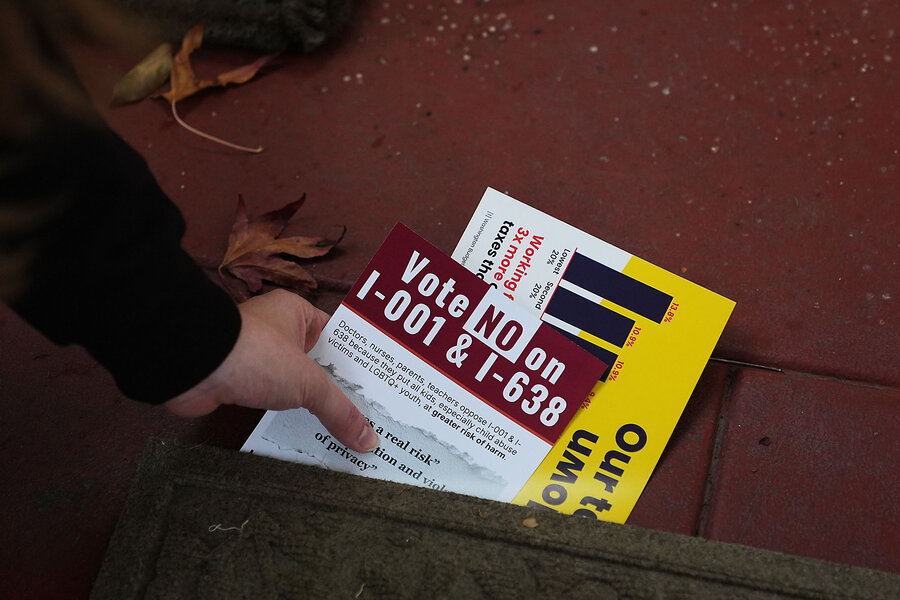
As the United States gears up for midterm elections Nov. 3, voters are weighing not just the balance of power in Congress, but also a host of issues in state ballot measures. In 39 states, the public will decide 145 such measures, in which people vote directly on changes to state laws or constitutions.Ballot measures often reflect local issues in each state, says John Matsusaka, executive director of the Initiative and Referendum Institute at the University of Southern California. But sometimes, “there are issues ... that happen at the national level that spark a response across multiple states.”That dynamic is playing out this year, with many ballot measures reflecting policies that have taken center stage during President Donald Trump’s second term. More than 15 states are mulling changes to how they conduct elections, including some that might revise their redistricting rules or congressional maps. Others are considering measures on campaign financing and initiatives targeting noncitizen voting. Also on the ballot are initiatives focused on abortion, transgender rights, and wealth taxes. Here’s a look at some of this year’s most consequential ballot measures. Joshua A. Bickel/AP/FilePeople vote on Election Day, Nov. 7, 2023, at Knox Presbyterian Church in Cincinnati. Voters in Ohio this year will decide on whether the state constitution should require voter ID for same-day voter registration. Voting rights and redistrictingVoters in Alaska, Kansas, South Dakota, West Virginia, Arizona, and Arkansas will weigh whether to amend state laws or constitutions to explicitly bar noncitizens from voting, even though federal and state laws already state that only U.S. citizens can vote in national and state elections.President Trump has claimed for years that U.S. elections are beset with fraud, including widespread noncitizen voting. Data shows there is no evidence that noncitizens vote in numbers large enough to influence elections, or that elections in general see meaningful fraud.Residents in Arizona, California, Nevada, North Carolina, and Ohio will also consider whether to require government-issued or photo identification to vote – another policy favored by Mr. Trump. Partisan redistricting of congressional districts has emerged as another key fight on ballots, following a rush of mid-decade map drawing this year. Missourians will decide whether a congressional map that could grant Republicans an additional House seat can go into effect. A measure in Colorado could make mid-decade redistricting harder by requiring the state’s Supreme Court and an independent commission to approve those maps. Maryland’s citizens, by contrast, could make partisan gerrymandering easier by amending the constitution to exempt congressional maps from the state’s redistricting criteria. Campaign financeA handful of ballot measures this cycle aim to clamp down on campaign contributions, but they take different tacks on whose money to regulate. The policies could prove popular across the aisle: Almost three-quarters of Americans polled by Politico this spring agreed that “there is too much money in American politics.” SOURCE: MultiState Elections | Jacob Turcotte/Staff Most significant among the measures is one in Montana, where voters could ban donations from “artificial persons” such as corporations, nonprofits, and trusts. The measure would directly contradict the Supreme Court’s landmark 2010 ruling, Citizens United v. Federal Election Commission, which remade American politics by opening it to corporate spending.An initiative in Michigan would ban contributions from certain electric and gas utilities, as well as from any entity holding state contracts exceeding $250,000 per year.AbortionBallot initiatives in Nevada and Virginia would enshrine abortion access by constitutional amendment. Ed Zurga/AP/FileResidents place their signatures on a petition in support of a ballot initiative to end Missouri's near-total ban on abortion, Feb. 6, 2024, in Kansas City, Missouri. The 2024 Missouri state constitutional amendment that allows abortion until fetal viability passed. Voters this year will decide whether to rescind it. Nevada law already allows abortion until the 24th week of pregnancy, but this year’s ballot measure would codify similar provisions in the state constitution, making them harder to repeal. Constitutional amendments in Nevada become valid only after they pass in two consecutive general elections. The current measure passed with 64% of the vote in 2024. An initiative in Virginia, where abortion is legal until the end of the second trimester, would similarly make the procedure a constitutional right.Missourians, by contrast, will decide whether to ban the procedure with very few exceptions. Should Missouri’s Amendment 3 pass, it would rescind a 2024 constitutional amendment that allows abortion until fetal viability. This year’s ballot measure would ban the procedure except in cases of “medical emergency, fetal anomaly, rape, or incest.” In cases of rape or incest, abortion would be illegal after 12 weeks.In Idaho, which has one of the strictest abortion bans in the country, a ballot measure would legalize the procedure until fetal viability, or in medical emergencies, via state statute.Transgender rightsFive states will consider ballot measures restricting transgender minors’ access to medical treatments for gender transitions or transgender athletes’ ability to play on teams matching their self-declared gender identity. Measures in Arizona, Nebraska, Washington, and Colorado would require student-athletes to play on teams that match their sex at birth. In Arizona, Nebraska, and Colorado, the rules would apply to K-12 schools and colleges; in Washington, they would apply only to primary schools. Washington’s rules would also require those who play on female teams to undergo sex verification, a controversial policy that can involve a physical exam. Lindsey Wasson/APA canvasser wears a button opposing Initiative 638, a ballot measure in Washington state, which would prohibit transgender girls from competing in girls' sports, Oct. 17, 2026, in Seattle. A second measure in Colorado would prohibit gender-transition surgery for minors. Missouri’s Amendment 3, in addition to implementing an abortion ban, would outlaw gender-transition surgery or hormone replacement therapy for children under age 18 seeking to change their sex.Wealth and income taxesIn California, voters could levy a one-time 5% tax on billionaires. Revenue from the tax would fund healthcare, food assistance, and public education. California’s Legislative Analyst’s Office estimates the tax would raise tens of billions of dollars in the short term, but could push out some of the state’s billionaires, leading to a long-term decrease in annual revenue by rates of less than $1 billion per year.Colorado’s Initiative 195 takes a different approach. It would replace the state’s flat 4.4% income tax with a progressive tax, with rates that rise from 3.7% to 8.4% depending on income. That would lower taxes for the state’s lowest earners, but nearly double them for the highest earners. The measure is competing with an opposing initiative that would cap the income tax at its current rate. Under Colorado law, when two conflicting ballot measures pass, the one with the most “yes” votes prevails. Deepen your worldviewwith Monitor Highlights.Politics with respectGet political stories with respectful analysis.There‘s a world of new ideas in everyBooks newsletter.There‘s more to life, enrich yours withCulture & Learning weekly.Follow humanity‘s discoveries withScience & Nature stories in your inbox.Gain a spiritual perspectivefrom the stories in your inbox.Want to understand the deeper impact of critical events? Learn the Monitor‘s insight.Already a subscriber? Log in to hide ads. Measures taxing rich people have picked up steam as income inequality has widened and politicians attempt to combat rising costs. But they’ve also inspired opposition.A ballot measure in Washington, backed by a local hedge fund manager, would eliminate the state’s recently passed 9.9% tax on household incomes exceeding $1 million. The state’s Office of Financial Management estimates that, should the initiative pass, it would result in an $11.4 billion revenue loss for the state over five fiscal years. ALREADY A SUBSCRIBER? LoginReal news can be honest, hopeful, credible, constructive.The Christian Science Monitor was founded in 1908 to lift the standard of journalism and uplift humanity. We aim to “speak the truth in love.” Our goal is not to tell you what to think, but to give you the essential knowledge and understanding to come to your own intelligent conclusions. Join us in this mission by subscribing.
From election integrity to wealth taxes, voters to decide key ballot measures
Full Article
Original Source
Read the full article at Csmonitor →KhanList aggregates and links to publicly available news content. We do not host full articles from third-party sources. Always verify important information with original sources.