
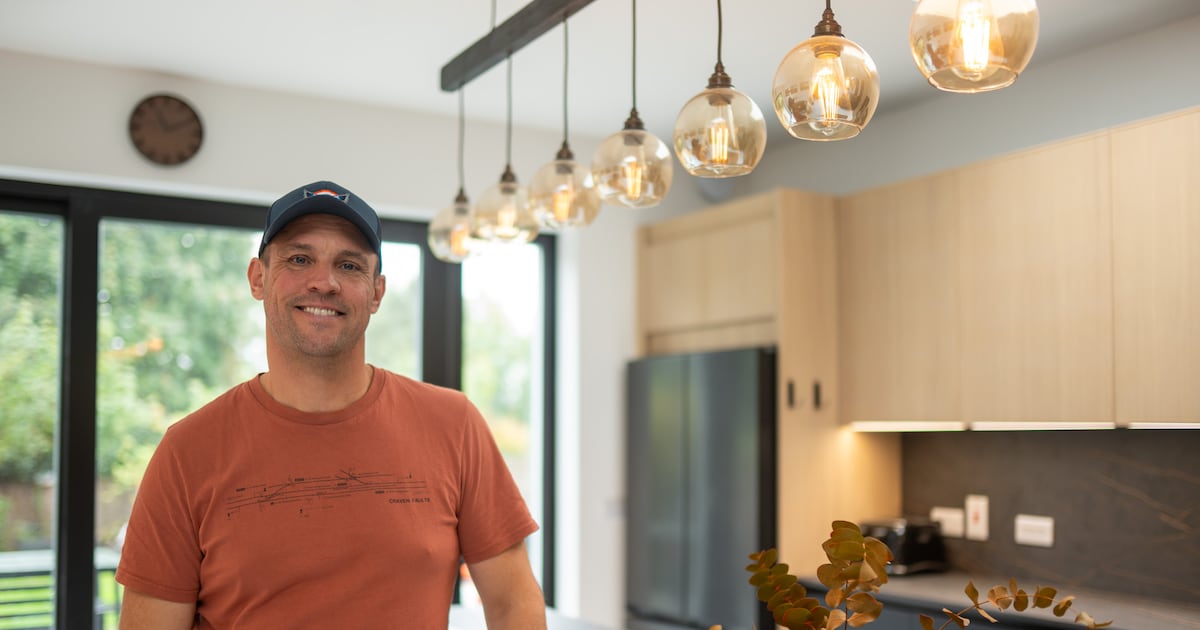
You know your home needs a deep energy retrofit when you can feel a breeze rising from the floorboards. Phil Tomlinson and Sarah Duke felt breezes coming from all directions when they bought their home in Lucan, Co Dublin, in 2020. “We were spending a fortune on heat,” she recalls. “You’d have to have the heat on all the time in the winter. And as soon as it was turned off, the house was cold again.”They bought the 1960s three-bedroom dormer bungalow with an immediate plan to renovate it to suit the needs of their household – a family of five with two dogs. “We loved the location. We love the very private, big south-facing back garden,” Tomlinson says. “But the head space in the upstairs bedrooms was very restricted because of the sloped roof. And we wanted to modernise the house, both in terms of the flow and the use, and energy performance wise.”They commissioned an architect and got planning permission for an extensive renovation project. “It included a double-storey extension with a master bedroom upstairs overlooking the garden, but when we priced it, it was 20 or 30 per cent more than we paid for the house. Construction prices went crazy during Covid,” he recalls.READ MOREDuke remembers one builder who gave her a quote that matched their budget, but when they examined it, the price did not include floors, kitchen or bathrooms. “It was just for the shell of the building and you can’t live in that.”They decided to press pause on their plans and this gave them the breathing space to figure out what they really needed. “Everybody says this, but it’s so true – wait until you’ve lived in the house for a good two or three years before even getting the architect in,” she says. “I was so impatient. I had all these ideas and it was all very exciting but it didn’t make sense, because I wasn’t 100 per cent sure what I wanted.”Tomlinson says the extra time helped them realise what they needed to change. “I love to cook, and the way the kitchen flowed really got under my skin. To get to the back garden, the children and dogs would come running through the kitchen, sometimes running between me and the hob when I was cooking. The fridge was down in the utility. It just wasn’t working.”They were watching the deep retrofit of a house on RTÉ’s Room to Improve one night and liked the work done by the builder, Larkrock Homes. While some builders specialise in extensions, and others in retrofitting, this firm does both. It is one of a number of firms approved by the Sustainable Energy Authority of Ireland (SEAI) to offer the One Stop Shop service. This service helps people to avail of grants for energy upgrades by managing the entire project, including the grant application. The building firms deduct the value of grants upfront, making the project more affordable for homeowners.“It was exactly what we wanted. We just needed a crew to come in and take it over from start to finish. And it’s one bill as well at the end, rather than us having to source windows, floors and tiles and pay all those different places,” Duke says.Exrerior of the renovated 1960s three-bedroom dormer bungalow in Lucan Reconfiguring the existing space rather than building a big extension greatly reduced the project's costs Larkrock recommended an architect – and when they received his plans, they finally had what they wanted at a price they could afford. “He came in with a fresh set of eyes on it. The previous plans were very elaborate, transforming the whole house, but he was like, no, just use the space a little differently. It ended up being a lot cheaper and made sense for us because we didn’t have to add a ton of square metres,” she says.Larkrock co-owner Damien Tracey says homeowners sometimes believe they need a big extension, but by reconfiguring the space they have, they will greatly reduce building costs. “Just try to keep it as simple as you can. What do you actually want? It might come down to someone wanting an en suite so they’re not queuing to get into the bathroom. It’s the simple things that make people happy, like living in a warm house with a stable temperature. Do you really need this extension when underfloor heating might be better?”This couple settled on a 28sq m (301sq ft) extension at the back of the house. They raised the dormer roof on the bedrooms and put their money into windows, underfloor heating and other energy conservation measures. “We put in Aluclad windows – triple glazed, new doors, external and internal insulation, underfloor heating throughout, new radiators, a heat pump, 18 solar panels, and we did the attic insulation.”Their home went from D1 to A0 – a new Ber category for the most energy‑efficient homes that do not use fossil fuels. The solar panels were recently installed, so it’s too soon to see the difference they are making, but they have two electric cars, so they expect to see a significant reduction in their home and motoring bills over time.Livingroom: The new windows and insulation have blocked out traffic sounds from the nearby N4 Kitchen: The Dekton worktop from Granite and Marble Crafts complements the Copperfish Lighting Company pendant light fittings The couple started the project last November and moved into their revamped home in July. The first thing they noticed was the silence in the house. It is close to the N4, but the new windows and insulation have blocked out the traffic sounds. “The kids could have all their pals in the sittingroom or bedrooms and you don’t hear a thing. The constant access to hot water is really nice too,” Duke says.“We’re actually looking forward to the winter for the first time, because we know the house is going to be warm and cosy and not too expensive to heat.”Larkrock’s calculations show that the home’s energy consumption was 239.04 kWh/m²/yr, but it has now become a net-energy producer thanks to solar panels, heat pump and insulation. “The combination of energy upgrades, thoughtful renovation and the new extension creates a home ready for the future,” Tracey says.Tomlinson says his favourite thing is the kitchen. “It’s the dream kitchen that we’ve wanted since we’ve first known each other,” he says. The soft-closing cabinet doors are still a delight, and they appreciate the pull-out larders and clever storage solutions. They sourced the pendants over their island and the dining table light from Copperfish Lighting Company, a family business in Co Wicklow. “The wood is 400 year-old French oak from a church in France, and he [Eoin Shanley] takes it and blackens it up by hand and makes all the lights for it.”The Dekton worktop from Granite and Marble Crafts complements the light fittings, and the cabinetry [from Good Brother Kitchens] feels luxurious. “It’s such a nice space to be in and to cook in.” Bathroom: The owners opted for underfloor heating throughout the house, new radiators and a heat pump The Neff induction hob has a built-in extractor system so there’s no need for an overhead fan. “You could be cooking steaks at a high heat and you can’t smell it at all. And we’ve got the double Neff ovens as well with the slide-and-hide doors.”The couple were comfortable making all the interior design choices “but what we found difficult were the practical things, like where sockets and light fixtures should go, things like that”. Tomlinson advises people to have a clear plan for lighting before embarking on a similar renovation. “You need certain types of lighting for working and for ambience. Where are you going to put them? Do you need LEDs and where do you want them? We hadn’t thought that through so we were kind of rushed at the end trying to figure it all out.” Since this project, Larkrock has begun offering its own interior design service to help customers with this part of the renovation.If they hadn’t added a few extras, the project would have come in on budget. “It was very transparent,” they say. “For example, we hadn’t factored in putting in new stairs. But the old stairs were kind of creaky, and we thought, ‘Why would we have these lovely new floors, and these old stairs?’ So halfway through the job, we decided to put it in a new stair and that added €5,000 to the cost.”They estimate that the SEAI grants covered up to 15 per cent of the total cost of the renovation. “It could be better, but it’s better than nothing,” Duke says. “Hopefully the Government will continue to give grants for people to be able to tap into systems like this because it is still out of reach for a lot of people.”How much will a retrofit cost me? One-stop shop grants vs cost of workSemidetached houseTypical upgrades: Heat pump, windows and doors, wall insulation, attic insulation, ventilation and solar panelsMedian works cost: €62,881Median grant: €23,880Average Ber improvement: D2 to A2Detached houseTypical upgrades: Heat pump, windows and doors, wall insulation, attic insulation, solar panels and ventilationMedian works cost: €66,304Median grant: €25,975Average Ber improvement: D2 to A1ApartmentTypical upgrades: Heat pump, windows and doors, wall insulation and ventilationMedian works cost: €20,638Median grant: €10,300Average Ber improvement: D1 to A3Mid terraceTypical upgrades: Heat pump, windows and doors, wall insulation, attic insulation, ventilation and solar panelsMedian works cost: €52,099 Median grant: €20,300Average Ber improvement: E1 to A2*Data based on median costs for 583 one-stop shop home energy upgrades completed between January and June 2026Source: The Sustainable Energy Authority of Ireland. See seai.ie for the full list of grant supports for home energy upgradesTracey also encourages homeowners to consider the Home Energy Upgrade Loan Scheme. This Government-backed initiative offers low-interest loans from €5,000 to €75,000, with repayment terms of up to 10 years (rates start from about 3 per cent). “We are hopeful that this might be extended above the €75,000 limit to closer to €150,000, to allow homeowners do a deeper retrofit and avail of the hassle-free low-cost loans.”[ A Galway kitchen ‘refresh’ ended up gutting half the house, but the owners couldn’t be happierOpens in new window ]These homeowners estimate that the money spent on their renovation has increased the value of their home by the same amount. But whatever their home is now worth, they have no plans to sell it. “We’re not going anywhere,” Tomlinson says. “This is the house we’ve been wanting for our family for ever. We love where we live.”
From breezy floorboards to a cosy A rating: A Lucan refurb more than worth the wait
Full Article
Original Source
Read the full article at Irishtimes →KhanList aggregates and links to publicly available news content. We do not host full articles from third-party sources. Always verify important information with original sources.