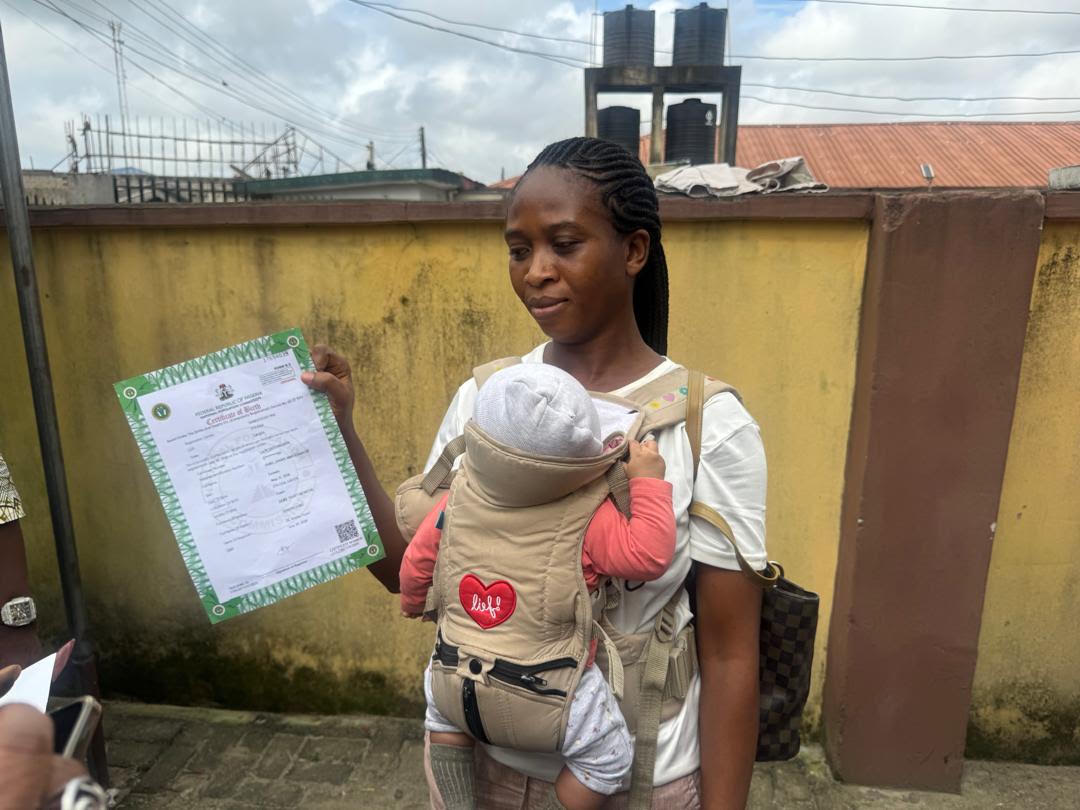
For millions of Nigerian children, the journey to education begins with a document many take for granted—the birth certificate. Beyond proving a child’s identity, birth registration can facilitate access to education, healthcare, and social protection, while helping the government plan and fund essential services. As Nigeria increasingly moves towards electronic birth registration, parents, health workers and civil registration officials face both the opportunities and challenges of ensuring every child is counted and ultimately able to make the journey from birth certificate to classroom. Funmi Ogundare reports For many children, the education journey begins long before they walk through the gates of a school. It begins with something as basic as having a name, a date and place of birth officially recorded. Yet, for millions of children, that first step remains incomplete. A birth certificate may seem like a document kept safely at home, but it is much more than that. It is a child’s legal proof of identity and a gateway to essential services, including education. For Mrs Deborah Eyoh, a mother of three, registering a child’s birth is more than obtaining a document. It is an important step towards securing the child’s identity and making future access to essential services easier. When THISDAY encountered her recently at a Primary Health Centre (PHC) in the Sangotedo area of Lagos, Eyoh said she embraced electronic birth registration after learning about the process and immediately registered her children, convinced that the digital system would make verification easier whenever the documents are needed. “Just in case your child wants to be admitted to school tomorrow, it’s very important,” she said, stressing that a properly registered birth gives authorities reliable information that can be verified when required. For her, the importance of birth registration becomes particularly clear when children begin navigating systems such as education, where accurate personal information can determine how easily their records are verified. She said electronic registration could also help curb age falsification, a practice that can create difficulties for institutions trying to establish applicants’ true age and identity. “By the time you do this and the person gives some information, you verify, and then you know that the person is lying,” she explained. But her advocacy does not stop with her own children. After discovering that some mothers in her neighbourhood were unaware that electronic birth registration services are available at health centres, she took it upon herself to share the information with them. She recalled advising several new mothers to ask for electronic birth certificates when they visit health centres for their babies’ immunisation. “I’ve even mentioned it to three mothers who gave birth in my area that they don’t even know,” she said. Eyoh stated that the health centre offers an opportunity to combine two important interventions: birth registration and access to routine childhood services. She encouraged mothers who take their babies to health centres for immunisation to also inquire about birth registration, because the service is available free of charge, especially for children between the ages of zero to five years, in the public system. Whenever a neighbour or relative gives birth, she said she makes a point of directing them to health centres where they can obtain the service. Another mother, Mrs Juliet Duke, said she did not want to postpone registering her baby’s birth. With her baby just 10 weeks old, Duke visited the Sangotedo PHC registration centre to obtain the child’s birth certificate, convinced that securing the document early would save her from future difficulties. “I came when my baby was six weeks old. I came to do it, and now my baby is 10 weeks. They said it was ready,” she said. Unlike the complicated processes many parents may fear, Duke said her experience at the registration centre was straightforward and involved little waiting. “There was not much process. It was easy,” she recalled. She acknowledged that not every parent may yet understand the importance of registering a child’s birth. Duke said she believed that routine visits to health facilities could provide an opportunity to spread the message. “I believe that once they go for immunisation, they can get it,” she stated According to UNICEF, about 3.5 million children under the age of one across Lagos, Ogun, Oyo, Osun, Ondo, Ekiti and Edo States were currently not registered at birth, leaving them effectively invisible within the civil registration system. The failure to register millions of children at birth could undermine government planning and funding for education, healthcare and social protection. Chief of UNICEF Lagos Field Office, Celine Lafoucriere, told journalists at a two-day media dialogue on birth registration held in collaboration with the National Population Commission (NPC) that the absence of accurate records could affect the government’s ability to plan and allocate resources for basic services adequately. According to her, the implications extend beyond a child’s inability to obtain a birth certificate, as unregistered children may be excluded from population estimates used to determine funding for essential services. “If 3.5 million children are still not registered, they will go unnoticed, and there will be no government funding to support them simply because they are invisible,” she said. The UNICEF official said government policies and programmes must be adequately financed based on the number of people expected to benefit, adding that children missing from the civil register risk being excluded from those calculations. “Having a civil register is very important. But in that civil register, no child that is not registered at birth will exist,” she said. She described birth registration as a fundamental right of every child and urged Nigerians to see a birth certificate as more than a document. According to her, birth registration establishes a child’s legal identity and can facilitate access to education, healthcare and other essential services. “A birth certificate is not a piece of paper. It is a child’s ticket into school. It is what allows a doctor to put a name on a patient file,” she said. She added that children without birth registration could face repeated challenges proving their identity as they grow into adulthood. Lafoucriere noted that Lagos State, in collaboration with the NPC and the Association of Local Governments of Nigeria (ALGON), was among the first states in southern Nigeria to launch birth registration for children under one formally. She also emphasised linking birth certificates to the National Identification Number (NIN), describing the development as a significant step towards strengthening the country’s civil registration system. However, she cautioned that the development had not eliminated the registration gap. “In every state in the southwest, the gap between children who are registered and those who are not is still too wide,” she stated. The registration gap, Lafoucriere stated, is not necessarily the result of parents deliberately refusing to register their children, adding that many families remained unaware that birth registration was free or that registration services were available at primary healthcare centres and other community locations. She identified geographical isolation as another major barrier, noting that some parents were willing to register their children but struggled to access registration points. She also observed that the digitalisation of birth registration was not yet fully functional in all locations. She noted that UNICEF was supporting government efforts to digitalise the registration process and take services closer to families, including through the deployment of tablets at ward level. Speaking with journalists, Gabriel Philip Agbatun, an NPC Registrar covering the Primary Health Centre, Sangotedo, explained that the digital system had been well received by more educated residents, many of whom had previously advocated for an online registration process. “But the locality around here is still trying to meet up with the standard. They are still coming up to meet up with the system,” he said. He identified poor internet connectivity as a major obstacle, noting that delays sometimes occurred when submitting registration details. According to him, while a registration could be completed within about five minutes when the network was stable, connectivity problems could extend the process to between 10 and 15 minutes for a single applicant. To minimise delays and prevent parents from spending unnecessary hours at the centre, Agbatun said registrars developed a system of collecting applicants’ details on a form before entering the information online. He said the information collected included the child’s details, the parents’ NIN, address and telephone number, adding that registrars could contact parents to clarify any issue before completing the online submission. Beyond the technical challenges, Agbatun stressed the importance of ensuring that the information supplied during birth registration was accurate, describing the birth certificate as an important legal document that could affect a child throughout life. He said registrars sometimes encountered cases where a child’s surname did not match the father’s, requiring clarification before registration could proceed. “I tell them no, we don’t just register. This is a legal document for this child. It is very important. It goes along for admission in schools, travelling and identification,” he said. He added that accurate birth registration is also important for establishing a child’s eligibility for various rights and claims, including family inheritance. Agbatun urged parents who are yet to obtain their NIN to do so, saying that resolving the identification challenge would make digital birth registration significantly easier. He also called for improved network connectivity at registration centres to ensure that the transition to digital registration did not create additional barriers for parents. The registrar clarified that birth certificates issued through the former paper-based system before July 1, 2026, remained valid, adding, “The NPC had only stopped issuing new paper-based registrations from that date. Any decision to migrate previously registered records from the paper system to the digital platform would depend on further directives from the NPC.”
From Birth Certificate to Classroom: Why Legal Identity Matters to a Child’s Education
Full Article
Original Source
Read the full article at Thisdaylive →KhanList aggregates and links to publicly available news content. We do not host full articles from third-party sources. Always verify important information with original sources.