
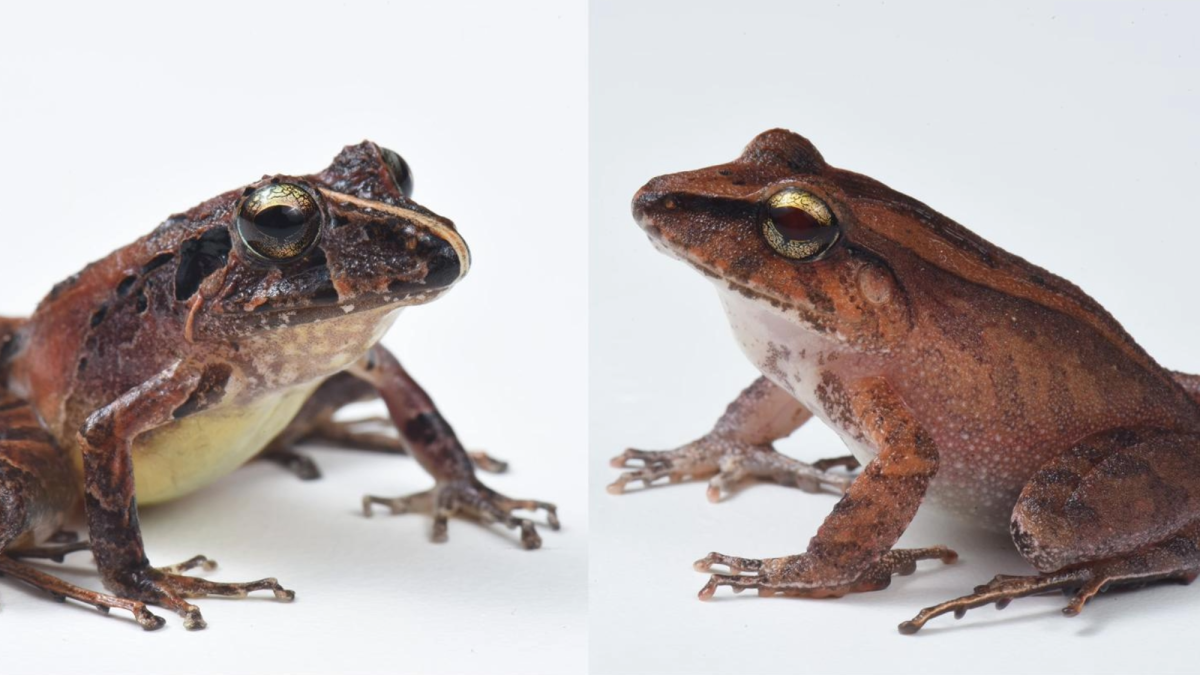
To test how skin-associated bacterial communities can protect tropical frog species against disease, the research team conducted a lab experiment in Brazil focusing on two frog species: ‘Ischnocnema henselii’ (left) and ‘Haddadus binotatus’ (right). Image: Renato Martins / Penn State To protect their porous skin, some tropical frogs have a suit of armor. But this covering isn’t made from metal or even a sturdy material like bullet-proof Kevlar. Frogs use bacteria to shield their skin from a deadly fungal disease caused by chytrid fungus (Batrachochytrium dendrobatidis or Bd). The findings detailed in a study published in the journal Animal Microbiome show that some frog species with a natural bacteria living on the frog’s skin microbiome can help them survive this fungus, which has already driven at least 90 frog species into extinction. “This is one of the clearest demonstrations that a host’s natural skin bacteria can be a frontline defense against a pathogen that has devastated amphibian populations globally,” Gui Becker, a study co-author and biologist at Penn State University, said in a statement. “One of the key messages from this study is that it’s not simply the diversity of these bacteria—referred to as the skin microbiome—that matters, but the protective function of these bacteria.” In amphibians, chytridiomycosis causes a wide variety of symptoms including skin damage, red skin, convulsions, and eventually leads to heart failure. According to the Cornell University College of Veterinary Medicine, it has been found in over 1,300 species of amphibians, but appears to be impacting frogs most severely. Chytrid fungus is water-borne, and spreads through a frog’s aquatic habitat. To test how bacterial communities commonly seen on frog skin can protect tropical frog species against disease, the team conducted a lab experiment in Brazil on two frog species: Haddadus binotatus and Ischnocnema henselii. The team used DNA sequencing to identify the bacteria living on each frog’s skin, so they could then compare how these bacterial communities predict their host frog’s health. One frog species, H. binotatus, naturally tolerated the chytrid fungus when its healthy skin microbiome could help protect it from infection. When the skin’s community of protective bacteria was suppressed with antibiotics, the frogs became more likely to develop signs of disease. The second frog species, I. henselii, was highly susceptible to the fungus with both a bacteria-filled skin microbiome and a microbiome that was suppressed with antibiotics. Laura Schuck, doctoral student in the Intercollege Graduate Degree Program in Ecology at Penn State and lead author of the study, cultured roughly 700 strains of bacteria from the frogs’ skin to better understand how the animal’s microbiome helped protect it from disease. Image: Sam Sholtis / Penn State. According to the team, this indicates that different frog species rely on different strategies to defend themselves against this dangerous fungal disease. “We see this striking contrast: one species has one of the highest prevalences of the fungus, while the other has no infections in the wild. That made them a perfect pair to understand what role the microbiome might be playing,” added Laura Schuck, a study co-author and ecology doctoral student at Penn State. “For years we knew that the tropical frog H. binotatus rarely became infected with the fungus in the wild, but we didn’t know why. Now we know. This study moved us from correlation to experimental evidence that the microbiome really is important against this disease.” To understand the specific protective bacterial mechanisms at play here, Schuck cultured roughly 700 strains of bacteria from the frogs’ skin. She then grew each one in culture, and exposed the chytrid fungus to the bacteria’s chemical byproducts. Over the course of one week, she tracked the fungal growth. The team then sequenced each culture. With the sequences, they built a custom reference database that linked bacterial identity with how strongly it inhibited the fungus’ growth. This way, they could map out which protective bacteria were present on each frog’s skin and when. This database was key to identifying which disease-inhibiting bacteria helped certain frogs survive infection. In future studies, the team hopes to look even closer at how frogs acquire protective skin microbiomes from the natural environment, with the goal of safeguarding tropical habitats that support the beneficial microbes. “If we understand how this frog recruits and maintains beneficial bacteria, we can begin to understand how the microbiome works as a natural defense and what we need to protect in the environment to keep those bacteria available to amphibians and other endangered vertebrates,” Schuck said. 2026 Popular Science Home of the Future Awards 39 products that will improve your everyday life.
Frogs wear bacterial suits of armor to fight off deadly fungus
Full Article
Original Source
Read the full article at Popsci →KhanList aggregates and links to publicly available news content. We do not host full articles from third-party sources. Always verify important information with original sources.