
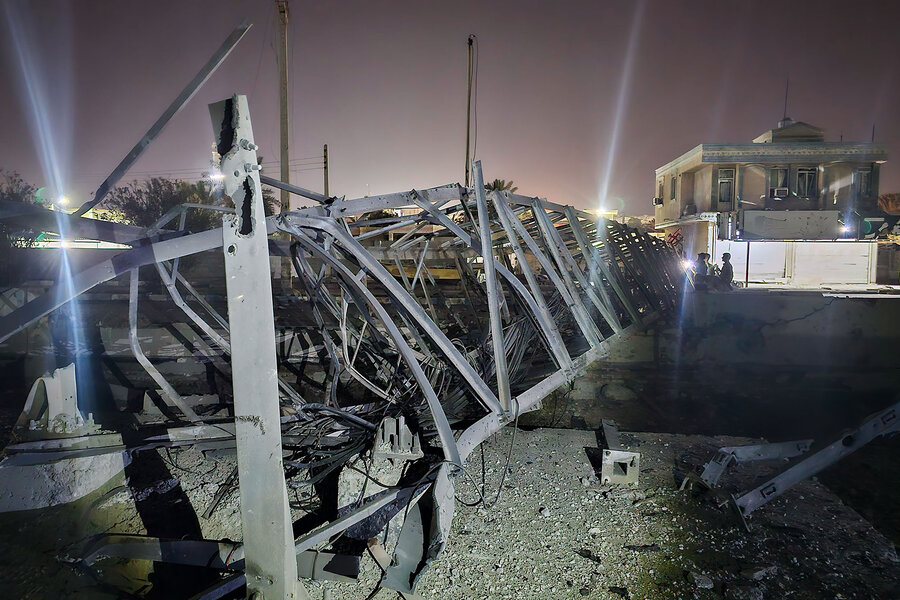
The United States and Iran traded strikes on Tuesday and Wednesday, ending a monthlong lull and risking a return to war with global consequences.U.S. military strikes across southern Iran on Tuesday targeted Iranian air defense sites, radar systems, and maritime assets, U.S. Central Command (CENTCOM) said Wednesday. The strikes followed “attempted attacks by the IRGC [Islamic Revolutionary Guard Corps] against commercial shipping in the Strait of Hormuz and against American service members.”President Donald Trump said over social media U.S. strikes were retaliation for Iran’s “failed attempt at adding sea mines” to the strait and for shooting missiles at a U.S. base in Jordan. Why We Wrote This After more than a month of relative calm, a new round of strikes by the United States and Iran threatens to restart a conflict in the Middle East with global economic repercussions. Iran said it fired missiles and drones at American forces not just in Jordan, but in Kuwait, Bahrain, and northern Iraq on Wednesday.Officials in Jordan, Kuwait, and Bahrain said their militaries intercepted multiple Iranian drones and missiles.The Iranian military also claimed that it targeted U.S. forces stationed at Emirati air bases in the United Arab Emirates. (No independent or state media reports in the UAE confirmed the claim.)The armed forces in Jordan said they shot down 10 ballistic missiles early Wednesday. Iranian state media reported that one of the U.S. strikes on Tuesday hit a wedding in the southern district of Sirik, killing at least four people, including two children.CENTCOM spokesperson U.S. Navy Capt. Tim Hawkins said the command was “looking into” Iran’s claims, while reiterating an earlier statement that the “U.S. military never targets civilians.”The IRGC said several of its fighters were also killed in Tuesday’s barrage. Vessels near the Strait of Hormuz are seen from Musandam, Oman, Sept. 2, 2026. The flare-up brought an end to more than a month of a tense calm in the Gulf region. It could also mark the start of a new stage of war in which Iran and the U.S. focus on economic warfare with dueling blockades of the Strait of Hormuz, the narrow Persian Gulf waterway through which 20% of global energy supplies moved before the war.A week ago, the U.S. Treasury announced new sanctions against Iran that the Trump administration described as “unprecedented.” Experts saw the move as a pivot from direct military action and toward quiet diplomacy.But Sunday President Trump ordered the military to carry out strikes near the strait, the first officially acknowledged U.S. actions since July. Attacks by both sides have escalated since.Iran now appears to be tightening its stranglehold over shipping in the Strait of Hormuz. On Wednesday, the IRGC said two oil tankers exploded after hitting a mine in the strait, sending shockwaves through the maritime and energy industries.In a statement on Wednesday, Saudi Arabia’s Foreign Ministry confirmed that an Iranian attack had killed two seafarers aboard a Saudi oil tanker on Monday. Saudi Arabia “stressed the necessity of halting escalations, and respecting international maritime safety and the security of global energy supplies.”Beyond the Middle East, the renewed fighting spiked energy prices.Wholesale diesel for sale in New York harbor jumped almost 7% to $4.71 a gallon. Brent crude oil prices jumped to over $95 a barrel Wednesday.With the latest price hikes, Brown University’s Iran War Energy Cost Tracker now estimates that the average American household has spent an additional $735.82 on diesel and gasoline since the war began Feb. 28.
Fresh strikes by US and Iran risk further destabilizing the global economy
Full Article
Original Source
Read the full article at Csmonitor →KhanList aggregates and links to publicly available news content. We do not host full articles from third-party sources. Always verify important information with original sources.