
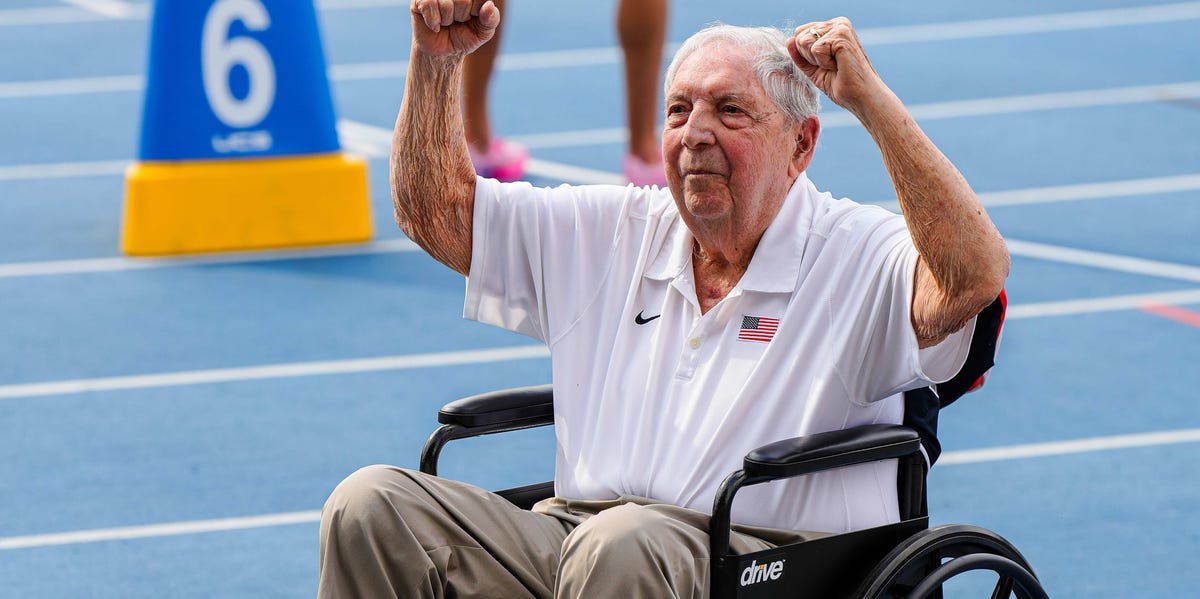
Frank Gagliano, the famed middle-distance and distance coach who guided more than 40 sub-4:00 milers, 15 Olympians, and a world championship medalist, has died. Gags, as he was affectionately known, was 89.Gagliano is survived by his wife, Roberta, and four children, along with multiple grandchildren.One of track and field and distance running’s most prolific coaches, Gagliano never officially retired, coaching athletes until around 2023. Gagliano influenced the sport at the scholastic, collegiate, and professional levels. He coached an NCAA championship team at Manhattan College, then made stops at Rutgers and Georgetown before working with pro groups in Washington, D.C.; Palo Alto, California; Eugene, Oregon; and New York. He forged deep connections with athletes at each stop.“He made you feel like you were the only athlete he cared about,” said Diljeet Taylor, who ran with Gagliano in Palo Alto and is currently the women’s coach at Brigham Young University. “Then you realized he did that with pretty much everyone he coached. It’s an amazing thing, really.”Francis X. Gagliano was born on March 20, 1937, in the Bronx. Growing up on East 237th Street with his parents, Perry and Clara, Gagliano’s childhood was filled with athletics. Dee Lycett, Gags’s only sister, said the house was a revolving door of athletes. “We grew up in an Italian household,” she told Runner’s World in a 2016 profile. “My mother made sure there was lots of food.”After a successful high school football career as quarterback with Mount Saint Michael Academy, Gagliano attended Richmond College in Virginia. “Five years and four summers,” he liked to joke about how long it took him to graduate. He spent two of those summers at Officer Candidates School in Quantico, Virginia, however, and he spent eight years as a reservist in the Marine Corps beginning in 1956. He was never called up.After graduating from Richmond, Gagliano was signed by the Canadian Football League’s Hamilton Tiger-Cats. In 1960, he was sent down to the London Lords, a minor league team. Selling coffee and soda at a construction site during the day and playing football at night while splitting time at quarterback was not the life Gagliano wanted, so he moved back to the U.S.There was also someone he missed back home. Roberta “Robbie” Arnold, whom Gagliano had met as a junior at Richmond, had stayed in touch with Gagliano during his time in Canada. They were married within a year of his return to the U.S., in 1961.He took a job teaching English and math and coaching track at Roselle Catholic High School in Roselle, New Jersey, that same year. School officials promised him he would become the football coach once the school got a team.Gagliano never coached football at Roselle Catholic, where even today there is no football team, and the world of track and field had a fiery new coach who would stick around for a while. He left Roselle Catholic in 1969 for an assistant track coach job at Manhattan College and took the head coach position at Rutgers in 1974.“His early years are the wonder years,” said Ron Speirs in the 2016 Runner’s World article, who ran for Gagliano and Rutgers and would become his first sub-4:00 miler in 1977. “It’s a wonder he survived.”Vin Lanana, a friend and famed track coach in his own right, remembered the first time he saw Gagliano when Gags was at Manhattan. “He was coaching the throwers and I heard this bellowing voice yelling at somebody out on the field. He was intense.”The intensity led to results. Manhattan won the 1973 NCAA indoor championship, and Gagliano coached Rutgers steeplechaser Mike Roche to the Olympic team in 1976. Gagliano was the head coach of Georgetown from 1983 to 1999, guiding multiple Penn Relays championship teams and Olympians.In 1993, while still coaching at Georgetown, Gagliano started the Reebok Enclave, his first foray into coaching a professional group with athletes like Steve Holman and Rich Kenah, who would run 1:43.38 for 800 meters and win bronze at the 1997 indoor and outdoor world track and field championships. Gagliano took the success of the Enclave and turned it into a job in Palo Alto, California, with the Nike Farm Team in 2001. Under his guidance, Nicole Teter set the American record in the 800 meters indoors. Five years later, Lanana convinced Gagliano to give Eugene, Oregon, a try, and Gags was off to one more professional group.Nick Symmonds winning the 800 meters at the 2008 Olympic Trials to lead an Oregon sweep was the lasting image from Gags’s time in Oregon—Gagliano coached Symmonds and third-place finisher Christian Smith, while the University of Oregon’s Andrew Wheating finished second. That time was cut short. In 2009, Gagliano’s daughter in law fell ill, and he returned to the East Coast to help his family.Bill Frakes//Getty ImagesNick Symmonds (center, in white) celebrates winning the 800 meters at the Olympic Trials in 2008. Christian Smith (right, in white) leaned at the finish to place third.He couldn’t keep from coaching, however, and in 2010 began working with Erin Donohue, a 2008 Olympian in the 1500 meters. More and more athletes sought out Gags’s tutelage on the East Coast. The group ballooned and eventually became the New Jersey-New York Track Club (NJNYTC), Gagliano’s final coaching stop.Every Monday and Friday from 2010 to 2016, he would drive from his home in Rye, New York, to Rutgers University to coach the group. Julie Culley and Donn Cabral made the 2012 and 2016 Olympic teams, respectively.His coaching was extremely successful with the women of NJNYTC, who had at least one runner finish in the top three at the U.S. outdoor championships from 2011 to 2015. Lanana credited that success to Gagliano’s desire to see an athlete improve, no matter which level they were at. “Sometimes people will say, ‘I’m coach of the men, and I coach the women also.’ I don’t think that enters Gags’s mind space,” Lananna told Runner’s World in 2016. “He genuinely appreciates and values the performances of an athlete, period.”Gagliano laughed when asked about his success with the women. “I just treat them as human beings,” he says. “It’s the same for men and women: workouts and communication and motivation.”Plus, Gags cared. For many of the athletes he coached, he became family. Gags and Robbie were two of the first people many called when they had big life news. If an athlete was passing through Rye, Gagliano would have a sandwich from the deli waiting for them. Robbie made sure to send out Christmas cards every year, even including your dog on the address if she had met them. Even once an athlete was done running, Gags would leave his quick, gruff voicemails. “Hi. Gag. Call me.” And the athletes would always call back.Gagliano, who had hinted that he would take a step back from coaching after the 2016 Olympic Trials, continued to bring on new athletes for the next Olympic cycle. NJNYTC moved to Westchester County, New York, and Gags couldn’t help but stay involved. The COVID-19 pandemic pushed back the 2020 Olympic Trials, and NJNYTC lost its Hoka One One sponsorship at the end of the year. Still, Gagliano met with the few athletes who stuck around to train in 2021.“No, I’m not surprised [that I’m still coaching],” Gagliano said on the Morning Shakeout podcast in 2019, “because there’s two things: My heart and my mind is in it big time. And as long as those two continue to be in it … I love it, and I’m not ready to pack it in at all. Actually, I have a lot of fire in my belly.”He would go on to coach until around 2023.Gagliano coached hundreds, if not thousands, of athletes. From world championship medalists to a walk-on at Georgetown, Gagliano didn’t care who you were, he simply wanted to help runners get faster. He often did. His impact was more than that, however. As Diljeet Taylor said, Gagliano made his athletes feel special—like family.Find Your Next Running Playlist
Frank Gagliano, Legendary Coach of Olympians and Sub-4 Milers, Dies at 89
Full Article
Original Source
Read the full article at Runnersworld →KhanList aggregates and links to publicly available news content. We do not host full articles from third-party sources. Always verify important information with original sources.