
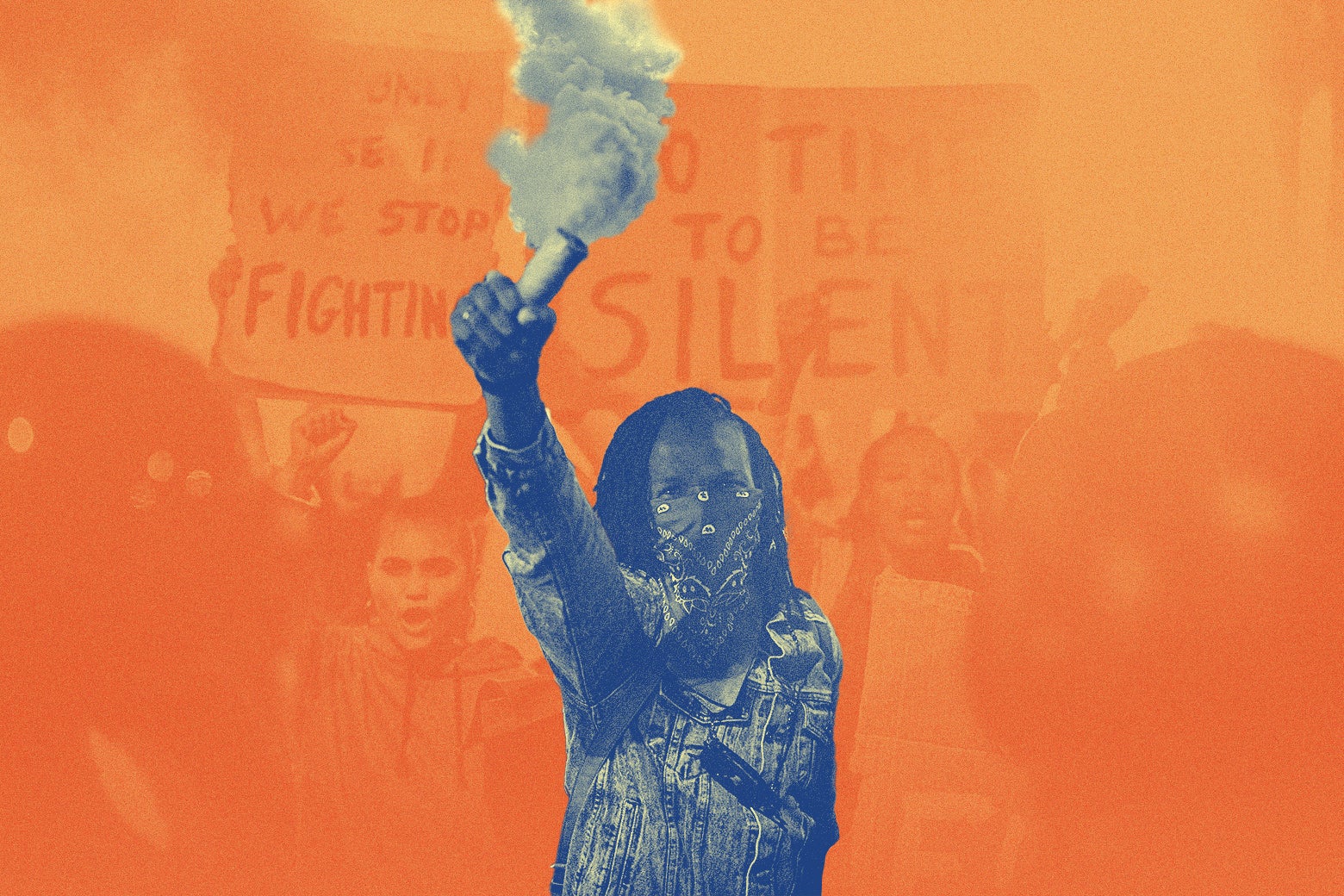
The Slatest Want to Help a Fascist? Start a Riot. The French protests are a warning about the political right’s ability to spin violence to its advantage. Photo illustration by Slate. Photo by jacoblund/iStock/Getty images Plus. This story is adapted from the Slatest newsletter. You can sign up here to get it in your inbox every day. Hundreds of thousands of people are protesting in the streets. Rioters are looting stores, burning buildings, and attacking police stations. The authorities have cracked down even as opposition politicians criticize the government for failing to quell the discord. That describes what’s been happening in France for the past month as students, activists, and labor unions protest everything from education funding to inflation. But it also describes what happened in the U.S. in the 1960s, when protests over racism, the Vietnam War, and the assassination of Martin Luther King Jr. sometimes escalated into riots. Civil unrest can be justified and has sometimes prompted progress. But when protests boil over into violence, history shows that right-wing politicians often benefit. In 1968, a broad sense of societal disorder after eight years of Democratic leadership helped Richard Nixon win the White House. Now, the riots in France threaten to help Marine Le Pen, who leads the far-right National Rally party, take over the Élysée Palace in next year’s presidential election. Le Pen, who wants to restrict legal immigration, ban Muslims from wearing hijabs, and distance France from the European Union, has been doing her best to turn the unrest to her advantage. “Our country is caught in a vise, held hostage between violence and powerlessness,” she said this week. “In six months, the French people will be able to choose a different path—one of authority and restored security.” It’s not just France and the U.S. either. In the 1920s, brawls between Italian Blackshirts and workers helped Benito Mussolini position his fascist movement as restorers of order. In 2013, deadly clashes between Hindus and Muslims in the Indian state of Uttar Pradesh helped propel Prime Minister Narendra Modi, a Hindu nationalist, to power. In 2020, China’s government used pro-democracy protests—which escalated to include arson, vandalism, and attacks on police—as a pretext to strip away Hong Kong’s political autonomy. And at the risk of violating Godwin’s law, yes, the Nazis themselves exploited the 1933 torching of the German parliament by a Dutch communist to suspend civil liberties and usher in fascism. Research tends to back up the historical pattern. In a 2020 paper, the UC–Berkeley political scientist Omar Wasow concluded that urban riots following King’s murder shifted white voters toward Nixon by enough to win him the presidency. In general, Wasow told me, public disorder tends to help conservatives because their ideology positions them as custodians of the status quo. With Donald Trump’s approval ratings deep underwater, an ABC News/Washington Post/Ipsos poll last week found that crime was the only issue voters trusted Republicans to handle better than Democrats. “A candidate who presents herself as the one who will restore order after a wave of rioting is following a script with a long record of success,” Wasow said of Le Pen. Ideology isn’t all Le Pen has going for her. She’s a member of the parliamentary opposition, which lets her criticize both the rioters (whom she calls “insurrectionary activists”) and her political opponents’ response (“exhausted, disoriented, and seemingly incapable”) without shouldering much responsibility for fixing either problem. Even so, there’s no guarantee that Le Pen’s bid to ride the riots to victory will work. President Emmanuel Macron and other politicians not of the far right have decried the chaos, and the election is still months away. As Wasow and other researchers have found, a heavy-handed police response—like the kind that happened during the Civil Rights Movement and has already happened in France—can engender public sympathy. Le Pen is also an imperfect messenger. Voters have thrice rejected her presidential aspirations, first in 2012 and again in 2017 and 2022. She was convicted last year of embezzlement but reduced her sentence on appeal by enough to run again. (Talk about déjà vu!) But as Americans have proved, voters are sometimes willing to overlook a candidate’s rap sheet if he or she promises to fix their biggest problems. Le Pen is practiced at trying to turn popular unrest to her advantage. As the journalist Enda O’Doherty relates in a new history of the French far right, Le Pen once counseled members of her own party to publicize a 2007 riot in the town of Saint-Dizier, during which young people clashed with police and set cars ablaze. “Outrage is something that has to be organized,” Le Pen said at the time. She has led polls of the next presidential election for months, and her instinct to frame politics in us-vs.-them terms might well carry the day. “If the choices before the people are presented as order vs. chaos,” O’Doherty told me by email, “I think they will choose order.” The outcome in France will matter on its own terms. But Le Pen’s response to the riots is also a cautionary tale for Americans, who are likely approaching a season of (even deeper) political angst. In the waning days of an ugly midterm season, the Trump administration is already laying the groundwork to contest results it doesn’t like. If Democrats do retake Congress, 2027 will accelerate the political death throes of a president who has toyed with declaring a national emergency and has a history of stoking violence. Many protests, like the “No Kings” rallies that have popped up throughout the president’s second term, are peaceful and patriotic demonstrations of dissent. Perhaps the most immediate lesson of France? If you want to help Trump, throw a rock. Tolga Akdoğan Congrats! You’ve made it to the end of another workweek. To honor the fruits of your labor, why not dig into a few tasty stories about the strange and surprising links between (literal) fruit and money? Apples: Apple picking is perhaps the quintessential autumnal activity. There’s something about an apple orchard that’s just suffused with nostalgia, especially if the trees bear heirloom fruits. “The cultural significance of heirlooms—their story, weaved through generations of family grafting and genealogy—is all fine and dandy, but hasn’t science rendered these older apple varieties obsolete?” Danny Palumbo went on a quest to find out. Pears: As the holiday season rolls around, there are always a few people for whom it is a real challenge to buy gifts. Luckily, Slate features editor Shannon Palus knows the perfect treat for that special someone. Grapes: In the mid-1800s a horticulturist in Massachusetts invented the perfect grape, to much fanfare. His invention became an American triumph—but then it fell into obscurity. Hannah Seo investigates why the iconic Concord grape lost its throne. Lemons: Fruit is a symbol of life, fertility, love, and wholesome goodness. But amid the sweetness, there is some seediness too. Christina Cauterucci digs into the intertwined history of organized crime and fruit, including the establishment of the Sicilian Mafia in response to a lemon farming boom. On that criminally delicious note, go forth and enjoy the weekend! We’ll be back in your inbox on Monday.
France’s Protests Are a Warning for America
Full Article
Original Source
Read the full article at Slate →KhanList aggregates and links to publicly available news content. We do not host full articles from third-party sources. Always verify important information with original sources.