
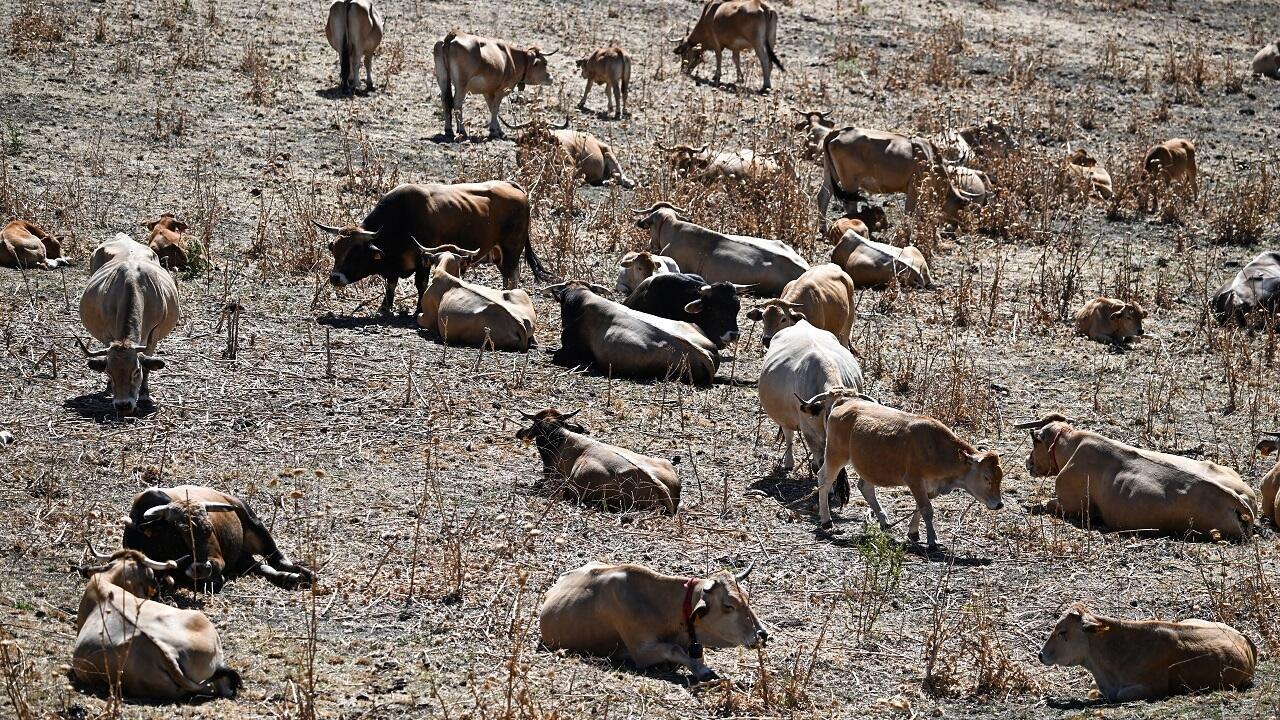
Farmers in France are expecting their first payments shortly under the government's billion-euro emergency aid package to support farmers affected by severe summer heatwaves, droughts and wildfires. As the effects of climate change worsen, experts say compensation alone will not be enough to protect French agriculture in the long term. Mathieu Courgeau, who runs a mid-sized dairy farm in Vendée, western France, says his thermometer recorded 45C this summer. "On my farm, the drought caused about €40,000 in losses," he told RFI. "I chose to insure my corn so I will get about €10,000 in compensation for that, but I had to buy feed and I lost a lot of milk." He called 2026 a "particularly difficult year" for farmers, with crisis coming on top of crisis. Three heatwaves, coupled with widespread water restrictions, turned fields yellow and scorched crops. The conditions wiped out harvests, killed livestock and drained farmers' cash reserves. As preparations for the next growing season get underway, French agriculture has been left depleted by a summer that is unlikely to remain a one-off. "The crisis affects all types of production and all parts of the country," said Maxime Buizard-Blondeau, a farmer in the Loiret region and president of the Centre-Val de Loire regional chamber of agriculture. He also serves as vice-president of the Young Farmers organisation, which has ties to France's biggest agricultural union, the FNSEA. This summer, he said, has been "a wake-up call for many agricultural leaders about the lack of resilience of our systems and farms in the face of climate change". Compensation falls short The government announced its emergency Climate, Adaptation, Drought and Wildfire Plan (Plan Casi) at the beginning of September, with a budget of some €1.3 billion. Around two-thirds of the funds will go to compensation, while the remainder has been allocated to helping farms purchase the supplies they need to resume production. The first payments are expected in early October. Agriculture Minister Annie Genevard warned that the government could not compensate in full for losses that the FNSEA estimates at around €10 billion. "The €1 billion in the plan is roughly the amount of compensation paid to sectors affected by avian flu in 2021-22," said Lucile Rogissart, an agricultural economist at the Institute for Climate Economics, a think tank in Paris. "The big difference is that, in that case, it covered almost all the costs of the crisis. Here, we are no longer talking about the same scale of compensation." Courgeau said he expects to receive €2,000 from the emergency package, in the form of a property-tax rebate. "This aid is essential, but it satisfies neither farmers, who would like to make a living from their work, nor public budgets, which are under considerable pressure," said Rogissart. French farmers dip into winter fodder as drought leaves pastures bare Solutions before problems Instead, Rogissart argues the government should be helping farmers to limit climate-related damage in the first place. "We can reduce our vulnerability to hazards by building resilient and sustainable systems," she said – noting that the predominant model, centred on intensive monoculture, is no longer such a system. Courgeau said he feared farmers would turn to technological fixes, such as air conditioning and irrigation, that do not address underlying vulnerabilities. "That is a major concern," said the dairy farmer, who co-chairs the Nourrir collective, which brings together 54 farming, environmental and civil society organisations campaigning to reform agricultural and food systems. Not all farms suffered equally this summer, he said. "Farms that are more self-sufficient, based on grassland and grass-fed livestock, which are diversified, which have worked to improve soil organic matter, which have developed hedgerows or practised agroforestry, and which have not incurred excessively high levels of investment – overall, these farms will weather the crisis better." In contrast, Courgeau said: "My neighbour, who grows non-irrigated corn and soybeans all year round, isn't sleeping because he can't see any way out or any model for change." A French farmer harvests his field of wheat in Haynecourt, northern France, on 19 July 2020. © REUTERS - PASCAL ROSSIGNOL French cereal farmers experiment with African sorghum to beat the heat Range of crops Experts say farmers can build resilience by diversifying their crops. "Diversification ticks all the boxes," said Rogissart. "It reduces vulnerability to climate hazards by spreading risk. It reduces dependence on imported fertiliser and soybean meal, and protects the climate, water and biodiversity, all of which are crucial to the long-term viability of agricultural production." While wheat, barley and corn largely dominate French fields, growing legumes such as peas, fava beans, alfalfa and lentils has the benefits of capturing nitrogen from the air and reducing the need for fertiliser. They are also alternative sources of protein to red meat. "But as long as the price of protein, such as soy imported on a massive scale from South America, remains so low, Europeans will have no incentive to grow it," said Courgeau. "There is no way round it: the price has to be increased." Alternatively, Rogissart suggests, the government pay higher subsidies for legumes. Corn, widely used for animal feed, typically offers farmers the highest returns, said Buizard-Blondeau. "Many farms don't have the money to make the transition and are stuck in a cycle of dependence on state aid." Hemp, the 'green gold' that France hopes will help cut carbon emissions Rethinking subsidies France spent around €54 billion of public funding on the farming and food sectors in 2024, according to Rogissart. "Yet less than 10 percent went to helping these sectors move towards more resilient systems." She calls for a smarter use of state support. "It is hardly surprising that our system lacks resilience to withstand unforeseen events, given that public support does not help to build it." Climate-proofing French agriculture means reconfiguring the entire value chain, including infrastructure, she said, something that can only be achieved with serious planning and major investment in the public sector. "The coming years will be crucial in shaping the direction of public support." A dairy farmer on his farm in Coutras, south-western France, on 22 September 2026. © AFP - PHILIPPE LOPEZ Next year in particular could be decisive. Negotiations are taking place in Brussels on the European Union's 2028-2034 Common Agricultural Policy (CAP), its shared system of farming subsidies and programmes. The CAP is the EU's biggest area of spending, distributing around €56 billion a year among the 27 member states – including €9.4 billion for France, the bloc's leading agricultural producer by volume. "We need to create room for manoeuvre at European level, both to adapt systems and to manage crises," said Courgeau. His collective is also calling on the EU to better target its subsidies to farmers who need them most, as well as to regulate markets to ensure prices reflect the cost of agricultural production. The new CAP is expected to give national governments greater freedom of action, but could also erode environmental safeguards. The European Environmental Bureau, a network of NGOs, says it is concerned the new policy will not ring-fence funding for the green transition, help farmers reduce the number of livestock they keep, or revise a payment system that results in most CAP funds going to the largest farms. Farmers unite worldwide against what they call ‘chemical colonisation’ Extra taxes Some argue that France needs a more creative approach to funding agricultural adaptation. The Young Farmers organisation wants consumers to contribute via a tax on "meals served outside the home – in supermarkets, traditional restaurants, collective catering and takeaway outlets", said Buizard-Blondeau. His group has proposed adding a 10 cent charge per meal sold by businesses that fail to comply with French legislation that requires 50 percent of products to be local or quality-certified. It estimates the measure has the potential to generate around €1 billion. "The drawback of a food tax is that it would fall on poorer households, which we know spend a larger share of their income on food," commented Carl Gaigné, a senior researcher at France's National Research Institute for Agriculture, Food and Environment (INRAE). He proposes a more radical option: taxing wealthy urban property owners, and specifically the heirs of the tens of thousands of "baby boomers" expected to pass on an estimated €7-10 trillion over the next 15 years. Without proposing a specific rate, Gaigné said there was a moral justification for an inheritance tax. "It is all the previous generations who produced the emissions that are leading to climate change. We know there is a very strong correlation between income levels, wealth and the impact on the climate. "It would make sense to recover part of these wealth transfers to finance adaptation, particularly in agriculture." This article has been adapted from the original in French by Géraud Bosman-Delzons.
France struggles to fund farm climate adaptation as losses mount
Full Article
Original Source
Read the full article at Rfi →KhanList aggregates and links to publicly available news content. We do not host full articles from third-party sources. Always verify important information with original sources.