
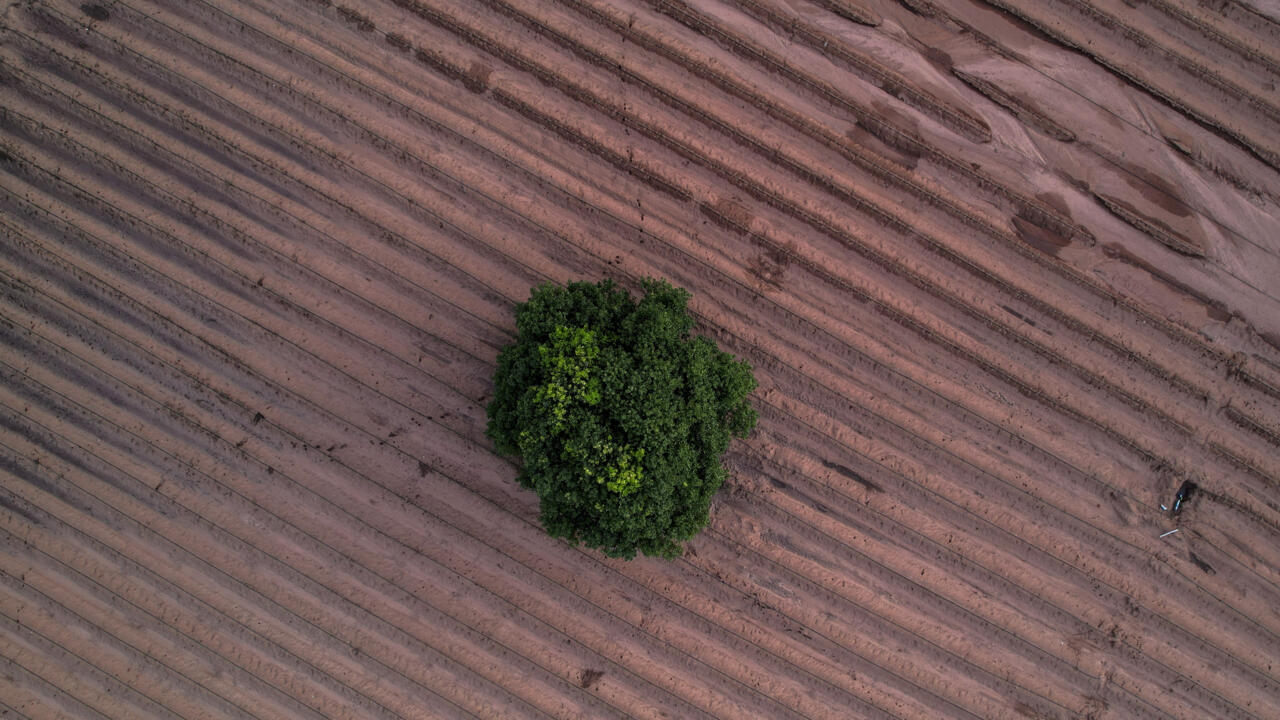
The soil that grows the world's food and holds its water is becoming less productive, yet governments are struggling to agree on how to respond to this crisis. As political talks at Cop17, the United Nations conference on desertification and land degradation, stepped up in Mongolia on Tuesday, France's environment ambassador Barbara Pompili warned that disputes involving the United States are threatening progress. The summit in Mongolia's capital Ulaanbaatar has entered its second and decisive week, traditionally when ministers and other senior political figures step in to try to resolve issues negotiators have so far been unable to settle. One of the main sticking points is whether countries should tackle land degradation alongside climate change, biodiversity loss and water scarcity, rather than treating each problem separately. How degradation and drought are threatening the land that feeds us A former French ecological transition minister, Pompili says protecting soil cannot be separated from food, water, energy and the economy. She spoke to RFI from Ulaanbaatar about the risk of deadlock, what France wants from the talks, and how the United States is "blocking progress on many issues". RFI: We’ve been closely following what's been happening at Cop17 over the past week. What do you hope the conference will achieve? BP: We want this Cop to deliver a number of useful decisions for the future and, in doing so, show that multilateralism can provide concrete solutions for countries facing desertification. Desertification is caused largely by intensive agriculture and livestock farming, as well as urban expansion and mining. These are issues that affect every country in the world, including traditionally temperate countries such as France. Unfortunately, we have seen the damage that climate change and biodiversity loss can do to soils, and the extremely serious consequences land degradation can have, including in our own countries. Degraded soil becomes less fertile. It retains less water, produces less food and stores less carbon, so it can affect huge numbers of people. As governments seek a way forward at UN desertification talks in Mongolia, around 40 percent of the Earth's land surface is already degraded, threatening food production, water supplies and livelihoods worldwide. AP - Felipe Dana We now know that half the world's population is already affected by desertification, including people in France. The issue is still not well understood, and the discussions here are largely about how to connect it with other challenges. France wants to show that taking care of soils means taking care of everything – our economy, our food and our energy. How do we connect this with the other Cops dealing with climate and biodiversity, and with issues such as water? We need all these issues to be linked, and that is precisely one of the sticking points in the negotiations. RFI: The US has opposed efforts from the outset to link the three Cops on climate, biodiversity and desertification. It also opposes gender parity and the participation of indigenous peoples at the Cop. With the US taking these positions, can this conference still achieve anything? BP: We can clearly see that the United States is blocking progress on many issues, although it is not the only country doing so. Russia, for example, is preventing the scientific body from working. RFI: Russia has also challenged the presence of Ukrainians on one of the convention's scientific committees. But back to the US – can you make progress with Washington as things stand? BP: This Cop works by consensus, and we are seeing issues that are not directly related to it being brought into the negotiations. That is a problem environmental and climate bodies are increasingly facing – issues that were not previously priorities are now being brought on to the agenda. So yes, the United States is trying to block the agenda to prevent certain issues from being discussed. But the US also faces desertification and the visible consequences of soil degradation. It therefore has a strategic interest in not being the country that, in the end, has blocked everything. UN report warns increase in permanently dry land is 'redefining life on Earth' RFI: So is France's message to Washington that it needs to be reasonable because these problems affect Americans too? BP: Exactly. These are questions of sovereignty. Drought, destroyed harvests, damaged infrastructure and decimated livestock affect every country to varying degrees. So every country has an interest in being constructive, including the United States. The US is also negotiating – it is part of the negotiating game to raise the stakes before things start moving. Our aim is to bring not only the United States but other countries as well back towards a reasonable position. There are also countries that want to use this Cop to add all sorts of other issues. We need to be reasonable and achieve something concrete. RFI: What would a concrete outcome look like for France? BP: There are several issues that are very important to us. The first is drought, which primarily affects African countries – although not just them, as we saw this summer. We need a clearer framework for dealing with it. We also need – and this is a little more technical – a strategic framework for the convention. Basically, we need a roadmap for how it will operate after 2030. Then there are projects on land management and protecting soil health. These are very concrete areas where initiatives are already under way. We also want to bring the private sector on board. An initiative called Business for Land was launched at the last Cop, and there is strong demand for local Business for Land initiatives. France was the first country to announce a French Business for Land hub. In practical terms, companies are helping to put policies in place to protect the soils they work on and the land they depend on for agriculture or industry. These are very concrete issues. Above all, we need to remember that France is also affected by desertification. Saudi Arabia hosts Cop16 to combat desertification crisis RFI: Protecting soil may require new agricultural and economic models. Are governments prepared to rethink how things are done? BP: That is what Amina Mohammed, the UN Deputy Secretary-General, has said. Many people ask whether we can afford to put all the necessary policies in place. Her point was that we cannot afford not to. So we absolutely have to rethink how we manage land, whether that means agriculture or the way land is developed. RFI: So there really is no choice – countries have to reach an agreement? BP: Exactly. There is no choice. And if we act together and give ourselves the means to do it – because all this also requires funding – we can succeed. But that means moving away from separate policies, where we deal with soil on one side, industry on another, agriculture somewhere else and water somewhere else. If instead we take all these things into account together, we will save money, be much more coherent and create opportunities for economic development. That applies to developed and developing countries alike. It will make development more sustainable and allow us to look to the future with a little more confidence than we can now. This interview has been adapted from the original version in French by Arnaud Pontus.
France says US risks ‘blocking everything’ at UN talks to protect world’s soils
Full Article
Original Source
Read the full article at Rfi →KhanList aggregates and links to publicly available news content. We do not host full articles from third-party sources. Always verify important information with original sources.