
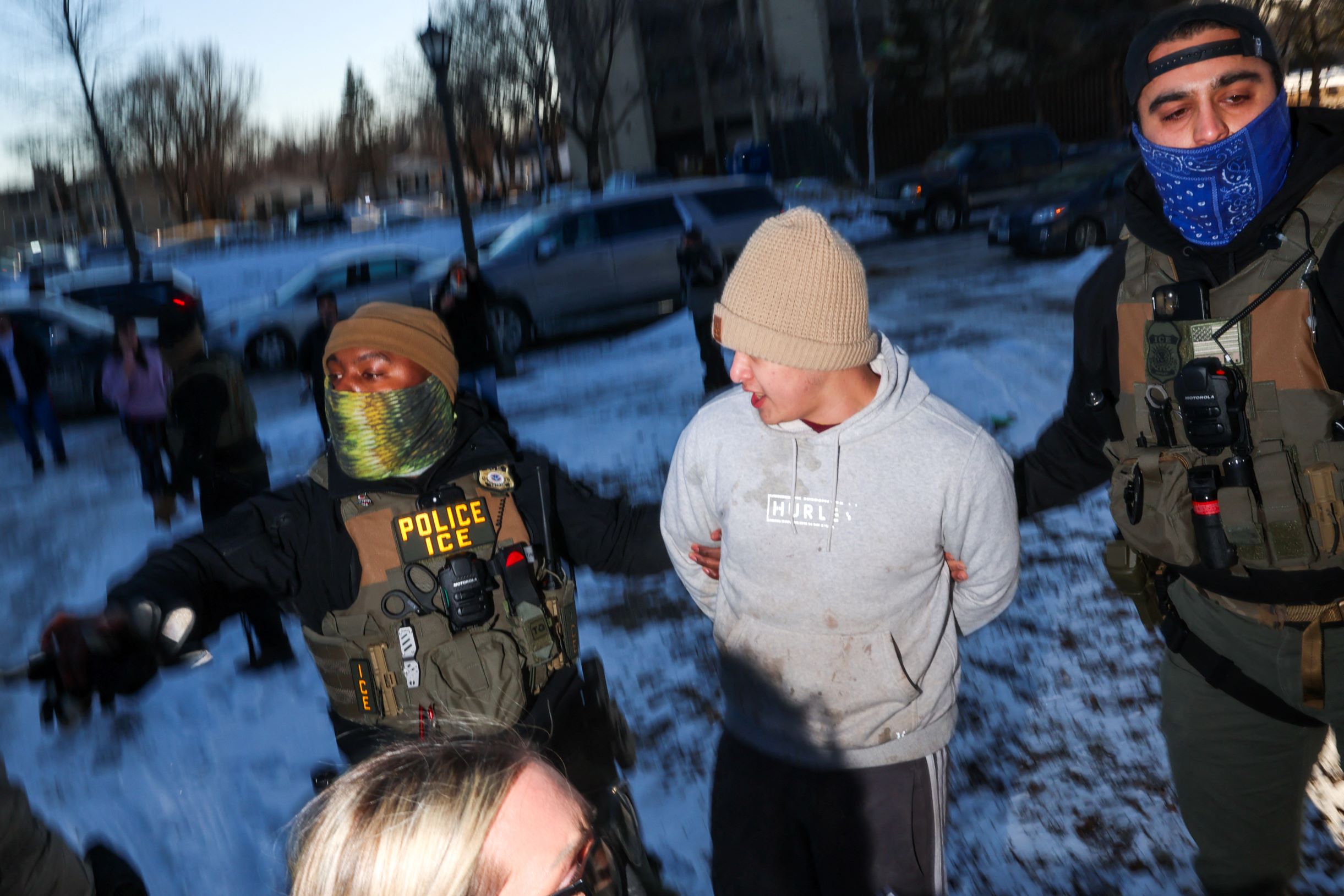
While Virginia can now limit ICE's immigration enforcement actions, it can't require officers to identify themselves.RICHMOND, Va. (CN) — A Fourth Circuit panel issued a mixed bag ruling Monday for Virginia Democrats who sought to rein in misconduct from federal immigration officials.Citing the principle of dual sovereignty, the three-judge panel said Virginia could restrict localities’ ability to work with U.S. Immigration and Customs Enforcement officials, but can’t require ICE agents to identify themselves by unmasking.“We question neither the sincerity nor the reasonableness of the commonwealth’s objections to masked and otherwise-unidentified law enforcement activities, and we emphasize that states may limit or forbid such conduct by their own state and local officers,” said U.S. Circuit Judge Toby Heytens, a Joe Biden appointee who authored the opinion. “But just as Congress may not ‘issue orders directly to the states,’ states may not issue orders directly to the federal government.”U.S. District Judge Robert Payne, a George H.W. Bush appointee, had blocked the laws over the summer after the Democrat-led Virginia General Assembly passed the bills in spring.Heytens said Payne correctly concluded that the law prohibiting ICE officials from wearing masks violates the intergovernmental immunity doctrine. But Heytens disagreed on Payne’s conclusion that a law restricting 287(g) cooperation agreements violates the contracts clause and the intergovernmental immunity doctrine.“Today’s decision upholding Virginia’s new law governing 287(g) agreements is a significant victory for Virginia and reaffirms the commonwealth’s authority to determine whether and under what conditions state and local resources may be used to assist federal immigration enforcement efforts," Virginia Attorney General Jay Jones said in a statement.The conditions the law imposes on localities to continue working with ICE include ICE refraining from enforcement actions at schools, churches, and polling places and refraining from using surveillance technology. The law also bars the localities from assisting in immigration operations unless presented with a valid judicial warrant, subpoena or detainer.“The intergovernmental immunity doctrine does not apply because the 287(g) law neither directly regulates the federal government nor prevents private parties from contracting with it,” Heytens said. “Its arguments get basic federalism principles backward.”Heytens pointed to the Supreme Court’s 1992 ruling in *New York v. United States,*where the majority ruled that the federal government could not commandeer the state government to participate in a federal regulatory program. He also cited other Supreme Court cases that prohibit the federal government from forcing state or local officials to enforce federal law.“The federal government could not order the commonwealth’s own agents — be they state or local officials — to enforce federal law, much less do so at their own expense,” Heytens wrote. “Just as the commonwealth was allowed to make one choice in the past, it is allowed to make a different choice in the future. Indeed, that is the essence of democratic self-government.”Heytens said that, unlike in the cases the federal government cites where a state prevents private parties from contracting with the federal government, the Virginia law concerns local governments. Heytens also said the law doesn’t violate the contract clause because it doesn’t affect existing contracts; instead, it restricts future ones.“The federal government cannot conscript our local officers into its mass deportation machine, and the General Assembly has every right to set the terms on which our own agencies cooperate,” State Senator Saddam Azlan Salim, a Democrat, said in a statement. “Our communities are safer for it, because public safety depends on trust, and trust disappears when a call for help can turn into a deportation.”The masking law required ICE officials to wear identifiable items on their clothing and prohibits facial coverings. Heytens agreed with Payne that the state lacks the authority to tell immigration officials how to do their jobs.U.S. Circuit Judge Robert King dissented from the majority on the facial covering law. King said the injunction erroneously restricts Virginia’s traditional police powers.“As those of us seasoned enough to receive Social Security know, the good guys in the Western movies of our youth — played by the likes of Roy Rogers, Gene Autry, Tom Mix and John Wayne — were always recognizable,” the 83-year-old Bill Clinton appointee said. “Again, they were the heroes, the good guys. Only the bad guys — the bank robbers and the stagecoach bandits — wore masks.”The federal government did not respond to a request for comment. U.S. Circuit Judge DeAndrea Gist Benjamin, a fellow Biden appointee, concurred with Heytens.Subscribe to our free newslettersOur weekly newsletter Closing Arguments offers the latest about ongoing trials, major litigation and rulings in courthouses around the U.S. and the world, while the monthly Under the Lights dishes the legal dirt from Hollywood, sports, Big Tech and the arts.Additional Reads
Fourth Circuit rejects Virginia ICE mask ban but OKs local cooperation
Full Article
Original Source
Read the full article at Courthousenews →KhanList aggregates and links to publicly available news content. We do not host full articles from third-party sources. Always verify important information with original sources.