
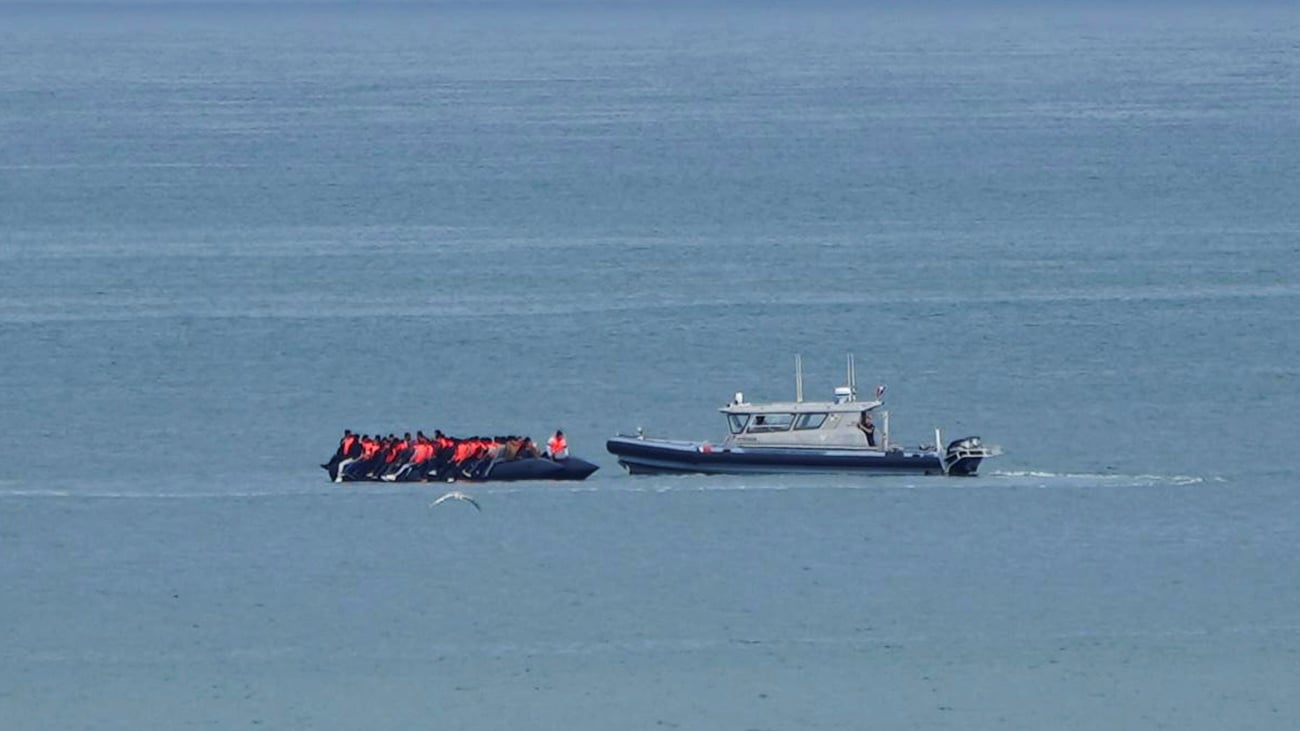
Roughly five years ago, inflatable dinghy bound for the U.K. sank with 31 migrants onboard, becoming the deadliest small-boat tragedy on record. Now, fourteen defendants are on trial in Paris for charges including involuntary homicide.PARIS (CN) — On Wednesday in a courtroom of the Paris Criminal Court, a father who lost his son in a small-boat migrant crossing on the English Channel in 2021 began to cry.“He finished his studies, he was very into sports,” he said, pulling a tissue from his pocket to wipe his eyes. “He was someone who was very strong.”The body of his then-20-year-old son was never found. He asked the presiding judge — the press is not allowed to publish her name — if the court could confirm that he was really dead. She said she couldn’t, but the evidence points to yes.“I asked you the question to know that in the end,” the father continued. “If he’s really dead, can you give us his body, even if there’s only a finger left?”Wednesday was the second day of hearings in a trial over 31 people who drowned crossing the English Channel. On Nov. 3, 2021, 33 migrants gathered on the shores of Calais in northern France to cross into the U.K. at around 10 p.m. Smugglers provided life jackets which didn’t meet the buoyancy standard for rough seas and weren’t designed to keep a person’s head upright should they lose consciousness.Hours later, a fishing vessel spotted the orange vests containing lifeless bodies at sea. It remains the deadliest small-boat crossing on record — only two people survived.Mohamad I., one of the two survivors of the attempted crossing, told the Paris court on Tuesday that after about three hours at sea, the driver felt water on his feet.“We started to see water rising in the boat, we started to contact rescuers in the U.K. Suddenly there was no air inside, it was completely deflated, everyone panicked,” he said. “We heard women screaming and crying in the water, and we tried mainly to save the children but it was very cold.”Fourteen defendants — two in absentia — face charges including involuntary homicide, involuntary injury, assisting the irregular entry, movement or stay of a foreign national within the territory of a state party to the protocol against the smuggling of migrants, endangering others, and assisting the irregular entry, movement or stay of a foreign national in in France as part of an organized group.The 113 plaintiffs are mostly the victims’ family members.The Tribunal de Paris on Oct. 28, 2025. (Lily Radziemski/Courthouse News)On Wednesday, the first defendant of the group took the stand. After facing numerous death threats from the Taliban in his native Pakistan, his family urged him to flee the country in 2017. He told the court that he spent two or three days traversing mountains before arriving in Turkey. From there, he crossed into Bulgaria, walked another three or four days to enter Serbia, eventually left for Austria, passed through Italy and finally arrived in France.He applied for asylum in France and was given a 10-year refugee card in 2019. In the years that followed, he primarily worked as an Uber Eats delivery driver. At his local chicken shop, where Afghans and Pakistanis would gather, he made friends with a man who offered him money to drive from Paris to Dunkirk and the Calais ‘Jungle’ refugee camp, where he would drop off food and pick up “whatever they wanted me to bring back,” which included cash.For roughly three hours, the judge pressed the defendant, who maintained that he had no idea that he was working for someone facilitating the migrant crossing. He was just in it for the money, he repeatedly said. Now, he recognizes that this man was a smuggler.“So he gets money from migrants, and you don’t ask yourself why migrants, who have no money at all, are giving him money?” the judge asked.“I told myself that what he does is his problem,” the defendant replied. “I’m a driver, I drive from point A to point B, that’s all.”The defendant made numerous trips during the middle of the night. He also crossed into Belgium and Germany multiple times; once he transported lifejackets from “point A to point B” in German territory, which he said he did under threat by the smuggler. The judge asked about the nature of the threats, and pointed out that he was driving his own car, but the defendant didn’t have a clear answer.After getting out of police custody in 2022, the defendant studied the building trade and launched his own business. He said that the phenomenon of bad people passing through one’s life happened to him, and he regrets it all.“You weren’t a kid — you came on foot, crossed mountains, faced threats in Pakistan — how were you so vulnerable to bad people?” the judge asked.The defendant looked down at the stand, pondering the question.“I have nothing to say to that, because it hurts.”The trial continues through the end of September.Subscribe to our free newslettersOur weekly newsletter Closing Arguments offers the latest about ongoing trials, major litigation and rulings in courthouses around the U.S. and the world, while the monthly Under the Lights dishes the legal dirt from Hollywood, sports, Big Tech and the arts.Additional Reads
Fourteen men go on trial for Channel crossing that left 31 migrants dead
Full Article
Original Source
Read the full article at Courthousenews →KhanList aggregates and links to publicly available news content. We do not host full articles from third-party sources. Always verify important information with original sources.