
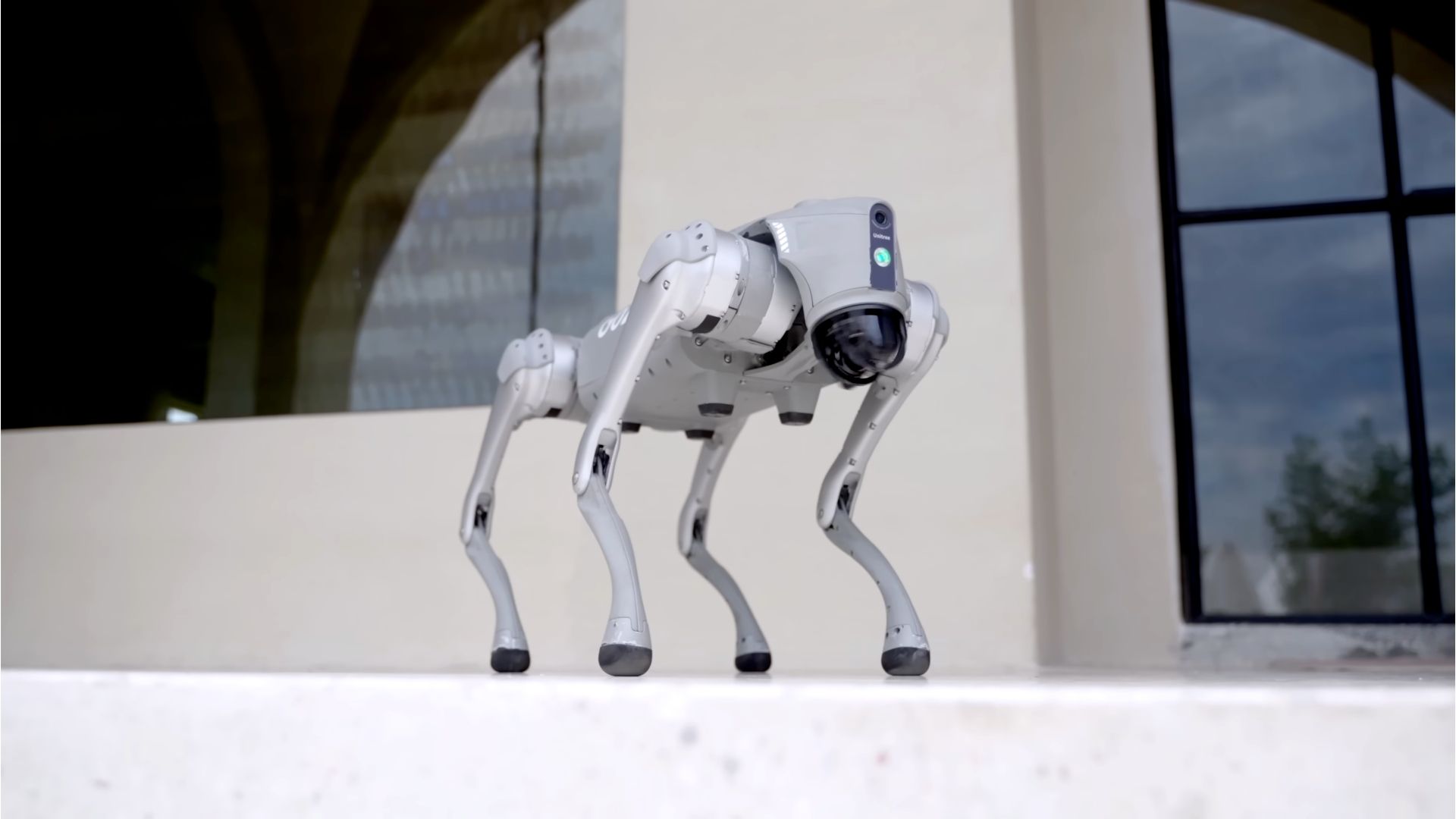
Researchers have developed a learning-based approach that enables four-legged robots to pass through narrow openings rapidly. The system is designed to help quadruped robots perform agile movements that are difficult to achieve using conventional control methods. Inspired by how dogs sprint toward obstacles and leap through tight spaces, the approach allows a robot to decide when to jump and adjust its movement accordingly. The researchers demonstrated the system on a quadrupedal robot, showing how learning-based control could help machines navigate confined spaces faster and more autonomously. Robot learns leaping The new system allows a quadruped to assess an obstacle, select an appropriate movement, and dynamically leap through it without relying on a pre-programmed jumping sequence. The technology was demonstrated on a 48-pound (22 kilograms) Unitree Aliengo robot, which autonomously traversed gates comparable in size to its own body. At the core of the system, developed by researchers at the University of Hong Kong (HKU) and the Oxford Robotics Institute, is a hierarchical reinforcement learning framework called ConsJump. Rather than teaching the robot every movement from scratch, the researchers divided control into two levels. Legged robots require highly aggressive locomotion skills and perception when they jump through a narrow space that is comparable with their body size. The low-level controller gives the robot a library of agile movements. It was trained using imitation learning to reproduce animal-like motion patterns, including pacing, cantering, jumping, and steering. These movements were adapted to the robot’s physical structure using inverse kinematics, allowing the system to learn how to coordinate its joints while maintaining a natural movement style. Jumping motions were given greater emphasis during training to help the robot master the more demanding aerial maneuvers. The high-level controller acts more like a decision-maker. It receives information about the environment and determines which movement should be used and when the robot should transition between them. Instead of directly controlling individual joints, it generates forward velocity and turning commands that are passed to the low-level locomotion system. This allows the robot to combine different learned movements continuously rather than switching abruptly between fixed motion sequences. Quadruped learns agility Vision is another key part of the technology. The robot uses an onboard Intel D435i RGB-D camera to identify the gate and determine its size and position. The perception system processes both color and depth information to detect the rectangular opening, calculate its center, and estimate its geometry. That information is then fed into the high-level controller, which uses the robot’s own state and the gate’s position to determine how it should approach the obstacle. According to the team, it allows the robot to make decisions dynamically instead of following a fixed trajectory. As it approaches a gate, the robot can transition from a slower-paced gait to a high-speed running jump. During testing, it accelerated to as much as 2.5 meters per second before rapidly decelerating to prepare for landing. The system also coordinates the robot’s joints during flight, allowing its feet to avoid the edges of the opening. The airborne phase lasted about 0.44 seconds. The researchers trained the low-level controller in simulation using 5,480 agents running in parallel and then transferred the learned behavior to the physical robot. To improve the transfer from simulation to reality, the training varied factors such as motor strength, latency, offsets, and added mass. On the physical Aliengo, the controllers ran on an onboard computer, while the perception system processed camera data separately. The approach also allows the robot to cope with changing conditions. Tests showed that it could adapt to different gate positions and uneven terrain, including situations where its feet slipped before takeoff. Because the low-level movement policy remains fixed while the high-level controller selects how those skills are used, the researchers say the same architecture can be adapted to other demanding robotic tasks without retraining the entire locomotion system. The result is a quadruped that combines animal-inspired movement with machine vision and hierarchical AI, bringing robots closer to the rapid, coordinated agility that allows animals such as dogs to navigate challenging environments. Get the latest in engineering, tech, space & science - delivered daily to your inbox.Jijo is an automotive and business journalist based in India. Armed with a BA in History (Honors) from St. Stephen's College, Delhi University, and a PG diploma in Journalism from the Indian Institute of Mass Communication, Delhi, he has worked for news agencies, national newspapers, and automotive magazines. In his spare time, he likes to go off-roading, engage in political discourse, travel, and teach languages.
Four-legged robot learns to jump through tight gaps without human help
Full Article
Original Source
Read the full article at Interestingengineering →KhanList aggregates and links to publicly available news content. We do not host full articles from third-party sources. Always verify important information with original sources.