
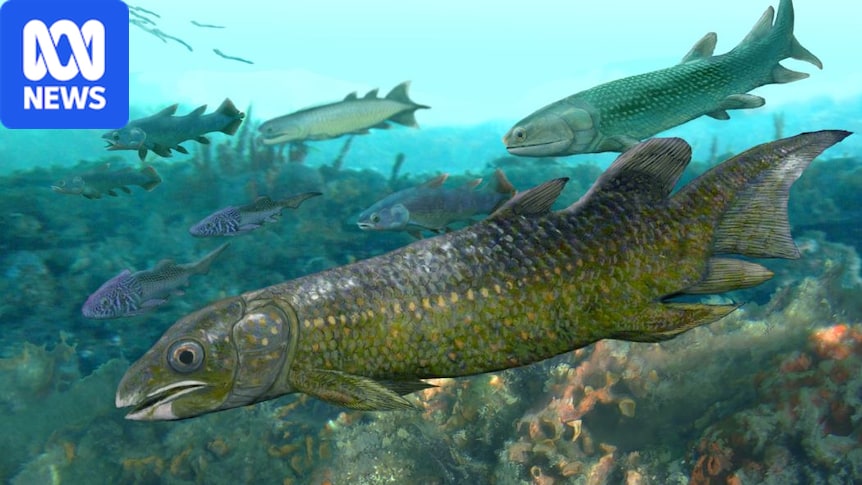
For millions of years, outback Queensland has hidden an ancient coral reef deep beneath its surface.Scientists hope the discovery of ammonite, coral and fern fossils, as well as a kilometre-long solid rock core, could help unravel marine mysteries dating back more than 325 million years.Geologists from Geoscience Australia found the specimens after drilling a 3-kilometre-deep hole in western Queensland to collect hundreds of rock and groundwater samples from the ancient Adavale Basin.Experts say the fossils offer insight into life in the Devonian era, when the world was warmer, sea levels were higher and the reef now buried beneath outback Queensland teemed with marine life."Often we hear about things that are found at the surface," said Espen Knutsen, a senior curator from the Queensland Museum."But they might forget about all the stuff that's still hundreds of metres underground."Reef fossils extracted, but no saltGeoscience Australia drilled to a depth three times the height of the world's tallest skyscraper as part of a $30.9 million project about 63 kilometres south-east of Blackall in western Queensland.It was meant to find eastern Australia's only known rock salt deposit, the Boree Salt layer, which geologists had hoped could be turned into an underground hydrogen battery.But Geoscience Australia's Mitchell Bouma said the deposit was not there — at least not in form.Instead, the agency found fossilised corals, sea sponges, ammonites and trilobites, providing fresh evidence of a "relatively rich reef ecosystem" buried underneath Australia."We did not find any salt, but we did intercept other types of evaporative rocks, [which] are formed by the evaporation of a highly saline lake or cut-off ocean," Mr Bouma said."What this really means is that the halite rock salt was there but was dissolved from this location somewhere around 325 to 370 million years ago."Unravelling the secrets of giant fishSome of the specimens have attracted international attention, including rocks that could help explain why prehistoric fish grew so big.Geologist Geoffrey Gilleaudeau from George Mason University in the United States visited Australia in July to inspect some of the limestone samples.Geoscience Australia has retrieved rock core samples from the Adavale Basin. (Supplied: Geoscience Australia)He said larger fish and animals needed more oxygen, and he wanted to investigate whether the Adavale Basin fossils were evidence of a major rise in ocean oxygen levels, as previously detected in North America."We're trying to see if that's a global signal, and that's why we're looking at another place which is very, very far away in the Adavale Basin in Queensland," Dr Gilleaudeau said.Dr Knutsen said little was known about the ancient reefs buried underneath Australia.In 2007, a Geological Survey of Queensland report found a "rich, varied and largely undescribed" fossil record of corals, molluscs and algae in the Bury Limestone under outback Queensland.Dr Knutsen said most of those fossils were only ever surfaced by mining companies or during deep-earth exploration."Who knows what we might be able to find if we could really, really just sort of dig through and see what kind of fossils it preserved?" he said.
Fossils to unravel secrets of ancient seabed buried beneath outback
Full Article
Original Source
Read the full article at Abc →KhanList aggregates and links to publicly available news content. We do not host full articles from third-party sources. Always verify important information with original sources.